

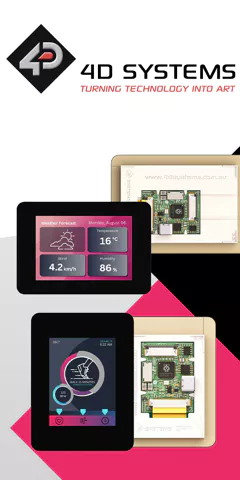
The graphical interface is the preferred method of control in many situations – above all for complex systems or in areas, where inexperienced people are likely to come into contact with the equipment, who prefer intuitive operation.
“Smart” displays are modules, which combine display and a microcontroller in a meticulously designed circuit board, which can perform advanced functions beyond the mere operation of the screen and what will be shown on it, what will be shown on it. In the case of 4D Systems solutions, these types of displays are equipped with universal circuits from the Espressif (ESP32) and Raspberry Pi (RP) brands – which allows easy integration of the circuit into existing systems, as well as efficient implementation of advanced control panels with a graphical interface. What’s more: many of the 4D Systems solutions are integrated with touch matrices, and therefore handling will be trivial for the user.
4D Systems smart displays are available directly from TME stock. Below you will find cross-sectional description and specifications of these products. In our catalogue you will find the precise characteristics of each model. This will allow you to the ideal module for the dimensions and requirements of your application.
In this article, we cover topics such as:
- Ease of interface design on the RP2350 microcontroller
- The wide communication capabilities of ESP32-based modules
GEN4-RP2350 series
Raspberry Pi has made itself known to the world as a manufacturer of excellent single-board computers – and a few years ago it also entered the market for microcontrollers. The RPi Pico module allowed standalone chips to be programmed with exceptional ease and flexibility, e.g. using Python-like languages (but also C and C) . The RP2350 microcontroller is the latest generation offered by the British manufacturer, based on a dual core ARM Cortex-M33 (150MHz) .
In the gen4-RP2350 series it is the Raspberry Pi chip that forms the heart of the circuitry. Below we will look at the capabilities of the microcontroller, however, let’s first note, how wide a choice of displays 4D Systems offers. Within this series, we find models with diagonal sizes from 2,4 inches to 9 inches, with resolutions of 240×320, 320×480 (vertical versions) and 800×480 (horizontal versions) . Their brightness can reach up to 600cd/m2, which allows the content to be presented clearly even when surrounded by intense lighting (e.g. ceiling lights of an office or machinery park). Customers can choose between versions equipped with resistive or capacitive touch panel (as well as options without a touch interface). Design features include the low profile of the displays and their adaptation for fixing (holes).
The modules have integrated 16MB Quad SPI Flash and 8MB Quad SPI PSRAM. The module requires a voltage in the range 4…6V DC (the circuit takes voltage regulators into account).
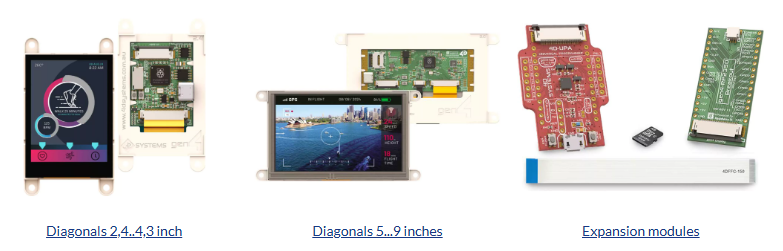
The RP2350 microcontroller is responsible for the content shown on the display – but designers do not need to painstakingly make the interface from scratch. For its implementation, the following can be used Workshop5 IDE supplied by 4D Systems, which has many convenient functionalities. It is based on Raspberry Pi Pico SDK, includes preview of the target graphics.
Most importantly: the GUI made using the display can be directly linked to the program executed by the microcontroller, and its computing power is sufficient, to control a complex device. Thus, the entire electronic circuit of the machine/terminal is reduced to a single module. Designers have at their disposal the extensive capabilities of the RP2350 microcontroller, which include:
- a high level of security (ARM TrustZone, sHA265 acceleration);
- interfaces I2C, SPI and UART;
- ADCs for handling analogue inputs (e.g. from sensors)
- configurable GPIO;
- PWM (control of light, drives, servos).
GEN4-ESP32 series
The second series presented was based on ESP32-S3 microcontrollers by Espressif. These popular chips are widely appreciated mainly for their communication capabilities. In combination with 4D Systems displays, they form an ideal basis for the construction of various IoT devices (Internet of Things), also for industry.
The displays themselves are similar in performance (if not identical) to those described above. We therefore have a choice of models with diagonal 2,4…9 inches and resolutions of 230×480, 240×320, 320×480 or 800×480 pixels. Touch panels available resistive and capacitive. Power supply 4…6V DC, and the products can operate in environments with temperatures from º-20°C to 65°C.
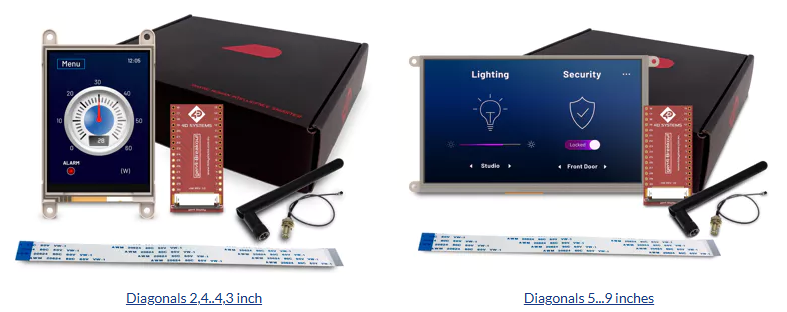
The most significant advantage of smart displays based on ESP32-S3 chips is the following native support for Bluetooth and WiFi communication – using wireless technologies that are the cornerstones of the IoT segment. They allow you to easily connect the project to a network, the project can be easily connected to a network in order to exchange data with a local server or even remote cloud, via the Internet. Gen4-ESP32 series displays are supplied including WiFi antenna and expansion board (breakout board).
As with the RP2350-based modules, ESP32-S3 based modules also allow you to take advantage of many microcontroller capabilities, which includes access to the interfaces GPIO, I2C and SPI.
From a programming point of view gen4-ESP32 display series uses proven technologies. Display support and interface building is done using Workshop4 IDE, which utilizes the Arduino environment for ease of development. Optionally, the user interface can be built with 3rd party graphics libraries and tools such as LVGL and Embedded Wizard. Interactive system with touchscreen interface, with wireless capabilities, can therefore be built on the basis of widely documented solutions – which on the one hand guarantees the high quality of the end product, on the other hand simplifies design and implementation, while reducing costs.
For more information, visit www.tme.com.