

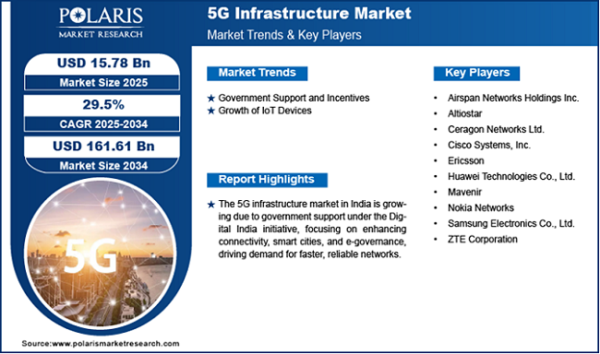
The global 5G Infrastructure Market is entering a phase of dramatic expansion, with the total market size expected to surge from USD 12.25 billion in 2024 to a staggering USD 161.61 billion by 2034, representing a robust compound annual growth rate (CAGR) of 29.5%.
What is Driving the Surge?
5G infrastructure encompasses the hardware, software, and network systems required to deploy next‑generation wireless connectivity — including base stations, antennas, backhaul systems, macro- and small-cell architectures, core-network upgrades, and edge-computing integration. As demand for high-speed, ultra-low-latency, high-capacity connectivity continues to intensify, telecom operators, enterprises, and governments are rapidly investing in building out 5G networks worldwide.
Several key factors are fueling this surge:
- Explosion of IoT and Connected Devices — The proliferation of Internet of Things (IoT) devices, from smart home systems to industrial sensors and connected vehicles, is creating massive demand for reliable, high-capacity networks. As the number of connected devices continues to climb, 5G’s high throughput and low latency make it essential to sustain this growth.
- Enterprise & Industrial Digitalization (Industry 4.0) — Industries such as manufacturing, logistics, healthcare, and transportation are embracing automation, real-time monitoring, and remote operations. 5G infrastructure is fundamental to enable these capabilities, providing the backbone for smart factories, remote diagnostics, robotics, and real-time data analytics.
- Government Support & Smart City Initiatives — Governments around the world are promoting digital infrastructure through favorable policies, spectrum allocation, and funding for 5G rollouts. Smart-city programs — aiming to optimize transportation, utilities, public safety, and services — rely heavily on robust 5G networks for data-driven operations.
- Rising Demand for High-Speed Connectivity & Content Consumption — With the explosion in video streaming, real-time communication, cloud adoption, and remote work, consumers and enterprises demand seamless, high-speed connectivity. 5G meets these needs by delivering far greater bandwidth, lower latency, and more stable connections than legacy networks.
Market Segmentation & Regional Dynamics
The 5G infrastructure market is segmented by communication infrastructure (small cell vs. macro cell), core network technologies (software-defined networking, network function virtualization), end-use sectors (commercial, residential, industrial, government), and region (North America, Europe, Asia-Pacific, Latin America, Middle East & Africa).
- In 2024, the small cell segment accounted for the largest share of revenue, particularly in densely populated urban centers, due to its capacity to deliver high bandwidth and handle large volumes of traffic efficiently.
- Commercial and industrial sectors are among the fastest-growing end-use segments, as enterprises increasingly adopt 5G for IoT, automation, cloud services, and real-time data processing.
- Regionally, while North America retains a leading share driven by strong telecom infrastructure investment, the Asia-Pacific region is emerging as a powerhouse, fueled by rapid urbanization, government initiatives, and massive demand for mobile connectivity.
What This Means for the ICT Industry
For ICT stakeholders — network equipment vendors, telecom operators, enterprise IT providers, and investors — the 5G Infrastructure Market represents a major opportunity window. As 5G networks proliferate, demand will surge not only for radio access network (RAN) equipment but also for core network upgrades, virtualization tools, edge-computing platforms, IoT connectivity solutions, and managed services.
- Telecom Equipment Vendors & RAN Providers: Expect rising orders for small-cell and macro-cell base stations, antennas, and associated hardware.
- Network Software & Virtualization Vendors: Demand for software-defined networking (SDN), network function virtualization (NFV), and virtualization-driven core networks will surge as operators upgrade legacy 4G infrastructure.
- Enterprise IT & Solutions Providers: Companies building private 5G networks for industrial IoT, smart factories, logistics, and smart-city infrastructure will see growing demand.
- Investors & Telecom Operators: Strong growth rates and broad adoption make 5G infrastructure a compelling investment target, especially in regions with nascent but fast-growing telecom infrastructure.
Looking Ahead: Why 2034 Could Mark a New Digital Era
By 2034, as 5G infrastructure investments scale and networks mature globally, transformative changes across many sectors are expected:
- Smart Cities & Public Services: Real-time traffic management, automated utilities monitoring, smart lighting, and remote monitoring will become mainstream.
- Industrial Automation & Industry 4.0: Factories with massive IoT sensor deployments, remote maintenance, predictive analytics, and robotics — all enabled by 5G.
- Connected Mobility & Autonomous Systems: From self-driving vehicles to connected transport infrastructure, ultra-low latency and high reliability of 5G make them feasible.
- Enhanced Digital Experiences: High-definition AR/VR, real-time streaming, immersive gaming, and remote collaboration will reach broader audiences.
5G infrastructure will serve as the backbone of the next wave of digital transformation, powering both consumer and enterprise innovations.
Key Players to Watch
Leading companies shaping the future of this market include Airspan Networks Holdings Inc., Altiostar, Ceragon Networks Ltd., Cisco Systems, Inc., Ericsson, Huawei Technologies Co., Ltd., Mavenir, Nokia Networks, Samsung Electronics Co., Ltd., and ZTE Corporation. These firms play a critical role in deploying base stations, small-cell networks, core-network upgrades, and integrating cutting-edge technologies such as network virtualization and edge computing.
Conclusion — The 5G Infrastructure Market Is the Next Frontier for ICT Innovation
As the world moves deeper into digitalization, the 5G Infrastructure Market stands out as a pivotal enabler — connecting devices, powering IoT ecosystems, enabling smart cities, and driving enterprise transformation. With a projected market value of USD 161.61 billion by 2034, and a high CAGR of 29.5%, this market offers significant opportunities for vendors, operators, solutions providers, and investors alike.
For stakeholders in the ICT industry, now is the time to engage — whether by enhancing product portfolios, forging strategic partnerships, or ramping up network investments. The fifth generation of mobile connectivity isn’t just about faster internet; it’s the foundation for an entirely new digital era.