

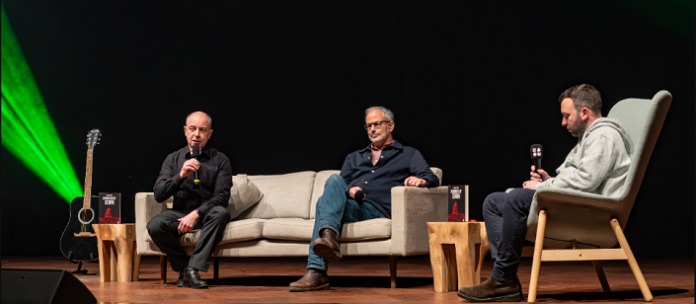
How do the best AI ideas from the startup scene make it to market-ready products? This question was the focus of a panel discussion at the 48forward innovation festival in Munich. Under the title “AI, Innovation, and Collaboration with Startups,” Alexander Gerfer, CTO at the Würth Elektronik eiSos Group, Lamin Ben-Hamdane, Head of Startup Cooperation at Infineon, and moderator Daniel Fürg discussed how young technology companies can develop, industrialize, and scale AI solutions together with established industry players.
An initial finding from the discussion group highlights that startups play a crucial role in turning innovative AI applications into reality. They combine rapid development with unconventional ideas and new business models. However, for concepts to become reliable products, startups need early partners from industry who can support them in areas such as component selection and circuit testing, and contribute their technical expertise. As a technology partner, Würth Elektronik eiSos has opened its laboratories and technology fields under the mission statement “creating together,” making its knowledge available, jointly developing prototypes, and supporting the establishment of resilient supply chains.
AI opportunity for Europe
“When it comes to AI solutions, we see ourselves as enablers, just as we do in other areas of technology,” said Gerfer during the panel discussion. “We often observe that startups underestimate the importance of hardware. That’s why we help them sharpen their focus on this physical foundation and closely accompany them on their journey to market readiness. It is crucial that scalability and industrial feasibility are considered an integral part of the overall concept from the outset.” In this context, the CTO of the Würth Elektronik eiSos Group also pointed out the strategic opportunity for Europe: cooperation between start-ups, industry, and research could help to reduce the gap in the use of AI and establish an efficient and sovereign AI landscape in Europe.
AI requires efficient electronics
Würth Elektronik is also keenly aware of its responsibility in advancing AI in Europe. Every training session and every inference relies on semiconductors, power electronics, and passive components. The company’s task, Gerfer explains, is to ensure “that energy is delivered efficiently, and that thermal and electromagnetic effects are controlled. This is the basic prerequisite for turning ideas into scalable and reliable systems,” Gerfer continues. In addition, the increasing use of AI is placing greater demands on magnetic materials, capacitors, and electromagnetic compatibility concepts. Higher switching frequencies, more compact designs, and significantly higher power densities require new solutions.
Green AI from the data center to the edge
Another focus of the panel was on the topic of “green AI.” An efficient power supply, carefully selected passive components, and consideration of the entire AI life cycle can significantly reduce the energy and resource requirements of AI systems. For Gerfer, passive components are therefore the “silent heroes” of modern AI- from the data center to the edge of the network.
For more information, visit www.we-online.com.