

NEC Corporation is providing vehicle management equipment (VME) for autonomous vehicles in an airport restricted area of Tokyo International Airport (Haneda Airport), one of the world’s busiest airports. This equipment is part of an order placed by the East Japan Civil Aviation Bureau of the Ministry of Land, Infrastructure, Transport and Tourism (MLIT).
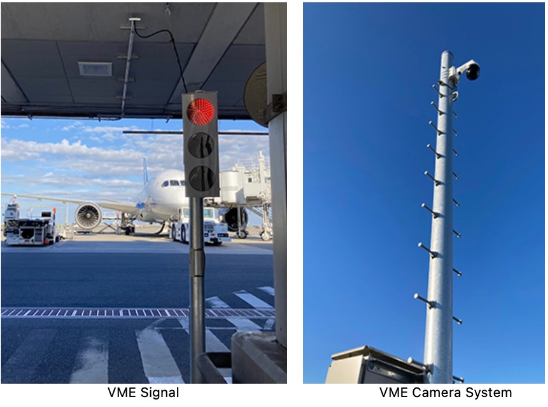
The VME includes signal equipment that synchronizes with autonomous vehicles and camera systems which help to cover blind spots. Use of towing tractors with a level 4 of autonomous driving ability began in an airport restricted area of Haneda Airport in December. These tractors will be managed by Japan’s two largest airlines, ALL NIPPON AIRWAYS CO., LTD. and Japan Airlines Co., Ltd.
With air traffic on the rise in recent years, airports have placed increasing urgency on labor-saving initiatives and efficiency improvements, particularly in ground operations. Against this backdrop, the MLIT, airlines, and airport operators are collaborating to promote the automation of towing tractors and buses used for passengers and crew transport. However, airports operate in a significantly different environment compared to public roads. Achieving autonomous operation requires extensive optimization across both technical and environmental aspects. Specifically, unique operating rules for runways, taxiways, and aprons need to be established, along with vehicle control systems that function in environments where aircraft and vehicles coexist. Furthermore, while safe traffic has traditionally relied on communication between human drivers, autonomous vehicles require new communication methods to ensure safety when they operate alongside human-driven vehicles.
NEC’s VME enable autonomous driving by leveraging over half a century of experience in air traffic control and airport-related systems, as well as close collaboration with stakeholders that include airlines and autonomous vehicle manufacturers.
The introduction of VME also enables automatic signal control at intersections within airport restricted areas. This facilitates safe and smooth traffic management among both human drivers and autonomous vehicles. Additionally, cameras placed in low-visibility areas send video to autonomous vehicle operators, helping to cover blind spots and support precise safety management. Going forward, NEC will continue to leverage digital technologies to help build a next-generation mobility society, striving to create safe, secure, and efficient transportation infrastructure.