

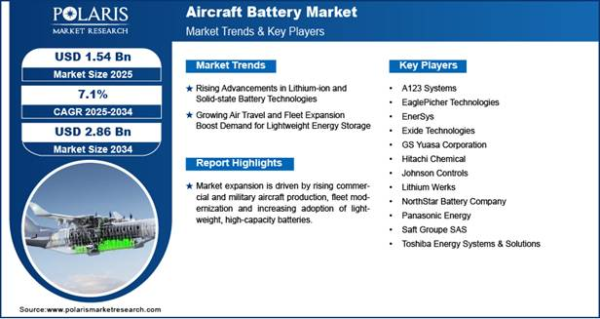
The Aircraft Battery Market is emerging as a critical growth frontier within the Electronics & Semiconductors industry, propelled by surging demand for electrification, sustainability, and high-performance energy storage across aerospace platforms. As the aviation sector accelerates adoption of next-generation power systems for commercial, military, and advanced airborne applications, the role of sophisticated battery technologies — and the semiconductor-driven electronics that control them — becomes more strategic than ever. Anchored by robust market forecasts and technological trends, the aircraft battery industry is poised for substantial expansion through 2034.
Market Forecast & Growth Drivers
According to comprehensive industry research, the global Aircraft Battery Market is projected to reach approximately USD 2.86 Billion by 2034, up from an estimated USD 1.44 billion in 2024, achieving a Compound Annual Growth Rate (CAGR) of 7.1% over the forecast period. This growth trajectory is underpinned by fundamental shifts in aviation — from traditional auxiliary power systems to more-electric aircraft architectures and hybrid-electric propulsion models that demand lightweight, high-energy battery solutions.
Key demand drivers include:
- Electrification of Aircraft Systems: Modern aircraft increasingly rely on battery systems for engine start, auxiliary power units (APUs), avionics, emergency backup, and — in advanced air mobility platforms — primary propulsion.
- Lightweight & High Energy Density Requirements: Lithium-based chemistries dominate due to their superior energy-to-weight ratios, enabling fuel savings and extended operational range compared to legacy lead-acid and nickel-cadmium systems.
- Urban Air Mobility & eVTOL Platforms: The rise of electric vertical take-off and landing (eVTOL) vehicles and other advanced air mobility solutions is creating new high-volume market segments that depend entirely on advanced battery packs.
- Regulatory Sustainability Goals: Global regulatory frameworks aimed at lowering aviation emissions are incentivizing the integration of electric and hybrid power trains, further boosting battery adoption.
These drivers underscore why the Aircraft Battery Market Growth Outlook is regarded as one of the most dynamic subsets of the broader aviation and electronics manufacturing landscape.
Electronics & Semiconductor Synergy
Within this market, semiconductors play a pivotal role in enabling battery performance, longevity, and safety. Advanced Battery Management Systems (BMS) and intelligent power electronics built around semiconductor components are essential for real-time monitoring, thermal management, and precise control of battery cells under rigorous flight conditions. These systems ensure optimal energy utilization while preventing failures and extending battery life cycles — a compelling advantage for aircraft designers and operators.
The integration between batteries and semiconductors elevates the Aircraft Battery Market beyond simple energy storage; it positions battery electronics as mission-critical systems that directly influence aircraft reliability and operational efficiency. As electrification intensifies — especially for hybrid and fully electric aircraft — demand for high-precision semiconductor solutions will grow in tandem with battery technologies.
Technology Trends & Market Segmentation
Battery Chemistry Evolution:
- Lithium-ion batteries are the market frontrunners due to their exceptional energy density, fast recharge capabilities, and compatibility with modern aircraft power needs.
- Emerging technologies such as solid-state batteries are gaining attention for potential improvements in safety and energy storage, representing future innovation pathways for battery developers looking to capture long-term growth opportunities.
Application Segments:
- Start & Backup Systems remain critical, providing essential redundancy and power for avionics, lighting, and emergency operations in aircraft.
- Propulsion Batteries are gaining prominence alongside hybrid-electric aircraft programs where high-capacity energy storage is integral to flight performance.
- UAVs and AAM Platforms (Advanced Air Mobility) are rapidly expanding segments where battery performance directly impacts flight duration, range, and payload capabilities.
Regional Landscape:
North America remains a dominant market owing to a well-established aerospace and defense ecosystem and robust R&D investment. Meanwhile, Asia-Pacific is emerging as a high-growth region, driven by domestic airline fleet expansions, policy support for electrified aircraft, and rapidly scaling manufacturing capabilities. Europe continues to push sustainability mandates that further accelerate battery system adoption in commercial and urban mobility applications.
Challenges & Strategic Imperatives
Despite strong growth prospects, the Aircraft Battery Market faces several challenges that could influence adoption rates:
- Certification Complexity: Aviation safety standards and certification requirements for new battery chemistries and systems remain stringent, sometimes slowing deployment timelines.
- Safety & Thermal Management: Lithium-based systems — while efficient — require meticulous thermal management solutions to mitigate risks associated with high energy densities, emphasizing the importance of sophisticated BMS designs.
To capitalize on market momentum, stakeholders across the electronics supply chain must focus on integrated solutions that combine energy storage with intelligent electronic controls. Cross-disciplinary collaboration between battery developers, semiconductor manufacturers, and aerospace OEMs will be key to unlocking long-term value and ensuring reliability in mission-critical operations.
Conclusion: Powering Tomorrow’s Aviation
The Aircraft Battery Market stands at the intersection of aerospace innovation, electronics integration, and sustainability transformation. With forecasted growth reaching billions of dollars through the next decade and strong demand across commercial, defense, and advanced air mobility sectors, this industry is poised for exceptional expansion. By leveraging advancements in battery technologies and semiconductor-driven intelligence, the aviation ecosystem can achieve higher efficiency, lower emissions, and new forms of airborne mobility.
For more information, visit https://www.polarismarketresearch.com/industry-analysis/aircraft-battery-market