

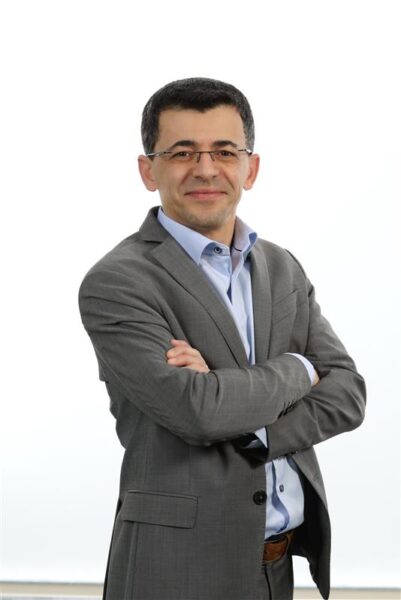
At the STM32 Summit, STMicroelectronics unveiled a breakthrough that redefines the limits of MCU performance—the STM32V8, the world’s first microcontroller built on 18-nanometer FD-SOI technology. In this exclusive interview, Patrick Aidoune, General Manager, General Purpose MCU Division at STMicroelectronics, shares how the STM32V8 introduces a new DNA for high-performance microcontrollers.
This conversation explores the technology behind the innovation, its real-world impact across industries—from industrial automation to space—and how STMicroelectronics’s growing ecosystem of tools, including the STM32 AI Model Zoo, is making edge intelligence practical and scalable for developers worldwide.
STMicroelectronics recently unveiled the STM32V8 series. To begin with, what makes this launch so significant?
The STM32V8 marks a major milestone for us. It is the world’s first microcontroller built on an 18-nanometer process technology, introducing a completely new DNA for high-performance MCUs. This leap enables higher performance, better power efficiency, and greater reliability than previous generations.
You mentioned a new DNA. What technologies form the foundation of this new STM32V8 architecture?
STM32V8 is built using 18 nm FD-SOI technology combined with phase-change memory (PCM). This combination delivers 2.5× higher non-volatile memory density compared to 40 nm, along with improved power efficiency and strong immunity to environmental stress.
How does this new technology translate into real performance gains?
The performance improvements are substantial. STM32V8 is powered by the Arm Cortex-M85 core, which provides a significant boost in scalar processing, DSP, and machine learning workloads compared to Cortex-M7. Thanks to the 18 nm node, the MCU can operate at up to 800 MHz, which is unprecedented in this category.
Reliability is critical in industrial and space applications. How does STM32V8 address this?
Reliability was a key design goal. The STM32V8 supports junction temperatures up to 140°C and offers enhanced robustness through FD-SOI technology. This makes it suitable for harsh environments, including industrial systems and even low Earth orbit applications.
Can you share an example of how STM32V8 is already being used in demanding environments?
Certainly. SpaceX has highlighted STM32V8 for its high computing performance, large embedded memory, and digital integration, which help meet strict real-time processing requirements. The 18 nm FD-SOI technology also provides the reliability needed for space environments.
What kind of applications will benefit the most from STM32V8?
STM32V8 is particularly well-suited for digital signal processing and analysis, power conversion, motor control, and secure IoT connectivity. These applications demand both high computational capability and deterministic real-time performance.
Edge AI is becoming increasingly important. How is ST supporting developers in this area?
STM32 AI Model Zoo now supports over 160,000 projects and includes 140+ ready-made models for vision, audio, and sensing applications. These tools significantly reduce development time for edge AI solutions.
What are the key features of the STM32 AI Model Zoo?
The Model Zoo offers native support for PyTorch models, includes 30+ new model families, and supports 4-bit quantized models for efficient deployment on microcontrollers. It is currently the largest curated collection of AI models for MCUs.
Were there any other notable announcements alongside STM32V8?
Yes, several. We introduced STM32 Sidekick, an AI-powered assistant on the ST Community platform trained on official STM32 documentation. We also announced the STM32WL3R, a highly energy-efficient long-range wireless MCU tailored for remote control applications in the 315 MHz band.
How does STM32V8 fit into STMicroelectronics’s long-term roadmap?
STM32V8 represents the start of a new generation of high-performance MCUs. We are committed to bringing new products every year, continuously expanding the STM32 ecosystem with advanced silicon and developer-friendly tools to make innovation faster and easier.
Finally, what message would you like to leave with developers and industry partners?
With STM32V8, we are redefining what microcontrollers can achieve. By combining cutting-edge process technology, powerful compute, and a rich AI-ready ecosystem, we are enabling developers to build the next wave of intelligent, reliable, and high-performance embedded systems.