

Accelerating Demand Driven by Network Deployment
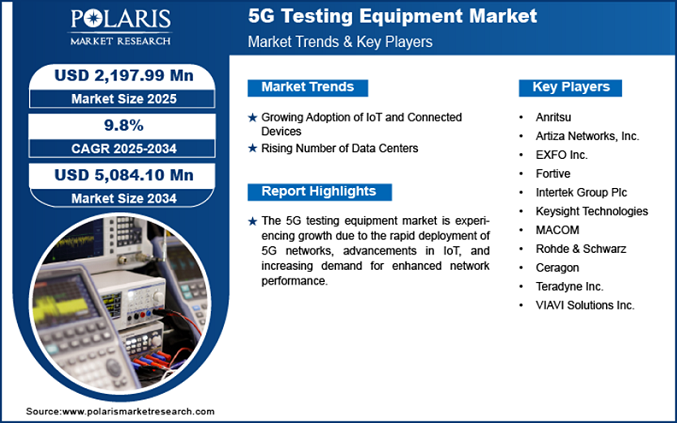
According to the latest study by Polaris Market, the 5G Testing Equipment Market sector achieved a valuation exceeding USD 2,006.70 million in 2024 and is projected to surge to over USD 5,084.10 million by 2034 exhibiting a CAGR of 9.8% from 2025 to 2034 representing a compound annual growth rate approaching double digits.
The expansion of this specialized market segment reflects the unprecedented scale of 5G infrastructure rollouts occurring across continents. Testing equipment including oscilloscopes, signal and spectrum analyzers, vector signal generators, and network analyzers has become indispensable for telecommunications providers, equipment manufacturers, and research institutions working to ensure network reliability, performance, and regulatory compliance.
Network operators worldwide are investing heavily in equipment that can validate signal integrity, measure latency, assess bandwidth capabilities, and identify potential interference issues before networks go live. This meticulous testing process has become non-negotiable as industries ranging from healthcare to manufacturing increasingly depend on the ultra-low latency and high-speed connectivity that 5G promises to deliver.
Rental Models Reshape Equipment Accessibility
One of the most significant trends reshaping market dynamics involves the growing preference for equipment rental over outright purchase. Industry analysis reveals that rental arrangements dominated market revenue in 2024, driven primarily by the substantial capital requirements associated with acquiring cutting-edge testing technology. For small and medium-sized enterprises, rental options provide access to state-of-the-art equipment without the burden of massive upfront investments.
This shift toward flexible equipment access models also addresses the rapid pace of technological evolution within the telecommunications sector. As testing standards evolve and new frequency bands come into operation, rental arrangements allow organizations to upgrade their testing capabilities without being locked into obsolete equipment. This approach has proven particularly attractive in markets where 5G deployment is still in early stages and testing requirements continue to evolve.
Network Analyzers Emerge as Fastest-Growing Segment
While the testing equipment market encompasses diverse product categories, network analyzers are anticipated to experience the most rapid growth trajectory through 2034. These sophisticated instruments play a pivotal role in ensuring seamless communication across increasingly complex 5G architectures, particularly as networks incorporate technologies such as massive MIMO, beamforming, and network slicing.
The critical importance of network analyzers stems from their ability to identify and resolve interoperability issues in multi-vendor environments common scenario as operators build out Open RAN architectures. These devices enable engineers to validate end-to-end network performance, measure return loss, assess cable integrity, and troubleshoot connectivity problems that could compromise service quality. As 5G networks grow more sophisticated and integrate with Internet of Things ecosystems, the demand for precision network analysis capabilities continues to intensify.
Regional Dynamics Shape Market Evolution
Geographic factors significantly influence market development patterns, with North America maintaining a leadership position throughout 2024. The region’s dominance stems from early 5G network deployments by major carriers, substantial research and development investments by technology giants, and a robust ecosystem of telecommunications equipment manufacturers. Government initiatives supporting next-generation wireless infrastructure have further accelerated demand for testing solutions capable of validating network performance against stringent technical specifications.
However, the Asia Pacific region is positioned to capture the highest growth rate during the forecast period. Massive 5G infrastructure projects underway in China, Japan, South Korea, and India are creating unprecedented demand for testing equipment. These nations are not only deploying extensive consumer networks but also pioneering industrial 5G applications in smart manufacturing, autonomous vehicles, and smart city initiatives each requiring rigorous testing and validation protocols.
IoT Integration Amplifies Testing Requirements
The proliferation of Internet of Things devices represents another powerful market catalyst. As industries deploy billions of connected sensors, actuators, and smart devices that rely on 5G connectivity, testing requirements become exponentially more complex. Equipment must validate not only individual device performance but also network behavior under scenarios involving massive concurrent connections core 5G use case.
Healthcare applications exemplify this trend, with electronic health record systems, remote patient monitoring devices, and medical imaging platforms increasingly dependent on reliable 5G connectivity. Similarly, manufacturing environments are deploying industrial IoT networks that demand ultra-reliable low-latency communication for robotics and automated production systems. Each of these applications requires specialized testing to ensure that networks can deliver the performance levels necessary for mission-critical operations.
Data Center Expansion Fuels Equipment Demand
The global proliferation of data centers constitutes another significant growth driver for testing equipment markets. As cloud computing, artificial intelligence, and edge computing applications generate massive data volumes, new data centers are being constructed to handle processing and storage requirements. These facilities depend on high-performance 5G backhaul connections that must be rigorously tested to ensure adequate bandwidth, minimal latency, and consistent reliability.
Testing equipment plays an essential role in validating the infrastructure that connects data centers to edge networks and end users. As operators deploy dense networks of small cells and distributed antenna systems to support 5G services, the complexity of testing scenarios increases dramatically. Equipment must assess performance across multiple frequency bands, validate beamforming capabilities, and ensure that networks can handle dynamic traffic patterns characteristic of modern cloud-based applications.
Technological Advances Drive Innovation
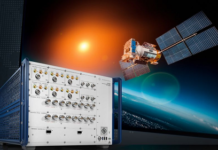
The testing equipment sector itself is experiencing rapid innovation as manufacturers develop solutions tailored to emerging 5G technologies. Millimeter-wave testing capabilities, over-the-air measurement systems, and multi-channel RF testers represent just a few examples of specialized equipment designed to address unique 5G requirements. As networks evolve toward standalone architectures and incorporate advanced features such as network slicing for differentiated service delivery, testing solutions must keep pace with these technological advances.
Artificial intelligence integration represents another frontier for testing equipment evolution. Machine learning algorithms are being embedded into testing platforms to automate complex analysis procedures, predict potential network issues before they impact service quality, and optimize testing workflows for improved efficiency. These AI-enhanced capabilities enable engineers to process vast amounts of network performance data and identify subtle patterns that might indicate emerging problems.
Market Outlook and Future Trajectory
As 5G networks continue their global expansion and evolve toward more sophisticated implementations, the testing equipment market is positioned for sustained growth. The transition from non-standalone to standalone 5G architectures, the introduction of advanced features such as ultra-reliable low-latency communication for industrial applications, and the eventual migration toward sixth-generation wireless technologies will all sustain demand for cutting-edge testing solutions.
Market participants are responding to these opportunities through strategic investments in research and development, partnerships with telecommunications operators, and geographic expansion into high-growth regions. The sector’s evolution reflects broader trends in telecommunications increasing network complexity, rising performance expectations, and the critical importance of reliable connectivity for an ever-widening array of applications and industries.
For organizations across the telecommunications ecosystem, advanced testing equipment has transitioned from a technical necessity to a strategic imperative. As wireless networks become foundational infrastructure for economic activity, ensuring their performance through rigorous testing represents an investment in the digital future that will define the coming decade.
For more information, visit https://www.polarismarketresearch.com/industry-analysis/5g-testing-equipment