

Market Overview
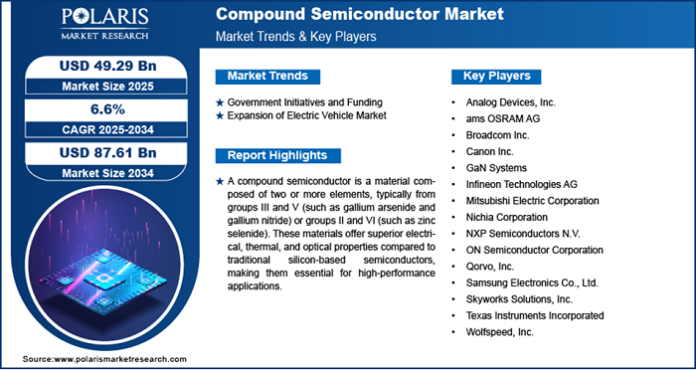
The compound semiconductor market has demonstrated remarkable resilience and growth potential, with valuations reaching USD 49.29 billion in 2025, ultimately reaching an impressive USD 87.61 billion by 2034. This trajectory represents a compound annual growth rate of 6.6% throughout the forecast period, underscoring the technology’s fundamental importance to modern electronics.
Unlike traditional silicon-based semiconductors, compound semiconductors combine elements from different groups of the periodic table, creating materials with superior electronic and optical properties. Key materials including gallium arsenide (GaAs), gallium nitride (GaN), and silicon carbide (SiC) offer enhanced performance characteristics such as higher operating frequencies, improved energy efficiency, and exceptional thermal stability—attributes that are increasingly critical in today’s demanding applications.
Key Growth Drivers Reshaping the Industry
Government Investment Catalyzes Innovation
Strategic government initiatives worldwide is providing substantial momentum for compound semiconductor development. The United States’ CHIPS and Science Act of 2022, which allocated $52.7 billion toward domestic semiconductor manufacturing and research, exemplifies this global trend. Such investments aim to strengthen supply chain resilience while advancing technological capabilities, directly benefiting compound semiconductor manufacturers through enhanced research facilities, production capacity, and workforce development programs.
Electric Vehicle Revolution Accelerates Demand
The automotive industry’s dramatic shift toward electrification has created substantial new demand for compound semiconductor components. Silicon carbide devices, in particular, have become indispensable in electric vehicle power electronics due to their superior efficiency and durability. As governments worldwide implement stricter emissions regulations and consumers increasingly adopt sustainable transportation solutions, the symbiotic relationship between the EV market and compound semiconductor industry continues to strengthen.
5G Infrastructure Deployment
The global rollout of 5G networks represents another major catalyst for compound semiconductor adoption. These advanced materials enable the high-frequency, high-efficiency radio frequency components essential for next-generation telecommunications infrastructure. With telecommunications companies investing billions in network upgrades and expansion, compound semiconductors have secured a pivotal role in enabling faster data transmission speeds and enhanced network capacity.
Market Segmentation: Understanding Industry Dynamics
Power Electronics Dominates Product Categories
Among various product segments—including LEDs, optoelectronics, power electronics, diodes, and modules—power electronics has emerged as the dominant category. This segment’s leadership stems from rising demand for high-performance devices capable of operating under extreme conditions, including elevated temperatures, voltages, and frequencies. Applications in renewable energy systems, industrial automation, and advanced consumer electronics continue driving power electronics growth.
Telecommunications Leads Application Segments
The telecommunications sector commands the largest share among application segments, which also include general lighting, automotive, military and defense, consumer devices, and commercial applications. The explosive growth in mobile data consumption and the necessity for higher bandwidth capabilities have positioned compound semiconductors as fundamental components in modern communication infrastructure.
Regional Dynamics: Asia Pacific’s Market Leadership
Asia Pacific has established itself as the compound semiconductor market’s dominant region, leveraging robust electronics manufacturing capabilities and aggressive 5G infrastructure deployment. China’s construction of approximately 3.22 million 5G base stations by October 2023 exemplifies the region’s commitment to advanced telecommunications technology. Additionally, the region’s cost-effective manufacturing environment and expanding consumer electronics sector contribute significantly to its market leadership position.
Europe, particularly Germany, represents another significant market driven by strong industrial foundations and technological advancement. The region’s focus on automotive innovation and renewable energy systems has increased demand for compound semiconductor components. Meanwhile, the United Kingdom is positioning itself as an emerging player through strategic investments in semiconductor super clusters and national institutes dedicated to industry development.
Competitive Landscape: Innovation Through Collaboration
Leading industry players including Nichia Corporation, Samsung Electronics, ams OSRAM AG, Qorvo, Skyworks Solutions, Wolfspeed, and Infineon Technologies are driving market evolution through continuous research and development initiatives. Strategic partnerships and collaborations have become commonplace as companies seek to strengthen market positions and expand technological capabilities.
Recent developments highlight this collaborative approach. Qorvo’s introduction of high-gain GaN-on-SiC power amplifier modules for radar applications demonstrates ongoing innovation in defense and commercial sectors. Similarly, Infineon’s multi-year supply agreement with II-VI for silicon carbide wafers exemplifies strategic partnerships aimed at ensuring material availability and supply chain resilience.
Future Outlook: Sustained Growth Through Innovation
The compound semiconductor market’s future appears increasingly promising as technological advancement continues accelerating across multiple industries. Ongoing research efforts focused on improving manufacturing efficiency and reducing production costs are expected to make these advanced materials more accessible to a broader range of applications.
The convergence of artificial intelligence, Internet of Things, and edge computing technologies is creating new opportunities for compound semiconductor adoption. As these technologies mature and proliferate, demand for high-performance, energy-efficient semiconductor components will intensify, further solidifying compound semiconductors’ central role in the electronics industry’s future.
Conclusion
The compound semiconductor market represents a cornerstone of modern electronics innovation, enabling breakthrough applications across telecommunications, automotive, and industrial sectors. With robust growth projections, strong government support, and continuous technological advancement, the industry is well-positioned for sustained expansion throughout the coming decade. As manufacturers continue investing in research, development, and production capacity, compound semiconductors will remain essential enablers of the high-performance electronic systems that define our increasingly connected world.
For industry stakeholders seeking comprehensive insights into market dynamics, competitive landscapes, and growth opportunities, detailed market research reports provide invaluable strategic intelligence for navigating this rapidly evolving sector.