

Ai Everything MEA Egypt:
Artificial Intelligence (AI) has moved from aspiration to infrastructure in Egypt. Once framed as distant ambition, it is now shaping economic policy, investment priorities, and public debate. Across government, enterprise, and civil society, AI has become a key strategic lever for competitiveness, sovereignty and growth.
This shift explains why Cairo is increasingly viewed as a focal point for regional AI collaboration, investment, and innovation. In early 2026, this momentum coincides with the launch of Ai Everything Middle East & Africa (MEA) Egypt, a large-scale and AI-first platform convening governments, global technology companies, investors, and startups in the Egyptian capital.
From digital services hub to AI infrastructure economy
Egypt already plays a critical role in global digital services, ranking among the world’s leading outsourcing destinations while producing over 750,000 university graduates each year, many in engineering and ICT disciplines. This talent base is now being channelled towards AI-enabled services, cloud operations, and applied research.
According to the Oxford Insights Government AI Readiness Index, Egypt ranks first in Africa for AI readiness, driven by policy maturity, skills development, and public-sector adoption. Fitch Solutions also projects that cloud, cybersecurity, and data services growth will propel Egypt’s ICT market beyond US$9 billion by 2030. This growth is reinforced by Egypt’s Second National AI Strategy (2025-2030), which explicitly positions AI as a matter of sovereign capability – prioritising compute access, local model development, data governance, and sector-level deployment.
Considering these factors alongside United Nations Development Programme (UNDP) estimates that AI could add US$1.5 trillion to African GDP by the end of the decade, strategic infrastructure decisions have essentially become economically consequential rather than theoretical exercises.
Sovereign intelligence and the politics of compute
One of the most visible themes in Egypt’s AI discourse is sovereignty. As generative AI models grow larger and more resource-intensive, questions around where data is stored, how models are trained, and who governs access have moved into mainstream policy debate. This has driven accelerated investment in sovereign cloud, regional data centres, and energy-efficient compute architecture. Egypt’s geography, energy mix, and connectivity position it as a practical base for serving Africa, the Middle East, and parts of Europe. The result is rising interest from global AI and infrastructure companies seeking local partners, skilled workforces, and compliant hosting environments.
Applied AI for real economic impact
Unlike markets where AI discourse is dominated by consumer tools, Egypt’s focus remains firmly applied. Priority sectors include financial services, digital health, manufacturing, logistics, agriculture, and public administration. These are areas where automation, predictive analytics, and computer vision can deliver immediate productivity gains.
The rise of local AI startups working on Arabic language models, computer vision, and enterprise automation is particularly significant. Arabic remains under-represented in global AI systems, creating both a market gap and a strategic opportunity. Investment in locally trained models addresses not only language accuracy, but also cultural context and regulatory alignment.
Investor interest reflects this pragmatism. Regional and international venture capital is increasingly directed towards companies solving infrastructure-level problems as opposed to consumer novelty.
Conducting dialogue on AI governance
Against this backdrop, Cairo’s emergence as a convening platform for global AI dialogue is structural rather symbolic. Large-scale AI gatherings increasingly function as deal-making environments, policy alignment forums, and infrastructure marketplaces.
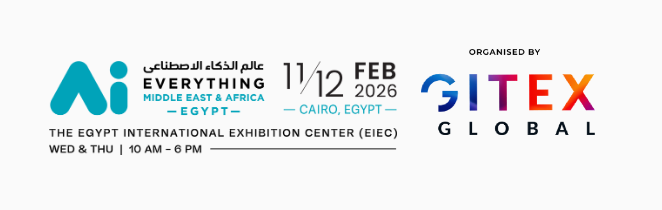
Platforms such as Ai Everything MEA Egypt, hosted in Cairo from 11-12 February 2026, mirror this strategic recalibration. The conference programme under the AI Nations Summit theme will bring together global authorities from IBM, United Nations, European Bank for Reconstruction and Development (EBRD), Cerebras (builders of the world’s largest and fastest AI chip), Tenstorrent (Forbes AI 50 2025 Unicorn), Cognizant (Fortune 500 tech), Standard Bank (Africa’s largest bank by assets), Honeywell, among many more.
Alongside the Summit, many of the world’s frontrunning tech enterprises and startups will unveil industry breakthroughs and live AI use-cases across sectors, including Cisco, HPE, Fortinet, Barq Systems, Brightskies, Cyshield, Ziwo & Zoho, among others. By bringing together policymakers, hyperscalers, startups and investors in a single location, the event supports Egypt’s broader ambition to align global AI expertise with national priorities and regional demand.
Egypt’s AI momentum is real, but its long-term position hinges on sustained capability, skill pipelines, energy capacity, regulatory clarity and public trust. What is clear, however, is that AI in Egypt has moved decisively beyond experimentation.
As AI becomes embedded in how states compete and collaborate, Cairo’s role as host to Ai Everything Middle East & Africa points to a deeper reality: Egypt is no longer positioned on the margins of the AI economy, but at its negotiating table and development forefront.
For more information on Ai Everything MEA Egypt, visit: www.aieverythingegypt.com