

Space Weather Prediction Technology:
Fujitsu Limited and Tokai National Higher Education and Research System (THERS) announced the successful development of a new technology to predict solar radiation events and their potential impact. The new technology combines probability estimation and the identification of past similar events based on Fujitsu’s Wide Learning explainable AI technology which is part of the Fujitsu Kozuchi XAI service.
Solar radiation events have been difficult to predict using simple empirical methods based solely on solar flare magnitude. By leveraging AI, this technology extracts complex causal relationships and presents them in an explainable manner. Furthermore, by presenting past solar radiation events similar to those predicted, based on the extracted conditions, it allows for a comprehensive understanding of the actual impact on daily life and corresponding countermeasures that were implemented during those previous events.
With this new technology, Fujitsu and THERS aim to establish an environment for promptly determining future solar radiation risks and countermeasures based on scientific evidence, thereby facilitating optimal operational decisions regarding possible lethal threats to astronauts in activities like extravehicular operations, lunar base planning, and crewed transport for lunar and Martian missions.
Moving forward, Fujitsu and THERS will enhance the developed technology to protect vulnerable societal infrastructure including power grids, satellite communications, GPS, and polar flights from space weather impacts, thereby showcasing the efficacy of Fujitsu’s Wide Learning and positioning it as a foundational technology for a sustainable and resilient society.
Overview of the new technology
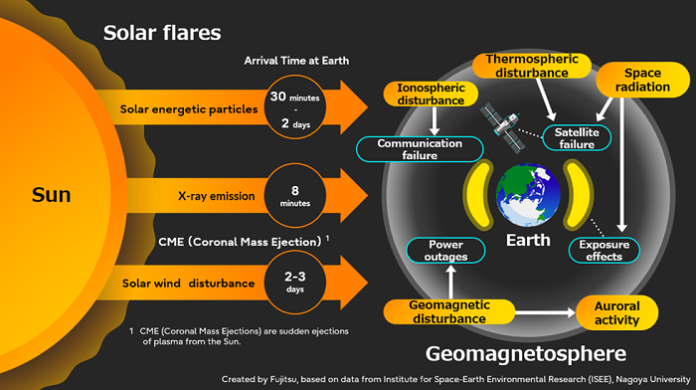
Solar activity, including flares and coronal mass ejections (CMEs), impacts societal infrastructure by causing communication outages, degrading GPS accuracy, and inducing power grid currents. Additionally, solar radiation events, while more likely with larger solar flares, pose unpredictable and serious threats to astronauts and satellites due to a weak correlation between flare size and radiation dosage, meaning that even relatively small flares can potentially deliver lethal doses of radiation in space.
To address these challenges, Fujitsu and THERS have developed the following technologies to improve the accuracy of solar eruptive event predictions and provide scientific evidence for risk assessment in operational settings:
- Technology for estimating the probability of solar radiation events using Wide Learning
- Utilizing conditions identified by Wide Learning, the technology automatically selects past solar radiation events that are most similar to current predictions
- This enables operators to quickly understand not only event probabilities but also potential radiation levels and impacts by referencing data from analogous previous occurrences
2. Technology for presenting past similar events based on prediction evidence
- Utilizing conditions identified by Wide Learning, the technology automatically selects past solar radiation events that are most similar to current predictions
- This enables operators to quickly understand not only event probabilities but also potential radiation levels and impacts by referencing data from analogous previous occurrences
For more information, visit global.fujitsu.