


Semiconductor-Enabled Innovations:
The chips that power today’s smartphones contain over 15 billion transistors; the semiconductors powering data centers can have hundreds of billions of transistors. Semiconductors drive and power breakthroughs across hundreds of critical and emerging industries, such as robotics, personal electronics and artificial intelligence. As semiconductors continue to enable the world to function and make life more convenient and safer, their role will only increase.
The importance of chips – and the electronics they’re enabling – have been made possible by years in semiconductor progress. Let’s review how semiconductor technologies are enabling three innovations in electronics that impact how we experience the world.
Innovation No. 1: Systems that operate safely around humans
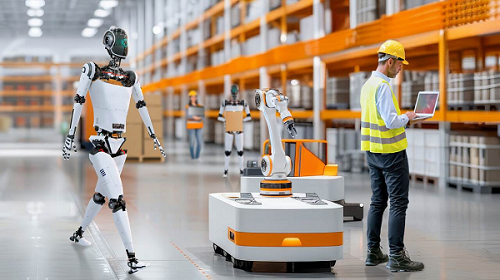
“You might think humanoids are 3 to 5 years away. But really, humanoids are the present,” said Giovanni Campanella, general manager of factory automation, motor drives and robotics at TI, at a Computex speech.
Humanoids’ emergence is anything but simple. Robots that perform chores in homes, complete tasks in a factory, or even clean dishes in a restaurant kitchen, must adapt in dynamic environments, where things change every second.
In order to build adaptable robots that can operate around humans in diverse settings, such as domestic or business environments, design engineers must leverage semiconductor technologies. Each of these technologies must work together to perform the actions of one safe and functional humanoid. Actuators in robots enable its movements. With sensing, the robot can perceive its surrounding environment, and a central compute acts as its brain, analyzing and making decisions from that sensing data. Communication with compute units and actuators happens in real time so the humanoid can complete a task, such as handing an object to someone.
Apptronik used these TI technologies to develop a humanoid robot capable of moving safely around people and performing complex tasks in warehouse and industrial settings. With a humanoid that can function in a factory, one that can function elsewhere is just on the horizon.
Innovation No. 2: Smaller, more affordable, smarter devices
Smartphones and laptops keep getting thinner and lighter. Medical patches provide continuous monitoring without external equipment. Devices are on a trajectory to fit into an individual’s life, increasing convenience and accessibility.
How are designers able to continually progress toward the trend of “smaller” and more convenient when last year’s newest smartphone was already the smallest ever?
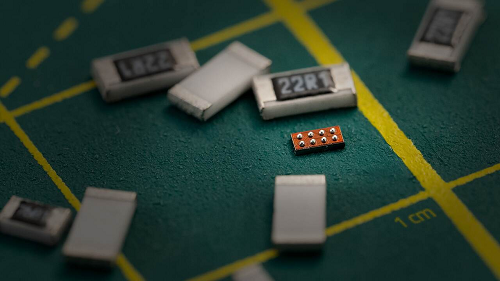
Significant advances in component design are enabling this progress. An example of this was our launch of the world’s smallest MCU, reflecting breakthroughs in packaging, integration and power efficiency that allow more functionality to fit into dramatically smaller spaces.
“With the addition of the world’s smallest MCU, our MSPM0 MCU portfolio provides unlimited possibilities to enable smarter, more connected experiences in our day-to-day lives,” said Vinay Agarwal, vice president and general manager of MSP Microcontrollers at TI.
Due to semiconductors, headphones that were once clunky can now fit into a pocket and provide a premium audio experience. Smart rings instantly track health metrics like activity and heart rate without interrupting everyday activities. With devices like the world’s smallest MCU, the prevalence of smaller, more affordable electronics that seamlessly blend into an already-existing routine is expanding.
Innovation No. 3: AI everywhere

By 2033, the global AI market is expected to account for $4.8 trillion – 25 times higher than the $189 billion valuation in 2023. AI is already enabling smartphones to process images in real time, cars to monitor drivers and their surroundings, and medical devices to deliver precise insights, and with its projected growth, the possibilities of where else AI can appear seem endless.
But with the influx of power needed to process the massive amounts of data that AI requires – and the inevitable demand to process even more data – there must be supporting infrastructure.
This is why moving energy from the grid to the gate is crucial – by optimizing every stage of the power chain, from the electrical grid to the logic gates inside computer processors, TI helps support widespread AI adoption while improving efficiency, reliability and sustainability.
At the same time, the need for more power to process the computations that AI requires has reshaped system designs. Software-defined architectures have enabled products to adapt and deploy new AI capabilities without new hardware. Software is increasingly becoming an important driver of flexibility, differentiation and energy efficiency in applications such as vehicles, robotic systems and appliances.
Even at the edge, we’re working with designers now to implement AI onto devices such as solar panels to detect potentially dangerous arc faults. But that’s only one way we’re supporting the increase of AI.
“We’ll continue developing those use cases that make sense,” said Henrik Mannesson, general manager of energy infrastructure at TI. “But we also recognize the need to build universal tools that enable customers to further innovate with edge AI.”
The continued drive for innovation
These major strides are not destinations, but part of an ongoing journey of innovation at TI that continually strives to increase safety, convenience and intelligence. When each chip or collaborative effort builds on what we previously thought was impossible, we continually redefine what safety, convenience and intelligence look like in electronics as we build the foundation for tomorrow.
For more information, visit www.ti.com.
Source: TI blog