

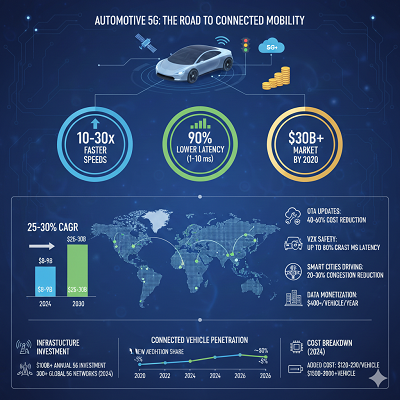
Automotive 5G is transforming vehicles from mechanical machines into high-speed, software-defined platforms. With multi-gigabit data rates, sub-10 millisecond latency, and 1 million devices per km² capacity, 5G enables real-time connectivity for advanced driver assistance systems (ADAS), autonomous driving, vehicle-to-everything (V2X), and over-the-air (OTA) updates. According to recent industry analysis by Dataintelo, this technological shift is expected to accelerate significantly through 2026, driven by rising connected vehicle penetration, expanding 5G infrastructure, and growing demand for software-defined mobility ecosystems.
Below is a data-driven breakdown of where Automotive 5G stands in 2024–2026, with hard numbers on market size, performance, safety, and ROI.
2024 Performance Metrics: 5G vs 4G in Vehicles
| Metric | 4G LTE | 5G (Sub-6 / mmWave) | Improvement |
| Peak download speed | 100–300 Mbps | 1–10 Gbps | 10–30× faster |
| Latency | 30–70 ms | 1–10 ms | Up to 50× lower |
| Device density | ~100,000/km² | 1,000,000/km² | 10× higher |
| OTA update (2 GB file) | ~5–8 min | ~30–60 sec | ~80–90% faster |
Why it matters: Autonomous systems generate up to 4 terabytes (TB) of data per day per vehicle, requiring ultra-fast processing and cloud connectivity.
Global Market Growth: $4B to $30B+ in Under a Decade
The Automotive 5G market has expanded rapidly:
- 2020: ~$2.5 billion
- 2022: ~$4.8 billion
- 2023: ~$6.3 billion
- 2024 (est.): ~$8–9 billion
- 2030 (forecast): $25–30+ billion
This represents a CAGR of 25–30% (2023–2030).
Key growth drivers:
- Over 95% of new vehicles in North America (2023) shipped with embedded connectivity.
- Over 75% of new cars globally are expected to be connected by 2026.
- 5G vehicle penetration is projected to exceed 60% of new car sales by 2030.
5 Data-Backed Reasons Automotive 5G Is Accelerating
- OTA Software Updates Cut Costs by 40–60%
Before OTA:
- Software recalls required physical service visits.
- Average recall service cost: $300–$500 per vehicle.
With OTA:
- Remote updates reduce service costs by 40–60%.
- Update deployment time reduced from weeks to under 24 hours.
- Some automakers report OTA adoption in over 80% of 2024 models.
2. V2X Safety: Potential 70–80% Crash Reduction
Vehicle-to-everything (V2X) communication enables:
- Collision warnings within 10 milliseconds
- Intersection hazard alerts within 100 meters
- Real-time hazard data sharing across 1000+ vehicles/km²
Research suggests:
- Up to 80% of non-impaired crashes could be prevented with full V2X adoption.
- Rear-end collisions (≈29% of U.S. crashes) could drop by 50%+ with cooperative braking alerts.
3. Autonomous Driving Requires Sub-10 ms Latency
Level 4/5 autonomy demands:
- Reaction times below 20 milliseconds
- Sensor fusion across 10–20 cameras, radar, and LiDAR systems
- Data throughput exceeding 1 Gbps during peak operation
5G’s 1–5 ms latency supports:
- Cloud-assisted AI decisions
- HD map updates in real time
- Remote diagnostics in under 5 seconds
Compared to 4G (50 ms average latency), that’s a 90% reduction in delay.
4. Smart Cities & Traffic Flow: 20–30% Congestion Reduction
5G-enabled traffic systems:
- Reduce average commute times by 15–25%
- Lower fuel consumption by 10–20%
- Cut urban emissions by up to 15%
Pilot deployments (2021–2023) showed:
- Signal coordination improves intersection throughput by 18–22%
- Emergency vehicle response times improved by 20–40%
5. In-Car Data Monetization: $400+ Per Vehicle Annually
By 2030:
- Connected services revenue may exceed $400–$500 per vehicle per year
- Global automotive data monetization projected at $250–400 billion annually
Revenue streams include:
- Subscription ADAS upgrades ($10–30/month)
- In-car streaming services
- Usage-based insurance (discounts of 10–30% for safe driving)
Connected Vehicle Penetration: Year-by-Year Growth
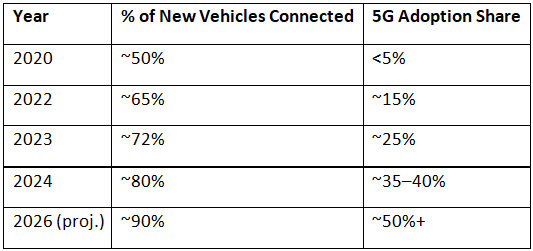
This reflects a 2× increase in 5G vehicle integration between 2022 and 2024.
Infrastructure Investment: Billions in Network Expansion
Telecom providers globally invested:
- $100+ billion annually (2022–2024) in 5G infrastructure
- Over 300 commercial 5G networks deployed worldwide by 2024
- Coverage reaching 40%+ of global population in 2023, expected to exceed 65% by 2026
Automotive OEM partnerships with telecom carriers increased by 35% between 2021 and 2023.
Cost Breakdown: What 5G Adds to a Vehicle
Estimated incremental cost (2024):
- 5G modem: $40–$80
- Antenna system: $20–$50
- Integration/software stack: $50–$100
- Total added cost: $120–$230 per vehicle
However:
- Connected feature revenue can exceed $1,500–$2,000 per vehicle lifecycle
- ROI timeline: typically 12–24 months
Key Statistics at a Glance
- 1–10 ms latency (vs 30–70 ms for 4G)
- 10–30× faster speeds than LTE
- $8–9B market in 2024, projected $25–30B by 2030
- 25–30% CAGR (2023–2030)
- 80% crash prevention potential with full V2X adoption
- 40–60% reduction in recall costs via OTA
- $400–$500 annual revenue per connected vehicle (by 2030)
- 4 TB data/day per autonomous vehicle
- $120–$230 added hardware cost per car
- 90% of new cars connected by 2026 (projected)
- 300+ global 5G networks live in 2024
- $100B+ annual telecom 5G investment
Risks & Challenges (Quantified)
- Cybersecurity Risk Increase
- Connected vehicles face 2–3× more attack vectors than non-connected cars.
- Automotive cybersecurity spending grew 20%+ annually (2021–2024).
2. Infrastructure Gaps
- Rural 5G coverage remains below 30% in many regions.
- Full V2X effectiveness requires >70% fleet penetration.
3. Data Storage & Processing
- 4 TB/day per vehicle equals 1.4 petabytes annually per 1,000 vehicles.
2030 Forecast: What the Numbers Suggest
By 2030:
- 60–70% of new vehicles likely 5G-enabled
- Level 3+ autonomy adoption may exceed 25% of premium segments
- OTA updates expected in 95% of new models
- Automotive connectivity revenues projected to exceed $300B annually
- Global connected car fleet may surpass 400 million vehicles
Conclusion: Automotive 5G by the Numbers
Automotive 5G isn’t incremental—it’s exponential. With 10–30× speed improvements, 90% lower latency, and up to 80% crash-reduction potential, the technology underpins the next generation of intelligent mobility.
The market is scaling from ~$8–9 billion in 2024 to potentially $30+ billion by 2030, fueled by 25–30% annual growth. Even with an added hardware cost of $120–$230 per vehicle, lifecycle revenues of $1,500–$2,000+ make the business case compelling.
By the end of the decade, with 400 million connected vehicles and $300B+ in annual digital mobility revenue, Automotive 5G will define how cars communicate, update, monetize, and drive—measured not in vague innovation claims, but in milliseconds, gigabits, and billions of dollars.
For more information, visit: https://dataintelo.com/report/automotive-5g-market