

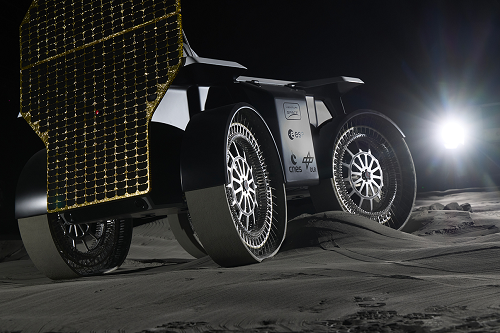
Under a contract signed with the European Space Agency (ESA), Venturi Space has been conducting, since 1 January 2026, a risk reduction study focusing on three key technologies for future lunar rovers. This study will also make it possible to demonstrate, through dedicated test campaigns, the effectiveness of the technologies developed by the company.
Commissioned by ESA, the study covers three key aspects for the development of future lunar rovers: mobility capability, power supply systems, and thermal regulation capability. The project aims to prepare the technologies intended to equip the next generation of lunar rovers, which are expected to play a central role in future exploration and logistics missions on the surface of the Moon. The objective is to consolidate the technical knowledge already acquired and translate it into requirements and specifications consistent with ESA’s lunar exploration roadmap.
Through several test campaigns, Venturi Space will be able to test the hyperdeformable wheels, high-performance batteries, suspension system, and the egress system (the system enabling the rover to descend from the lander), using its MONA LUNA rover as the test platform for this campaign. The technologies under study are designed to equip significantly heavier lunar rovers, weighing up to several tonnes, in line with the needs of future logistics and crewed missions.
The test campaigns will take place within the LUNA building, jointly developed by ESA and the Deutsches Zentrum für Luft- und Raumfahrt (DLR). This facility is dedicated to the preparation of future European lunar missions and to the qualification of technologies and systems in an analogue environment representative of lunar conditions. Field tests will make it possible to demonstrate the operability and the effective implementation of all requirements and specifications defined within the framework of the project.
The study includes the analysis of mobility technologies and, in particular, the suspension system and hyper-deformable wheels. These technologies must enable rovers to operate with a high level of efficiency on the loose and uneven soils of the lunar surface, while withstanding temperature variations of approximately 400°C. In parallel, the electrical power supply and thermal management subsystems are subject to specific studies and validation activities in order to ensure, in particular, their ability to withstand the long lunar nights.
Also under this contract, a representative model of the geometry of the European Argonaut lander will be designed, assembled, and tested by ESA in order to validate the mechanical interfaces and operational conditions associated with the rover deployment phase. This phase, known as egress, constitutes a critical step between landing and the start of surface operations.
QUOTES
Gildo Pastor, President of Venturi Space:
“For more than twenty-five years, we have been exploring territories where solutions do not yet exist. This project fully reflects that pioneering approach: identifying a need, imagining a new response, and confronting it with reality. Seeing our technologies contribute to shaping future lunar missions is a source of pride. Exploration has always progressed through boldness, and it is this spirit that drives Venturi Space.”
Dr. Antonio Delfino, Director of Space Affairs at Venturi Space:
“This contract enables us to work in close collaboration with ESA on key technologies for future lunar missions. The objective is to consolidate solutions aligned with the agency’s roadmap and bring them to a level of maturity compatible with the operational requirements of forthcoming missions. The issue of egress, in particular, is a central challenge, and we are pleased to be able to propose and test an innovative concept within a joint and structured framework.”
Daniel Neuenschwander, Director of Human and Robotic Exploration at ESA:
“The space sector is experiencing growing development, with increasing involvement of the private sector and an overall acceleration in the development of new technologies. In order to strengthen European agility and capabilities, agencies and institutions are establishing new partnerships with industry. For this study, the European Space Agency has adopted an approach consistent with this strategy by developing a test and risk-reduction campaign based on technologies already under development at Venturi Space.”