

The Hydrogen Turbine Retrofits Market is gaining momentum as power producers and industrial operators seek measurable pathways to reduce carbon emissions without retiring existing gas turbine assets. By enabling turbines to operate on hydrogen or hydrogen-natural gas blends, retrofits offer a data-backed alternative to full system replacement—combining emissions reduction, asset life extension, and capital efficiency.
According to market research insights by Dataintelo, hydrogen retrofit projects are increasingly viewed as a bridge technology within the global energy transition. The approach enables operators to decarbonize while protecting long-term investments in combined-cycle power generation assets.
Between 2024 and 2033, the market is expected to experience double-digit growth, supported by regulatory pressure, falling hydrogen costs, and maturing retrofit technologies.
Key Statistics at a Glance
| Metric | Value |
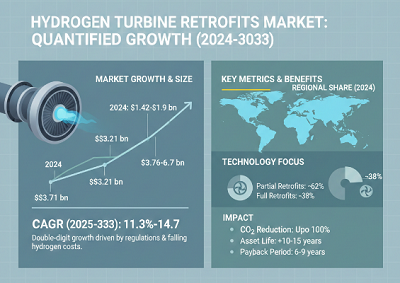
| Global market size (2024) | $1.42–$1.9 billion |
| Estimated market size (2025) | ~$1.65–$1.7 billion |
| Forecast market value (2030) | ~$3.21 billion |
| Projected value range (2033) | $3.76–$6.7 billion |
| CAGR (2025–2033) | 11.3%–14.7% |
| Europe market share (2024) | ~38% |
| Partial retrofit share | ~62% |
| Power generation share | ~54% |
| Leading turbine capacity | 100–300 MW (≈47%) |
1. Market Size and Growth Trajectory (2024–2033)
Current Market Landscape (2024–2025)
In 2024, the hydrogen turbine retrofits market was valued between $1.42 billion and $1.9 billion, reflecting regional differences in hydrogen infrastructure readiness and regulatory incentives. By 2025, revenues are estimated to reach ~$1.67 billion, driven largely by hydrogen co-firing projects in Europe and North America.
This early growth phase is characterized by:
- Retrofit adoption for existing combined-cycle gas plants
- Increased use of hydrogen blends between 10% and 30%
- Retrofit investments focused on extending turbine operational life rather than full replacement
Medium-Term Outlook (2026–2030)
By 2030, the market is projected to reach ~$3.21 billion, representing a ~90% increase
compared to 2025 levels. Key growth metrics include:
- Average annual growth rate: ~14%
- Installed base expansion: 2× increase in retrofitted turbines
- Capital allocation shift: Retrofit projects accounting for a growing share of turbine service budgets
Long-Term Projections (2031–2033)
Forecasts for 2033 vary by adoption scenario:
- Conservative estimate: $3.76 billion
- High-adoption estimate: up to $6.7 billion
Even under conservative assumptions, the market expands by 2.6× from its 2024 baseline, highlighting strong long-term fundamentals.
2. Retrofit Technology Breakdown: Partial vs Full Conversion
Partial Hydrogen Retrofits (≈62% Market Share)
Partial retrofits dominate current deployments due to lower cost and faster execution.
Quantified characteristics:
- Hydrogen blending capability: 20–30%
- Retrofit execution time: 25–40% shorter than full retrofits
- Average downtime reduction: ~30%
- Capital expenditure savings: 20–35% vs full conversion
These retrofits are commonly applied to turbines aged 10–20 years, enabling compliance with emissions targets while deferring new-build investments.
Full Hydrogen Retrofits (≈38% Market Share)
Full retrofits enable 100% hydrogen combustion, delivering maximum emissions reduction.
Measured trade-offs:
- Engineering timelines: 30–40% longer
- Upfront capex: 30–50% higher
- Hydrogen infrastructure dependency: High
Despite higher costs, full retrofits are increasingly pursued for large utility-scale turbines in regions with established hydrogen supply chains.
3. Turbine Capacity and End-Use Segmentation
Market Share by Turbine Size
| Turbine Capacity | Share |
| Below 100 MW | ~22% |
| 100–300 MW | ~47% |
| Above 300 MW | ~31% |
The 100–300 MW segment leads the market due to its widespread use in baseload and mid- merit power generation, where retrofit economics are most favorable.
Market Share by Application
- Power generation: ~54%
- Industrial energy users: ~31%
- Distributed generation & CHP: ~15%
Industrial demand is rising steadily as manufacturers seek to reduce Scope 1 emissions while maintaining high thermal reliability.
4. Regional Market Distribution (2024 Baseline)
Europe
- Market share: ~38%
- Estimated value: $530–$720 million
- Growth driven by emissions pricing and hydrogen strategies
North America
- Market share: ~29–30%
- Estimated value: $370–$550 million
- Adoption led by utilities modernizing gas fleets
Asia-Pacific
- Market share: ~21–25%
- Fastest CAGR through 2033
- Growth concentrated in Japan, South Korea, Australia, and China
5. Quantified Benefits of Hydrogen Turbine Retrofits
Hydrogen retrofits deliver measurable operational and environmental outcomes:
- CO₂ emissions reduction: Proportional to hydrogen blend; up to 100% reduction with pure hydrogen
- Asset life extension: 10–15 additional years
- Fuel flexibility: Ability to shift hydrogen ratios based on availability
- Efficiency impact: Less than 2% thermal efficiency loss in modern systems
- Compliance readiness: Aligns with 2030–2040 emissions targets
6. Cost Structure, Investment Trends, and Risks
Cost & Investment Trends
- Hydrogen production costs declining at 10–15% annually
- Digital control and combustion systems now account for ~18% of turbine service revenues
- Average retrofit payback period: 6–9 years Key Risks and Constraints (Quantified)
| Risk Factor | Impact |
| Hydrogen supply limitations | +20–30% capex |
| Engineering complexity | +30–40% project duration |
| Safety & regulatory compliance | +5–10% total project cost |
| Fuel price volatility | ±15–25% operating cost variation |
Conclusion: A Market Defined by Measurable Performance
The Hydrogen Turbine Retrofits market is evolving into a multi-billion-dollar, data-backed solution for decarbonizing existing power infrastructure. Between 2024 and 2033, the market is projected to grow from ~$1.5 billion to as much as $6.7 billion, supported by:
- Sustained 11–15% annual growth
- Partial retrofits accounting for over 60% of installations
- Europe leading adoption with ~38% market share
- Clear emissions reductions and 10–15 years of asset life extension
For operators prioritizing quantifiable emissions reduction, cost control, and infrastructure reuse, hydrogen turbine retrofits represent one of the most economically and technically compelling pathways in the global energy transition.
For more information, visit: https://dataintelo.com/report/hydrogen-turbine-retrofits-market