

Introduction
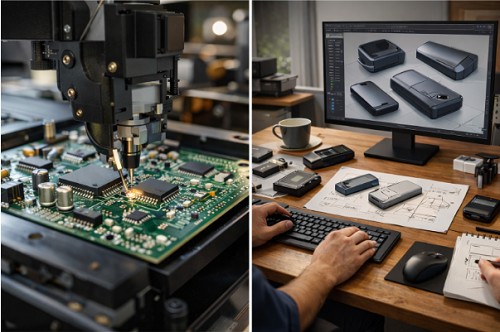
In today’s fast-moving technology landscape, electronic product design is no longer just about making circuits work. It is about transforming an idea into a reliable, manufacturable, user-friendly, and market-ready product. Whether it’s a smart home device, industrial controller, IoT module, medical instrument, or consumer electronic gadget, every successful product begins with a clear design concept and a structured development process.
Understanding the design logic behind electronic products helps businesses reduce risk, shorten development cycles, control costs, and deliver better user experiences. In this article, we will explore the complete design thinking behind electronic products, including circuit board design and assembly, enclosure development, system integration, prototyping, and manufacturing considerations.
1. Understanding the Core Concept of Electronic Product Design
Electronic product design is a multidisciplinary process that integrates:
- Electrical engineering
- Embedded system development
- Mechanical design
- Industrial design
- Manufacturing engineering
- User experience (UX) design
A strong design concept answers four fundamental questions:
- What problem does the product solve?
- Who is the target user?
- What technical performance is required?
- How can it be manufactured reliably and cost-effectively?
A well-defined concept prevents costly redesigns later in development. It aligns engineering decisions with market expectations.
2. System Architecture: The Foundation of Smart Design
Before jumping into PCB layout or enclosure modeling, engineers define the system architecture. This step determines:
- Power supply structure
- Communication protocols (WiFi, Bluetooth, RS485, CAN, etc.)
- Microcontroller or processor selection
- Sensor integration
- Safety and protection design
- Firmware structure
A good architecture balances performance, power consumption, expandability, and cost. For example, choosing an overpowered processor may increase BOM cost unnecessarily, while underestimating performance requirements may cause instability later.
Clear architectural planning ensures that hardware and firmware teams work efficiently together.
3. Circuit Board Design and Assembly (PCB & PCBA)
At the heart of every electronic product lies the PCB (Printed Circuit Board). This is where the electronic intelligence physically exists.
3.1 Schematic Design
The schematic is the logical blueprint of the product. Engineers define:
- Power circuits
- Signal processing paths
- Microcontroller connections
- Communication interfaces
- Protection circuits (ESD, overcurrent, surge)
Component selection is critical at this stage. Engineers must consider:
- Availability in global supply chains
- Long lifecycle components
- Thermal characteristics
- Electrical reliability
- Certification requirement
Good schematic design reduces noise, improves stability, and prepares the design for EMC compliance.
3.2 PCB Layout Design
PCB layout is both technical and artistic. It determines product performance and reliability.
Key design considerations include:
- Signal integrity
- Power integrity
- Ground plane strategy
- Thermal management
- EMI/EMC control
- Trace width and current capacity
- High-speed routing techniques
Proper component placement reduces signal interference and improves heat dissipation. High-speed signals require controlled impedance routing. Power circuits need wide copper traces and solid grounding.
A well-designed PCB improves product lifespan and reduces field failures.
3.3 PCB Assembly (PCBA)
After PCB fabrication, assembly begins. PCBA includes:
- SMT (Surface Mount Technology) placement
- Reflow soldering
- DIP insertion (if required)
- Wave soldering
- Functional testing
- AOI (Automated Optical Inspection)
- ICT (In-Circuit Testing)
Manufacturing design (DFM – Design for Manufacturing) plays a crucial role here. Engineers must ensure:
- Proper pad spacing
- Correct footprint design
- Panelization strategy
- Test points for debugging
- Assembly-friendly component layout
A product designed without considering assembly may face soldering defects, high rejection rates, or costly rework.
4. Embedded System Integration
Hardware alone cannot deliver value. Firmware brings intelligence to the product.
Embedded development includes:
- Microcontroller programming
- Communication protocol implementation
- Power optimization
- Error detection and handling
- Bootloader design
- OTA (Over-The-Air) update capability
Firmware must be written with robustness in mind. Real-world environments are unpredictable — voltage fluctuations, communication interruptions, temperature changes, and user misuse must all be anticipated.
A well-designed embedded system ensures long-term product reliability.
5. Electronic Enclosure Design
Once internal electronics are defined, the next major step is enclosure design. Many people underestimate its importance, but the enclosure defines:
- Product appearance
- User interaction
- Mechanical protection
- Heat dissipation
- Waterproof and dust resistance (IP rating)
- Assembly convenience
5.1 Mechanical Structure Design
Mechanical engineers use 3D CAD tools to design the housing. Considerations include:
- Internal PCB mounting structure
- Screw positioning
- Snap-fit structures
- Cable routing
- Connector alignment
- Ventilation or heat sink positioning
Improper mechanical design can cause stress on the PCB, leading to long-term failure.
5.2 Material Selection
Common enclosure materials include:
- ABS plastic
- Polycarbonate (PC)
- Aluminum alloy
- Sheet metal
- Silicone sealing materials
Material selection depends on:
- Strength requirements
- Heat resistance
- Waterproof rating
- Weight constraints
- Cost targets
- Production volume
For industrial applications, aluminum housings may improve heat dissipation. For consumer products, plastic injection molding reduces cost at scale.
5.3 Industrial Design & User Experience
Beyond protection, enclosure design defines how users perceive the product.
Designers consider:
- Ergonomics
- Button placement
- LED visibility
- Touch feedback
- Surface texture
- Color matching
- Brand identity
A product that functions perfectly but feels uncomfortable or looks outdated may struggle in the market.
Human-centered design transforms technical products into user-friendly solutions.
6. Thermal Management Strategy
Heat is one of the most common reasons electronic products fail.
Thermal design strategies include:
- Heat sinks
- Thermal vias
- Copper pour optimization
- Ventilation holes
- Active cooling (fans)
- Thermal pads
Simulation tools help engineers predict heat distribution. Ignoring thermal planning can result in overheating, shortened component lifespan, and certification failure.
7. Prototyping and Validation
Before mass production, prototypes are built.
Prototype testing includes:
- Functional testing
- Environmental testing
- Vibration testing
- Temperature cycling
- EMC testing
- Load testing
- User trials
Each testing phase validates a different aspect of reliability.
Engineering validation reduces the risk of large-scale production defects.
8. Design for Manufacturing (DFM) and Cost Control
A product that works in the lab is not automatically suitable for mass production.
Design for Manufacturing ensures:
- Efficient assembly
- Reduced manual labor
- Lower rejection rate
- Optimized BOM cost
- Stable production yield
Engineers continuously balance:
- Performance
- Reliability
- Cost
- Production scalability
Early DFM consideration prevents costly redesign before mass production.
9. Regulatory Compliance and Certification
Depending on the target market, products may require:
- CE certification
- FCC certification
- RoHS compliance
- UL safety approval
Compliance should be considered early in the design phase. Ignoring certification requirements can delay product launch significantly.
10. From Concept to Market Success
Electronic product design is not just engineering — it is strategic thinking.
Successful products share common characteristics:
- Clear functional positioning
- Stable and reliable PCB design
- Well-integrated firmware
- Thoughtful enclosure engineering
- Manufacturability
- Cost control
- Compliance readiness
When hardware, software, and mechanical systems are designed together from the beginning, the final product becomes more than a device — it becomes a reliable solution.
Conclusion
The design logic behind electronic products is a balance between innovation and practicality. From PCB design and assembly to enclosure engineering and manufacturing optimization, every stage plays a critical role in determining product success.
Companies that invest in structured design processes gain:
- Faster development cycles
- Reduced risk
- Improved reliability
- Better user satisfaction
- Stronger market competitiveness
Electronic product design is not simply about creating circuits — it is about building trust through reliability, precision, and thoughtful engineering.