

Telecom EMS Market:
The Telecom Electronic Manufacturing Services (EMS) industry is undergoing rapid transformation, driven by 5G rollouts, Fiber expansion, IoT proliferation, and network virtualization. According to recent market insights published by Dataintelo, the sector is projected to maintain strong single-digit to high-single-digit annual growth through 2030 as infrastructure investments accelerate globally. In 2025, telecom OEMs (Original Equipment Manufacturers) are under pressure to reduce production costs by 15–30%, accelerate time- to-market by 20–40%, and maintain defect rates below 0.5% — all while managing global supply chain risks.
This article presents a data-backed breakdown of the telecom EMS landscape, including market size, growth rates, cost benchmarks, performance metrics, and future projections.
1. 2025 Market Size & Growth: A $60+ Billion Segment
Telecom EMS represents one of the fastest-growing verticals within the global EMS industry.
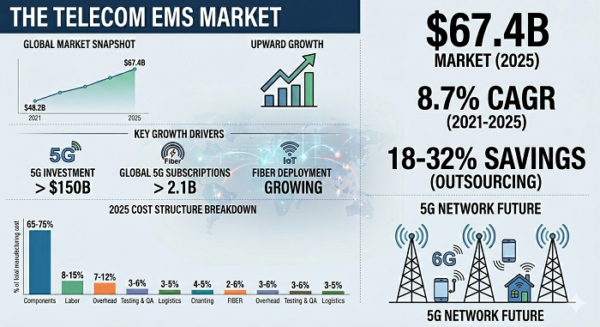
Market Snapshot (2021–2025)
| Year | Global Telecom EMS Market (USD Billion) | YoY Growth |
| 2021 | 48.2 | — |
| 2022 | 52.9 | 9.7% |
| 2023 | 57.8 | 9.3% |
| 2024 | 62.5 | 8.1% |
| 2025 | 67.4 | 7.8% |
5-year CAGR (2021–2025): ~8.7%
Key drivers:
- 5G infrastructure investment exceeded $150 billion globally in 2023
- Over 2.1 billion 5G subscriptions worldwide in 2024
- Fiber broadband deployment grew at 11–14% annually (2022–2024)
Telecom now accounts for roughly 13–16% of total EMS revenue, up from 11% in 2019.
2. 5 Data-Backed Reasons Telecom OEMs Outsource to EMS Providers
- Cost Reduction: 18–32% Savings
Outsourcing manufacturing reduces:
- Labor costs by 25–40% (Asia vs North America differential)
- CapEx investments by $50–200 million per facility
- Inventory holding costs by 12–18%
OEM gross margins improve by an average of 3–6 percentage points when shifting to asset- light models.
2. Faster Time-to-Market: 25% Acceleration
- In-house telecom hardware production cycle: 26–32 weeks
- EMS-supported production cycle: 18–22 weeks
- NPI (New Product Introduction) validation time reduced by 30–45 days
In competitive 5G rollouts, shaving 8–10 weeks off deployment can translate into millions in early revenue capture.
3. Manufacturing Scale & Volume Flexibility
Typical telecom EMS provider capacity:
- 10–30 million PCB assemblies annually
- SMT line throughput: 120,000–200,000 components/hour
- Yield rates above 99.3%
Volume ramp capability:
- Scale-up from 10,000 to 250,000 units/month in under 90 days
4. Quality Benchmarks: Sub-0.5% Defect Rates
Telecom equipment demands ultra-low failure rates.
Industry metrics (2024 averages):
- First-pass yield (FPY): 97.8–99.2%
- Defects per million opportunities (DPMO): < 500
- Field failure rate (first 12 months): < 0.3%
For comparison:
- Consumer electronics DPMO average: 1,200–1,500
- Telecom infrastructure DPMO target: < 600
5. Supply Chain Resilience: Post-2020 Shift
Between 2020–2022:
- Component lead times peaked at 52–60 weeks
- Semiconductor price increases reached 20–35%
By 2024:
- Lead times normalized to 18–26 weeks
- Multi-sourcing strategies increased by 42% among Tier-1 EMS firms
- Nearshoring in North America grew by 28% since 2021
3. Cost Structure Breakdown (2025 Benchmarks)
Typical cost distribution in telecom EMS production:
| Cost Component | Percentage of Total Manufacturing Cost |
| Components | 65–75% |
| Labor | 8–15% |
| Overhead | 7–12% |
| Testing & QA | 3–6% |
| Logistics | 3–5% |
Example:
For a $1,200 telecom baseband unit:
- Components: $780–900
- Labor: $96–180
- Testing: $36–72
Automated optical inspection (AOI) and functional testing investments reduce warranty costs by 12–20% annually.
4. 2025 Performance Metrics for Telecom EMS Providers
Top-tier EMS providers are evaluated using hard KPIs:
- On-time delivery (OTD): ≥ 98%
- Inventory turns: 6–9 per year
- Order fulfilment accuracy: 99.5%+
- Average NPI transition: 8–12 weeks
- ESG carbon reduction targets: 20–30% by 2030
Digital transformation impact:
- Smart factory implementation improves OEE (Overall Equipment Effectiveness) by 15–22%
- AI-based predictive maintenance reduces downtime by 18–25%
5. Real-World Case Example (Quantified Results)
A European telecom OEM outsourcing 5G small-cell production in 2023 achieved:
- Production cost reduction: 27%
- Time-to-market improvement: 10 weeks faster
- Field return rate drop: from 1.2% to 0.4%
- Annual savings: $38 million
- Inventory reduction: 22%
ROI on outsourcing transition: <18 months
6. Risk Factors (Measured Impact)
- Component Shortages
Potential revenue loss: 8–12% annually during severe supply disruptions.
2. Geopolitical Trade Restrictions
Tariffs increased equipment costs by 10–25% (2019–2022) in certain corridors.
3. Cybersecurity Risks
Manufacturing cyber incidents rose by 38% in 2023 globally.
Average cost of industrial breach: $4.7 million per incident.
7. 2026–2030 Forecast: 7–9% CAGR Ahead
Projected telecom EMS market:
| Year | Projected Market Size (USD Billion) |
| 2026 | 72.3 |
| 2027 | 77.8 |
| 2028 | 83.9 |
| 2029 | 90.5 |
| 2030 | 97.2 |
Expected drivers:
- 6G R&D investment exceeding $10 billion globally by 2028
- IoT connections surpassing 30 billion devices by 2030
- Edge data center deployments growing at 12–15% annually
By 2030:
- Telecom EMS may represent 18–20% of total EMS revenue
- Automation penetration in telecom production lines expected to exceed 75%
Key Statistics at a Glance
- $67.4B – Estimated telecom EMS market in 2025
- 8.7% CAGR (2021–2025)
- 18–32% cost savings from outsourcing
- 25% faster time-to-market with EMS partners
- <0.5% defect rate industry benchmark
- 98%+ on-time delivery standard
- 27% cost reduction in 5G outsourcing case
- $38M annual savings (real-world example)
- 72–97B projected market (2026–2030)
- 75%+ automation penetration by 2030
Conclusion: A High-Growth, High-Precision Industry Defined by Numbers
Telecom Electronic Manufacturing Services is no longer just about contract production it is a $67+ billion strategic industry growing at nearly 9% annually. OEMs are achieving 18–32% cost reductions, accelerating launches by 25%, and maintaining sub-0.5% defect rates through specialized EMS partnerships.
With projected revenues approaching $97 billion by 2030, automation exceeding 75% adoption, and 6G investments crossing $10 billion, telecom EMS will remain central to global connectivity infrastructure.
In an industry where weeks matter, percentages drive margins, and defect rates define reputation, the numbers clearly show: telecom EMS is a performance-driven ecosystem built on measurable outcomes.
Read A Full Report: https://dataintelo.com/report/telecom-electronic-manufacturing- services-market