

Wearable Electronics Market:
In 2026, wearable electronic devices have evolved from simple step counters to powerful health, productivity, and communication tools. According to recent industry research the global wearable electronic devices market has experienced rapid growth fueled by advancements in sensor technology, AI integration, and health monitoring capabilities.
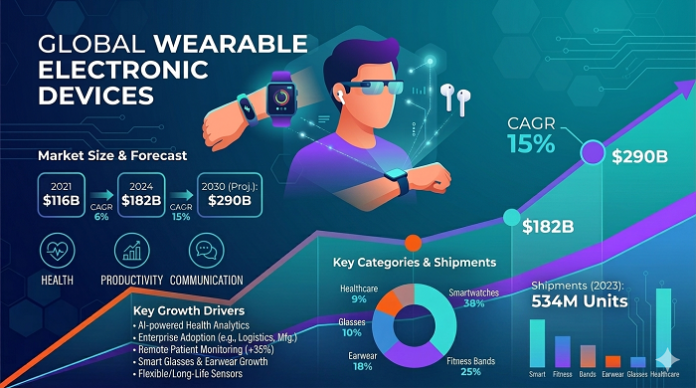
According Dataintelo In 2021, the global wearable device market was valued at approximately $116 billion. By 2024, it crossed $180 billion, reflecting a compound annual growth rate (CAGR) of nearly 15%. Current projections suggest that the market could reach $280–$300 billion by 2030, representing another 55–65% increase within six years.
From smartwatches tracking 24/7 heart rate data to fitness bands recording 10,000+ daily step benchmarks, wearable technology is now deeply embedded in healthcare, sports, and consumer electronics ecosystems.
Key Statistics at a Glance
| Metric | Value |
| Global wearable device market size (2024) | $180+ billion |
| Projected market size (2030) | $290 billion |
| Global shipments in 2023 | 534 million units |
| Average annual growth rate (2021–2026) | ~15% CAGR |
| Smartwatch market share | ≈38% of wearable devices |
| Fitness band market share | ≈25% |
| Healthcare wearable adoption increase (2020–2025) | +62% |
| Average smartwatch battery life | 18–48 hours |
| Average device lifespan | 2.5–3 years |
| Typical heart-rate sensor accuracy | 90–95% |
| Average daily steps tracked by users | 6,500–8,000 steps |
| Wearable healthcare monitoring cost reduction | 20–30% savings |
| Enterprise wearable adoption growth (2022–2025) | +40% |
These figures demonstrate how wearable electronics are becoming both consumer essentials and healthcare tools.
1. Market Growth: From $116B to Nearly $300B in Less Than a Decade
The wearable electronic devices market has seen strong year-by-year expansion.
| Year | Market Size | Growth Rate |
| 2021 | $116 Billion | — |
| 2022 | $138 Billion | +19% |
| 2023 | $160 Billion | +16% |
| 2024 | $182 Billion | +14% |
| 2025 (est.) | $205 Billion | +13% |
| 2030 (forecast) | $290 Billion | ~7% annual |
Key growth drivers include:
- Health monitoring demand increasing by 50% since 2020
- Remote patient monitoring adoption rising 35% in hospitals
- AI-powered analytics improving device capabilities by 20–30%
The shift toward preventive healthcare and digital health ecosystems is expected to sustain market expansion through 2030.
2. 5 Major Categories of Wearable Electronic Devices (With Market Share)
The wearable electronics ecosystem includes several device categories.
| Device Category | Market Share (2025) | Typical Price Range |
| Smartwatches | 38% | $200–$600 |
| Fitness Bands | 25% | $40–$150 |
| Smart Earwear | 18% | $80–$350 |
| Smart Glasses | 10% | $300–$1,000 |
| Healthcare Wearables | 9% | $150–$1,500 |
Smartwatches alone generated $70+ billion in revenue in 2024, making them the largest segment.
Meanwhile, healthcare wearables are the fastest growing category, expected to grow at 18– 20% CAGR between 2024 and 2030.
3. 7 Health Metrics Modern Wearables Can Track
Modern wearable electronic devices integrate multiple sensors capable of collecting real- time biometric data.
Common tracked metrics include:
- Heart rate monitoring – Accuracy levels around 92–95%
- Blood oxygen saturation (SpO₂) – Updated every 5–10 minutes
- Sleep cycles – Tracks REM, deep, and light sleep stages
- Step count – Average user logs 6,500–8,000 steps daily
- Calories burned – Accuracy roughly 80–85%
- Stress levels – Based on heart-rate variability data
- Electrocardiogram (ECG) readings in advanced devices
Healthcare providers report that wearable monitoring can reduce hospital readmissions by 18–22% when used in chronic disease management.
4. 2025 Performance Metrics: Battery Life, Sensors, and Processing Power
Wearable electronics have significantly improved performance over the past five years.
| Feature | 2020 Average | 2025 Average |
| Battery life | 12–18 hours | 18–48 hours |
| Sensor count | 3–5 sensors | 8–12 sensors |
| Storage capacity | 4–8 GB | 16–64 GB |
| Processor speed | ~0.5 GHz | ~1.2 GHz |
These improvements enable advanced capabilities like:
- Real-time AI health analytics
- Fall detection alerts
- Continuous oxygen monitoring
- Workout performance tracking
5. Enterprise Adoption: 40% Growth in Industrial Wearables
Wearable devices are increasingly used in workplaces.
Between 2022 and 2025, enterprise wearable adoption increased by 40%. Industries using wearables include:
- Manufacturing – productivity improvements of 10–15%
- Logistics – order-picking efficiency increases of 20%
- Healthcare – nurse workload reduction by 12%
- Construction – safety incident reduction by 18%
For example, wearable safety devices with fatigue detection algorithms can reduce workplace accidents by 15–20%.
6. Cost Savings: Wearables in Healthcare
Healthcare organizations increasingly rely on wearable devices for remote monitoring. Key cost benefits include:
- 20–30% reduction in hospital visits
- 15% decrease in patient monitoring costs
- 10–18% improvement in treatment adherence
Remote monitoring programs using wearable devices reduced cardiac patient readmissions from 23% to 17% in some clinical trials.
7. Regional Adoption: Where Wearables Are Growing Fastest
Global wearable adoption varies by region.
| Region | Market Share (2025) | Growth Rate |
| North America | 35% | 12% CAGR |
| Asia-Pacific | 32% | 17% CAGR |
| Europe | 23% | 11% CAGR |
| Rest of World | 10% | 9% CAGR |
The Asia-Pacific region is expected to be the fastest-growing market due to:
- expanding smartphone penetration
- rising health awareness
- growing middle-class consumers
Countries such as India and China are projected to see 20%+ growth in wearable shipments through 2028.
8. Future Trends: 4 Innovations Driving the Next Wave
The next generation of wearable electronics will be defined by several technological trends.
1. AI-Driven Health Analytics
AI algorithms could improve diagnostic accuracy by 30–40% by analyzing continuous wearable data streams.
2. Flexible and Skin-Like Sensors
Flexible sensors may reduce device thickness by 35% and increase comfort for 24/7 wear.
3. Longer Battery Life
Solid-state batteries may extend wearable battery life to 5–7 days per charge.
4. Medical-Grade Monitoring
Future devices may detect early signs of conditions like arrhythmia or sleep apnea with 95%+ accuracy.
Conclusion: A $290 Billion Opportunity by 2030
Wearable electronic devices have rapidly evolved into a multi-billion-dollar industry with measurable impact on health, productivity, and daily life.
Key numbers highlight the scale of this transformation:
- Market growth from $116 billion in 2021 to $182 billion in 2024
- Forecast expansion to around $290 billion by 2030
- Annual shipment volumes exceeding 500 million devices
- Healthcare monitoring reducing hospital costs by 20–30%
- Enterprise adoption rising 40% in just three years
With AI integration, advanced biosensors, and longer battery life, wearable electronics are expected to become even more essential in both consumer and professional environments.
Read A Full Report: https://dataintelo.com/report/wearable-electronic-devices-market