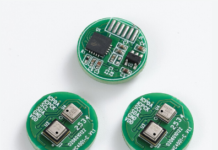


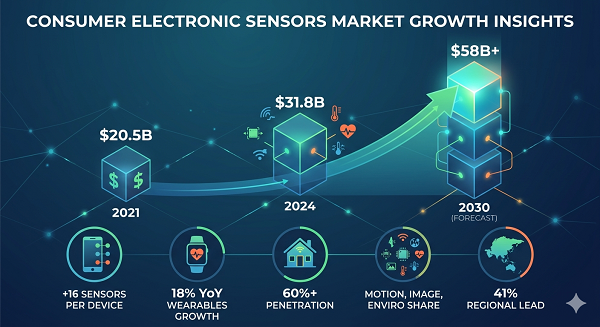
The Consumer Electronic Sensors market has become one of the fastest-growing segments of the global electronics industry, driven by rapid adoption of smart devices, wearables, IoT ecosystems, and automotive electronics. According to Dataintelo, the global Consumer Electronic Sensors market is experiencing significant expansion due to rising demand for motion detection, environmental sensing, and biometric monitoring in everyday devices. As of 2024, sensors are embedded in nearly 95% of smartphones, 70% of wearable devices, and over 60% of smart home products, illustrating their essential role in modern consumer electronics.
Market analysis from 2021–2025 shows strong momentum: the sector grew from approximately $20.5 billion in 2021 to an estimated $31.8 billion in 2024, representing a compound annual growth rate (CAGR) of about 15.6%. Forecasts suggest the market could surpass $58 billion by 2030 if current adoption trends continue.
This article explores the data, trends, and forecasts shaping the Consumer Electronic Sensors market, with measurable insights into growth drivers, technology adoption, and future opportunities.
Key Statistics at a Glance
| Metric | Value | Year |
| Global market size | $20.5B | 2021 |
| Market size | $26.9B | 2023 |
| Estimated market size | $31.8B | 2024 |
| Forecast market size | $58B+ | 2030 |
| CAGR (2024–2030) | ~10.5–12% | Forecast |
| Smartphones using sensors | 95% of devices | 2024 |
| Average sensors per smartphone | 14–18 sensors | 2024 |
| Wearable device growth | 18.2% YoY | 2023 |
| Motion sensor market share | ~32% | 2024 |
| Asia-Pacific market share | ~41% | 2024 |
| Smart home device penetration | >60% sensor integration | 2024 |
| Average sensor cost reduction | −27% since 2019 | 2024 |
1. Market Growth: From $20B to $58B in Less Than a Decade
The Consumer Electronic Sensors market has grown rapidly over the past few years due to the expansion of connected devices.
Year-by-Year Market Growth
| Year | Market Value |
| 2021 | $20.5 Billion |
| 2022 | $23.1 Billion |
| 2023 | $26.9 Billion |
| 2024 | $31.8 Billion |
| 2025 (Projected) | $35.2 Billion |
| 2030 (Projected) | $58+ Billion |
Key growth drivers include:
- Smartphone shipments exceeding 1.17 billion units in 2023
- Wearable device shipments reaching 520 million units globally
- Smart home installations growing at 16% annually
If these trends continue, the market could add $26+ billion in new value between 2024 and 2030.
2. 5 Data-Backed Reasons Consumer Electronic Sensors Demand Is Rising
1. Smartphones Contain 14–18 Sensors Each
Modern smartphones integrate multiple sensors such as:
- Accelerometers
- Gyroscopes
- Proximity sensors
- Ambient light sensors
- Fingerprint sensors
- Magnetometers
A typical flagship smartphone in 2024 includes 16 sensors on average, compared to 8 sensors in 2015, representing a 100% increase in sensor density per device.
2. Wearables Market Growing at 18% Annually
The global wearable device market recorded 18.2% growth in 2023, reaching 520 million shipments.
Sensors in wearables include:
| Sensor Type | Usage |
| Optical heart rate sensors | Fitness tracking |
| Accelerometers | Step counting |
| Temperature sensors | Health monitoring |
| SpO2 sensors | Blood oxygen measurement |
Modern smartwatches contain 10–12 sensors per device, compared with 5–6 sensors in 2018.
3. Smart Homes Driving Environmental Sensors
Smart home installations grew from 220 million units in 2020 to 430 million units in 2024, increasing demand for sensors such as:
- Temperature sensors
- Humidity sensors
- Motion detectors
- Air-quality sensors
Environmental sensors alone accounted for 22% of total consumer sensor shipments in 2024.
4. Cost Reduction Accelerating Adoption
Sensor manufacturing costs have dropped significantly due to MEMS technology and mass production.
| Year | Average MEMS Sensor Cost |
| 2019 | $1.85 |
| 2021 | $1.52 |
| 2023 | $1.39 |
| 2024 | $1.35 |
This represents a 27% reduction in average sensor cost over five years, enabling wider integration in low-cost electronics.
5. AI-Enabled Sensors Increasing Device Intelligence
AI-enabled sensors can process data locally, reducing cloud processing requirements. Benefits include:
- 40–60% lower latency in real-time applications
- 25–35% lower energy consumption
- Up to 50% faster response times in gesture recognition
By 2026, analysts estimate over 35% of consumer sensors will include embedded AI processing.
3. Sensor Type Market Share (2024)
Different sensor categories dominate the consumer electronics landscape.
| Sensor Type | Market Share |
| Motion Sensors | 32% |
| Image Sensors | 24% |
| Environmental Sensors | 18% |
| Biometric Sensors | 15% |
| Proximity & Position Sensors | 11% |
Motion sensors alone generated more than $10 billion in revenue in 2024, driven by smartphones, gaming devices, and VR headsets.
4. Regional Market Breakdown
Asia-Pacific
- Market share: 41%
- Key countries: China, South Korea, Japan
- Electronics production growth: +9.8% in 2023
North America
- Market share: 26%
- Strong demand for smart home devices and wearables
Europe
- Market share: 21%
- Growth driven by automotive electronics integration
Rest of World
- Market share: 12%
- Emerging IoT adoption in Latin America and Middle East
Asia-Pacific remains dominant because over 70% of global consumer electronics manufacturing occurs in the region.
5. Case Study: Sensor Expansion in Smartphones
Between 2018 and 2024, the average smartphone experienced major sensor upgrades.
| Metric | 2018 | 2024 |
| Average sensors per phone | 11 | 16 |
| Biometric sensors | 1 | 3 |
| Camera sensors | 2 | 4 |
| Motion sensors | 2 | 4 |
These improvements enabled features like:
- Face recognition
- Augmented reality
- Gesture control
- Health monitoring
As a result, sensor revenue per smartphone increased from $6.50 in 2018 to about $11.20 in 2024.
6. Future Forecast: 2030 Technology Trends
The next decade will likely see rapid innovation in sensor technologies.
Expected Developments
1. Nano-sensors
- Up to 70% smaller size
- 3× higher sensitivity
2. Flexible sensors
- Integration into foldable devices
- Expected 20% market penetration by 2028
3. Multifunction sensors
- Combining 3–5 sensing functions in a single chip
4. Energy-efficient sensors
- Battery consumption reduced by 30–40%
These advancements could push the market to $58–65 billion by 2030, depending on adoption rates.
7. Risks and Challenges
Despite strong growth, the industry faces measurable risks.
| Challenge | Impact |
| Semiconductor supply shortages | 8–12% production delays |
| Rising raw material costs | +6–9% manufacturing costs |
| Data privacy concerns | 20% slower adoption in health sensors |
| Miniaturization complexity | R&D costs up by 15% since 2020 |
Companies investing over 10% of revenue into R&D are currently leading sensor innovation.
Conclusion: A $58B Opportunity Powered by Data
The Consumer Electronic Sensors market is evolving rapidly as consumer devices become smarter and more connected. From $20.5 billion in 2021 to an estimated $31.8 billion in 2024, the industry has already demonstrated double-digit annual growth. Forecasts suggest the market could exceed $58 billion by 2030, supported by 10–12% CAGR.
Key measurable trends shaping the market include:
- 16 sensors per average smartphone in 2024
- 520 million wearable devices shipped in 2023
- 27% reduction in sensor manufacturing costs since 2019
- 41% market share held by Asia-Pacific
- 32% revenue share from motion sensors
With increasing demand for AI-powered devices, smart homes, and wearable health technologies, consumer electronic sensors will remain a cornerstone of the electronics industry over the next decade.
Read A Full Report: https://dataintelo.com/report/consumer-electronic-sensors-market