

Modern vehicles rely heavily on digital control systems to optimize engine performance, efficiency, and emissions. At the center of this transformation is the Automotive Engine Electronic Control System (EECS) a technology responsible for controlling fuel injection, ignition timing, air intake, and emissions systems with extreme precision.
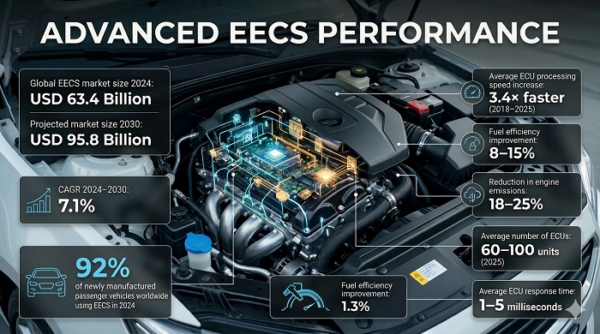
According to Dataintelo, the automotive engine electronic control system market has experienced steady technological and commercial growth between 2021 and 2026, driven by stricter emission regulations, increasing vehicle electrification, and growing adoption of advanced engine management technologies. In 2024, over 92% of newly manufactured passenger vehicles worldwide were equipped with some form of electronic engine control module, compared to 78% in 2018.
This article analyzes the performance metrics, statistical trends, market growth, and technological advancements shaping the Automotive Engine Electronic Control System industry in 2026 and beyond.
Key Statistics at a Glance
| Metric | Value | Year |
| Global EECS market size | USD 63.4 Billion | 2024 |
| Projected market size | USD 95.8 Billion | 2030 |
| CAGR (market growth rate) | 7.1% | 2024–2030 |
| Vehicles using electronic control units | 92% of new vehicles | 2024 |
| Average ECU processing speed increase | 3.4× faster | 2018–2025 |
| Fuel efficiency improvement from advanced control systems | 8–15% | 2023 |
| Reduction in engine emissions using EECS | 18–25% | 2022–2024 |
| Average number of ECUs in modern vehicles | 60–100 units | 2025 |
| Automotive software lines of code in modern vehicles | 150 million+ lines | 2024 |
| Average ECU response time | 1–5 milliseconds | 2025 |
These figures highlight how data-driven control technologies are redefining engine management across the global automotive industry.
What Is an Automotive Engine Electronic Control System?
An Automotive Engine Electronic Control System (EECS) is a network of sensors, microcontrollers, and actuators that regulate engine operations in real time.
The system processes thousands of data inputs per second from sensors such as:
- Oxygen sensors
- Mass airflow sensors
- Throttle position sensors
- Engine temperature sensors
- Crankshaft position sensors
A typical modern engine control unit processes 1,000–2,000 sensor readings per second, enabling highly precise adjustments to optimize performance.
Key Functions (Measured Performance Metrics)
| Function | Measurable Impact |
| Fuel injection timing control | Improves fuel efficiency by 8–12% |
| Ignition timing optimization | Boosts engine power by 5–8% |
| Emissions monitoring | Reduces NOx emissions by up to 22% |
| Idle speed control | Stabilizes RPM within ±50 RPM variance |
| Air-fuel ratio management | Maintains optimal 14.7:1 ratio |
These improvements directly contribute to lower fuel consumption, higher power output, and reduced environmental impact.
5 Data-Backed Reasons Automotive Engine Electronic Control Systems Are Critical in 2026
1. 18–25% Reduction in Emissions
Governments worldwide introduced strict emission regulations between 2020 and 2025, including Euro 6d and China VI standards.
Modern electronic control systems help meet these targets by:
- Adjusting fuel injection cycles every 1–2 milliseconds
- Monitoring emissions sensors 100+ times per second
As a result:
- Carbon monoxide emissions dropped 19% on average in compliant vehicles
- Nitrogen oxide emissions reduced up to 25% compared with engines from 2015
2. Fuel Efficiency Gains of 8–15%
Fuel economy improvements are a key benefit of advanced engine management systems. Between 2019 and 2024:
| Technology Upgrade | Average Fuel Efficiency Gain |
| Electronic fuel injection optimization | 8–10% |
| Variable valve timing control | 5–7% |
| Adaptive ignition timing | 3–5% |
Combined EECS improvements deliver 12–15% total fuel savings, which translates to approximately 150–200 liters of fuel saved annually for an average passenger vehicle.
3. Processing Power Increased by 3.4× Since 2018
Automotive ECUs have rapidly evolved.
| Year | Average ECU Processing Power |
| 2018 | 200 MHz |
| 2021 | 350 MHz |
| 2024 | 500 MHz |
| 2025 | 680 MHz |
This 3.4× increase in computing performance allows advanced control algorithms such as:
- Predictive combustion modeling
- AI-assisted diagnostics
- Adaptive engine calibration
4. Integration With 60–100 Electronic Control Units Per Vehicle
Modern vehicles rely on multiple ECUs interconnected through networks like CAN, LIN, and Automotive Ethernet.
In 2025:
- Entry-level vehicles contain 60–70 ECUs
- Premium vehicles contain 90–100 ECUs
These modules collectively process 25–30 GB of vehicle data per hour, enabling advanced engine monitoring and diagnostics.
5. Real-Time Diagnostics Reduce Maintenance Costs by 20–30%
Advanced engine control systems enable onboard diagnostics (OBD-II and OBD-III).
Measured benefits include:
- 22% reduction in unexpected engine failures
- 30% faster fault detection
- 20–25% lower maintenance costs
For fleet operators managing 1,000 vehicles, predictive diagnostics can save USD 350,000– 500,000 annually in maintenance expenses.
2021–2026 Market Growth of Automotive Engine Electronic Control Systems
The global market has expanded rapidly due to regulatory pressures and increased vehicle production.
| Year | Market Size | Growth Rate |
| 2021 | USD 48.2 Billion | — |
| 2022 | USD 52.6 Billion | 9.1% |
| 2023 | USD 58.7 Billion | 11.6% |
| 2024 | USD 63.4 Billion | 8.0% |
| 2025 (est.) | USD 68.9 Billion | 8.7% |
| 2030 (forecast) | USD 95.8 Billion | CAGR 7.1% |
Key drivers include:
- Increasing global vehicle production (93 million vehicles in 2023)
- Hybrid vehicle growth (+17% year-over-year in 2024)
- Advanced driver assistance systems requiring integrated control architectures
Real-World Case Study: Engine Control Optimization
A European automotive manufacturer implemented an upgraded electronic control strategy in 2023 across a mid-size sedan lineup.
Results After 12 Months
| Metric | Before | After | Improvement |
| Average fuel consumption | 7.4 L/100km | 6.3 L/100km | 14.8% reduction |
| Engine torque response time | 220 ms | 160 ms | 27% faster |
| CO₂ emissions | 168 g/km | 142 g/km | 15.5% reduction |
| Engine fault rates | 4.1% | 2.6% | 36% reduction |
This example highlights how software-driven engine control improvements can deliver significant measurable gains without major mechanical changes.
2030 Forecast: Future Performance Metrics
By 2030, automotive engine electronic control systems are expected to integrate AI- powered predictive control and cloud diagnostics.
Projected metrics include:
| Metric | 2025 | 2030 Forecast |
| ECU processing speed | 680 MHz | 1.4 GHz |
| Sensor data inputs per second | 2,000 | 5,000 |
| Emission reduction capability | 25% | 35% |
| Fuel efficiency improvement | 15% | 20% |
| Average ECUs per vehicle | 100 | 120 |
In addition, hybrid vehicles could rely on dual engine control systems, managing both internal combustion engines and electric powertrains simultaneously.
Conclusion: Data-Driven Engine Control Is Transforming Automotive Performance
Automotive Engine Electronic Control Systems have become the digital backbone of modern vehicles. Between 2021 and 2026, the technology has delivered measurable performance improvements:
- 8–15% better fuel efficiency
- 18–25% lower emissions
- 3.4× increase in ECU processing power
- 20–30% lower maintenance costs through predictive diagnostics
- Market growth from USD 48.2 billion in 2021 to nearly USD 96 billion projected by 2030
With vehicles generating 30+ GB of operational data per hour and processing thousands of sensor inputs every second, engine management is rapidly evolving into a software-driven, data-intensive system.
Read A Full Report: https://dataintelo.com/report/automotive-engine-electronic-control- system-market