

The global Self-Powered and Wearable Electronic Skin market is entering a high-growth phase as demand for advanced health monitoring, robotics, and smart wearable devices accelerates. According to industry analysis the market is witnessing significant expansion driven by improvements in flexible electronics, nanomaterials, and energy-harvesting technologies.
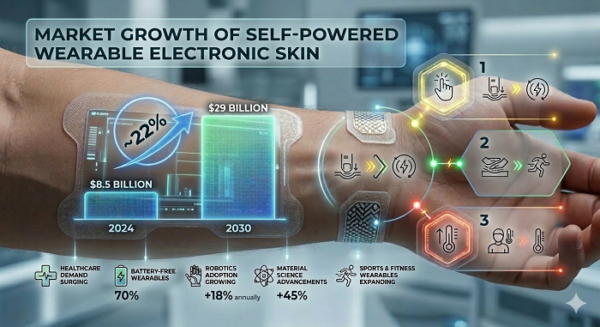
According to industry analysis from Dataintelo in 2024, the global wearable electronic skin market size is estimated to exceed USD 8.5 billion, and projections indicate the market could reach approximately USD 28–30 billion by 2030, reflecting a compound annual growth rate (CAGR) of around 21–23%. The rapid adoption of self-powered sensors, capable of generating electricity from body movement, temperature, or pressure, is a key driver behind this growth.
Self-powered electronic skin (often called e-skin) replicates the tactile sensing capabilities of human skin while eliminating the need for traditional batteries. These devices integrate piezoelectric, triboelectric, or thermoelectric energy harvesting systems, enabling continuous monitoring without external power sources.
Key Statistics at a Glance
| Metric | Value | Year |
| Global wearable electronic skin market size | USD 8.5 Billion | 2024 |
| Projected market value | USD 29 Billion | 2030 |
| CAGR | ~22% | 2024–2030 |
| Healthcare application share | 38–42% | 2024 |
| Flexible sensor efficiency improvement | +45% | 2021–2024 |
| Average sensor thickness | 20–50 micrometers | Current generation |
| Energy harvesting efficiency | 15–30% conversion rate | Latest triboelectric systems |
| Wearable device battery replacement reduction | up to 70% | Self-powered systems |
| Robotics tactile sensor adoption growth | +18% annually | 2023–2025 |
| Average wearable e-skin lifespan | 3–5 years | 2024 |
What Is Self-Powered Electronic Skin?
Self-powered electronic skin refers to ultra-thin, flexible sensor arrays designed to mimic human skin while generating their own energy. These systems can detect:
- Pressure
- Temperature
- Humidity
- Strain
- Chemical signals
Most modern e-skin systems measure between 20–50 micrometers thick, which is roughly 5–10 times thinner than a human hair (typically around 70 micrometers).
Energy Generation Mechanisms
Self-powered electronic skin typically relies on three energy-harvesting technologies:
| Technology | Energy Source | Typical Output |
| Piezoelectric | Mechanical pressure | 0.5–5 mW/cm² |
| Triboelectric | Friction or motion | 10–50 mW peak output |
| Thermoelectric | Body heat | 20–60 µW/cm² |
Triboelectric nanogenerators have improved efficiency by approximately 30–40% between 2020 and 2024, enabling longer operating lifetimes without batteries.
5 Data-Backed Reasons the Market Is Growing Rapidly
1. Healthcare Wearables Demand Is Surging
Healthcare is the largest application segment, accounting for about 40% of total market revenue in 2024.
Electronic skin sensors enable real-time monitoring of:
- Heart rate
- Blood pressure
- Muscle activity
- Sweat composition
According to healthcare device studies, continuous monitoring using wearable biosensors can reduce hospital readmission rates by 15–20% for chronic conditions such as cardiovascular disease.
Additionally, wearable health device shipments surpassed 320 million units globally in 2023, up from 240 million units in 2020, representing a 33% growth in three years.
2. Battery-Free Wearables Reduce Maintenance by 70%
One of the biggest limitations of wearable devices is battery life. Traditional wearables require charging every 24–72 hours.
Self-powered electronic skin systems can:
- Reduce battery replacements by 60–70%
- Extend device operational life to 3–5 years
- Lower maintenance costs by 30–40%
For large healthcare deployments involving 10,000+ wearable sensors, this reduction in maintenance can save hundreds of thousands of dollars annually.
3. Robotics Adoption Is Growing at 18% Per Year
Electronic skin is increasingly used in robotics to replicate human touch sensitivity.
Modern robotic e-skin systems can detect pressure as low as 0.1 kilopascals, comparable to human tactile sensitivity.
Robotics industry metrics show:
- 18% annual growth in tactile sensor adoption (2023–2025)
- Average robotic sensor arrays contain 500–1,500 sensing nodes
- Robotic e-skin coverage increased from 15% of advanced robots in 2020 to 28% in 2024
This growth is particularly strong in collaborative robots (cobots) used in manufacturing and healthcare.
4. Material Science Advancements Improved Performance by 45%
Recent advancements in nanomaterials such as:
- Graphene
- Carbon nanotubes
- Conductive polymers
have significantly improved electronic skin performance.
Between 2021 and 2024, research prototypes demonstrated:
- 45% higher sensor sensitivity
- 30% improved stretchability
- 25% longer durability cycles
Some advanced e-skin materials can stretch up to 150–200% of their original length without losing functionality.
5. Sports and Fitness Wearables Are Expanding
The global sports wearable market reached approximately USD 45 billion in 2024, with electronic skin sensors playing an increasing role in performance monitoring.
Athletes can track:
- Muscle fatigue
- Hydration levels
- Skin temperature
Studies show that biometric monitoring systems can improve training efficiency by 12–18% while reducing injury risk by 10–15%.
Professional sports teams are already integrating e-skin systems into smart athletic apparel to gather real-time physiological data during games and training sessions.
Regional Market Insights (2024–2030)
North America
North America currently leads the global market, accounting for approximately 35% of total revenue in 2024.
Key drivers include:
- Advanced healthcare infrastructure
- High wearable device adoption
- Strong robotics research funding
The United States alone invested over USD 2.3 billion in wearable health technologies in 2023.
Asia-Pacific
Asia-Pacific is the fastest-growing region with an expected CAGR of 24–26% between 2024 and 2030.
Major contributors include:
- China
- Japan
- South Korea
Manufacturing costs in Asia are typically 25–40% lower than in North America, accelerating large-scale production of flexible electronics.
Europe
Europe accounts for approximately 22–25% of the global market share.
The region is focusing heavily on medical-grade wearable sensors, particularly for aging populations. By 2030, Europe’s population aged 65+ is expected to reach 150 million, increasing demand for continuous health monitoring technologies.
Cost Trends and Manufacturing Benchmarks
The cost of producing flexible electronic skin sensors has dropped significantly over the past decade.
| Year | Average Cost per Sensor Patch |
| 2018 | $22–$28 |
| 2021 | $15–$18 |
| 2024 | $8–$12 |
| Projected 2030 | $4–$6 |
This represents an approximately 70% reduction in manufacturing cost between 2018 and 2030.
Mass production using roll-to-roll printing technology can produce up to 10,000 sensor patches per hour, significantly reducing production costs.
Challenges and Risks
Despite strong growth potential, several challenges remain.
1. Data Security
Wearable health devices generate large amounts of personal data. Healthcare cyberattacks increased by 38% between 2021 and 2023, raising concerns about data protection.
2. Material Durability
While many e-skin systems can withstand 10,000–50,000 bending cycles, real-world usage may require durability above 100,000 cycles.
3. Regulatory Approval
Medical-grade wearable sensors must undergo strict regulatory testing, which can take 2–5 years before commercial deployment.
Future Outlook: 2025–2030 Technology Roadmap
Over the next five years, self-powered electronic skin technology is expected to achieve major breakthroughs.
Key innovations expected by 2027–2030 include:
- Fully autonomous wearable systems with 0 external charging
- Sensor arrays with 2,000+ sensing nodes
- Ultra-thin patches below 10 micrometers thickness
- AI-driven health analytics integrated into wearable skin sensors
By 2030, analysts expect more than 1 billion wearable biosensor units to be in active use globally, many of which will rely on self-powered electronic skin technology.
Conclusion
Self-powered and wearable electronic skin represents one of the most transformative developments in the wearable technology ecosystem. With a projected 22% CAGR between 2024 and 2030, the market is expanding rapidly across healthcare, robotics, sports, and smart devices.
Advances in energy harvesting, flexible materials, and nanotechnology are making it possible to build ultra-thin, battery-free sensors capable of continuous monitoring. As manufacturing costs fall and performance improves, electronic skin technology is expected to become a core component of next-generation wearable systems.
According to industry insights, the combination of rising wearable adoption, increased healthcare digitization, and breakthroughs in flexible electronics will continue to drive strong market expansion through 2030 and beyond.
Read A Full Report: https://dataintelo.com/report/self-powered-and-wearable-electronic- skin-market