

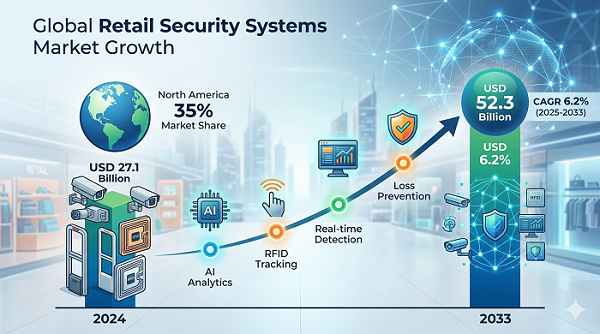
The Retail Security Systems market has become a critical component of the global retail infrastructure as theft, organized retail crime, and operational risks continue to increase. According to industry analysis by Marketintelo, the global Retail Security Systems market was valued at USD 27.1 billion in 2024 and is projected to reach USD 52.3 billion by 2033, expanding at a compound annual growth rate (CAGR) of 6.2% between 2025 and 2033.
Retailers worldwide are investing heavily in surveillance cameras, electronic article surveillance (EAS), RFID tracking, and AI-driven analytics to minimize losses and enhance store safety. Global shrinkage losses — primarily due to theft and operational errors — average 1.4%–1.6% of total retail sales, representing USD 94.5 billion in annual losses in recent surveys.
With increasing theft incidents and expanding retail networks, the Retail Security Systems industry is rapidly transitioning from traditional CCTV systems to integrated, AI-enabled security platforms.
Key Numerical Highlights
- Global Retail Security Systems market size: USD 27.1 billion (2024).
- Expected market value: USD 52.3 billion by 2033.
- Forecast CAGR: 6.2% (2025–2033).
- Alternative estimates show USD 14.25 billion in 2024 growing to USD 29.58 billion by 2032 at 8.3% CAGR.
- Retail shrinkage losses: 1.4%–1.6% of sales globally.
- External theft accounts for 37% of shrinkage.
- Video surveillance systems dominate with 42.5% market share.
- North America leads with 35% market share.
Historical Market Growth (2018–2024)
The Retail Security Systems sector has shown consistent growth over the past decade due to rapid retail expansion and digital transformation.
Between 2018 and 2024, global retail physical security revenues increased steadily as retailers expanded omnichannel operations and adopted smart store technologies.
Key historical indicators include:
- 2018–2020: Early adoption of cloud surveillance and RFID security tags.
- 2021: Retail crime surged globally as pandemic restrictions eased.
- 2022: Retail crime losses exceeded USD 112 billion in the United States alone.
- 2023: Increased deployment of AI-powered surveillance systems.
- 2024: Global Retail Security Systems market reached USD 27.1 billion.
Retail security spending is closely tied to retail industry growth. For example, India’s retail sector alone is expected to reach USD 1 trillion by 2030, increasing demand for security infrastructure.
Year-Over-Year Market Comparison
The following figures illustrate the recent year-over-year progression in the Retail Security Systems market.
| Year | Market Size (USD Billion) | Growth Rate |
| 2021 | 23.4 | — |
| 2022 | 24.9 | 6.4% |
| 2023 | 26.0 | 4.4% |
| 2024 | 27.1 | 4.2% |
| 2025 (est.) | 28.8 | 6.3% |
These figures indicate moderate but stable expansion as retailers continue to deploy integrated security technologies across stores, warehouses, and distribution centers.
Technology Segmentation and Market Share
Modern Retail Security Systems combine multiple technologies to create integrated store protection networks.
Major Technology Segments
- Video Surveillance Systems: 42.5% market share.
- Electronic Article Surveillance (EAS): ~18% share.
- Access Control Systems: ~14%.
- Intrusion Detection Systems: ~12%.
- Security Analytics & Software: ~9%.
- Other security solutions: ~4–5%.
High-definition cameras, facial recognition, and AI analytics are becoming central features in next-generation retail security deployments.
Retailers are increasingly adopting AI-driven video analytics that detect suspicious behavior, identify shoplifters, and monitor store traffic patterns.
Regional Market Analysis
North America
North America is the largest regional market, accounting for approximately 35% of global Retail Security Systems revenue in 2024.
Drivers include:
- High retail crime rates
- Strong adoption of AI surveillance
- Large retail chains investing in smart security
The United States alone represents over 20% of global demand for retail security systems.
Europe
Europe holds roughly 27–29% of the global market.
Retail crime trends are accelerating security spending. For instance:
- Shoplifting incidents in England and Wales rose 20% in 2025, reaching 530,643 recorded cases.
- Retail theft cost the UK industry £2.2 billion annually.
This has driven adoption of AI surveillance, RFID tagging, and automated loss-prevention systems.
Asia-Pacific
Asia-Pacific is the fastest-growing regional market, expected to register CAGR above 8% through 2033.
Growth factors include:
- Rapid urban retail expansion
- Increasing organized retail chains
- Rising shrinkage rates
India recorded shrinkage levels of 2.72% of retail sales, among the highest globally.
China, Japan, South Korea, and India are investing heavily in AI-powered retail security infrastructure.
Middle East & Africa
The Middle East & Africa market accounts for 8–10% of global revenue. Major drivers:
- Expansion of shopping malls in UAE and Saudi Arabia
- Smart city security initiatives
- Growth of luxury retail outlets
Key Industry Players and Investments
Major companies dominating the Retail Security Systems market include:
- Honeywell International
- Johnson Controls
- Bosch Security Systems
- Axis Communications
- Hikvision
- Dahua Technology
- ADT Inc.
- Genetec
These companies collectively account for over 40% of global market share through advanced surveillance solutions, integrated security platforms, and AI-powered analytics systems.
Recent developments include partnerships between security firms and retail analytics providers to integrate surveillance with customer behavior analytics.
Market Drivers
1. Rising Retail Theft
Global retail crime costs the industry over USD 100 billion annually. Breakdown of shrinkage sources:
- Shoplifting: 40.5%
- Employee theft: 33.8%
- Administrative errors: 20%
- Supplier fraud: 5%
This financial pressure is forcing retailers to adopt sophisticated Retail Security Systems.
2. Expansion of Organized Retail
The global retail industry is expanding rapidly, especially in emerging economies. Examples:
- India retail market forecast: USD 1 trillion by 2030.
- Global shopping mall construction increased 18% between 2019 and 2024. More stores directly translate into higher demand for security systems.
3. AI and IoT Integration
Artificial intelligence and Internet of Things technologies are transforming Retail Security Systems by enabling:
- Real-time theft detection
- Customer traffic analytics
- Automated alerts and incident tracking
AI-based surveillance solutions can reduce theft incidents by 20–30% in pilot deployments.
Future Market Forecast (2025–2035)
Industry projections show strong long-term growth for Retail Security Systems. Key projections:
- 2025: USD 28.8 billion market size.
- 2030: ~USD 40 billion market value (estimated).
- 2033: USD 52.3 billion global market.
- 2035: ~USD 45 billion under conservative scenarios.
Video surveillance, AI analytics, and RFID tracking systems will remain the fastest-growing segments.
Conclusion: Data-Driven Future of Retail Security
The Retail Security Systems market is transitioning rapidly toward integrated, intelligent security infrastructure. From USD 27.1 billion in 2024, the market is projected to exceed USD 52.3 billion by 2033, supported by a 6.2% CAGR.
Rising retail crime, expanding retail infrastructure, and rapid adoption of AI-powered surveillance are reshaping security strategies globally. North America currently dominates with 35% market share, while Asia-Pacific is emerging as the fastest-growing region.
With annual retail losses exceeding USD 94 billion and theft incidents increasing worldwide, retailers are expected to significantly increase investments in advanced Retail Security Systems, ensuring steady growth of the industry over the next decade.
Read A Full Report: https://marketintelo.com/report/retail-security-systems-market