

ChatGPT, the large language model that revolutionised the world of artificial intelligence and made it accessible to anyone with a smartphone, is facing increasingly greater competition from rival chatbots such as Google’s Gemini or xAI’s Grok. It remains a leader in this space, recently reaching 900 million weekly active users and having an estimated 1.2 – 1.5 billion monthly users as of March 2026.
This rapid growth has made ChatGPT one of the fastest-growing and most popular apps of all time. Beyond answering basic questions, this tool developed by San Francisco-based startup OpenAI can compose entire essays in seconds, engage in human-like conversations, generate images, solve complex math problems, translate texts, and even write code. However, ChatGPT consumes a lot of energy in the process, reportedly at least ten times more than traditional Google searches.
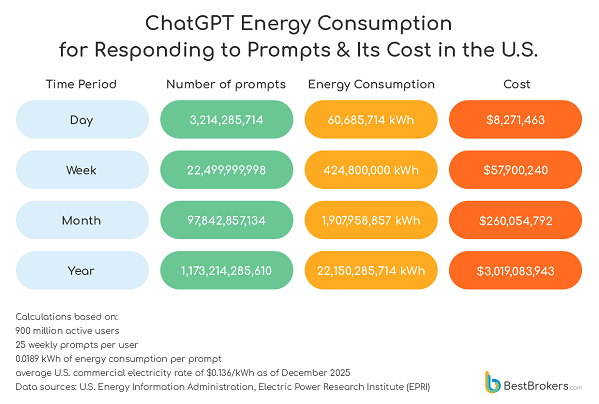
With this in mind, the team at BestBrokers decided to put into perspective the considerable amount of electric power OpenAI’s chatbot uses to respond to prompts on a yearly basis. We also looked at what that would cost at the average U.S. commercial electricity rate of $0.136 per kWh as of December 2025 (the latest rates published by the U.S. Energy Information Administration). After running the numbers, it turned out that for answering questions alone, ChatGPT consumes a whopping 22.15 billion kilowatt-hours on average every year, which amounts to an annual expenditure of $3.019 billion.
Key Takeaways:
- ChatGPT’s weekly active users (WAU) have reached 900 million, with paying subscribers now around 50 million.
- Based on 25 prompts per user per week, this suggests that ChatGPT now handles over 3.2 billion user queries a day, or just over a trillion a year.
- To process this many prompts, ChatGPT consumes 60.7GWh every day or more than 22TWh a year
I’ll ChatGPT it
When you submit a query to a trained AI model like ChatGPT, the process is known as inference. This involves passing your query through the model’s parameters, which allows the model to spot a pattern and generate a response from the available data. Estimating the energy required for that process is a bit tricky, however, as it depends on many variables, such as query length, number of users, and how efficiently the model runs. In most cases, this information is kept private. Still, we can make some rough calculations to get a sense of the amount of electricity that will be needed.
While the consumption of electricity ranges dramatically between specific models, the current iteration, GPT-5, is significantly more powerful, efficient, and power-hungry than previous models. According to researchers at the University of Rhode Island’s AI lab, ChatGPT-5, which launched on August 7, 2025, consumes anywhere between 2 and 45 watts per medium-length prompt, averaging around 18.9 Wh. The research suggests that the new model could be much more electricity-demanding than its predecessor, up to 8 times more, in fact. This also applies to the model’s latest iterations, namely GPT-5.4 and GPT-5.4 Pro (the most token-efficient reasoning models so far, according to OpenAI), which were released on March 5, 2026.
This is over fifty times more than the energy needed for a typical Google search, which consumes about 0.3 watt-hours per query, according to The Electric Power Research Institute (EPRI). People are increasingly using AI chatbots such as ChatGPT to seek information online, with recent findings from a National Bureau of Economic Research (NBER) working paper suggesting this is the most common use for ChatGPT right now. Data shows 19.3% of user conversations with the app can be categorised as ‘getting information’; close to half of all messages (45.2%) fall under the description of ‘use and manipulation’ of information.
On December 4, 2024, OpenAI posted on X that ChatGPT boasted 300 million weekly active users (WAU), double the number reported by CEO Sam Altman in September 2023. By September 2025, this number had risen to around 700 million, while by the end of the year, media reports cited a figure of 810 million, with projections for 2026 estimating that the weekly active users, both paid subscribers and paid users, would reach 1 billion.
On February 27, OpenAI announced that it had raised $110 billion in private funding in what turned out to be one of the largest private funding rounds in history. As part of the announcement, the company also put its WAU at 900 million, an extraordinary number that gave some researchers a basis for speculating about the monthly users (MAU) of the chatbot – they are now thought to be in the 1.2 – 1.5 million range, depending on the source.
While this is certainly a success for the company, these 900 million users are generating a minimum of 2.5 billion queries per day (a previously shared figure by OpenAI), with the current figure likely to be closer to 3.2 billion. This is our rough estimation, based on 25 prompts per user per week. To process these queries and generate answers, the chatbot uses roughly 60.7 Gigawatt-hours of energy every day. For context, the average U.S. household uses about 29 kilowatt-hours of electricity per day. This means the power consumed by ChatGPT on an annual basis could easily satisfy the electricity demands of 2.11 million households. Every day, ChatGPT consumes as much power as a country such as Puerto Rico or Croatia.
Over the course of a year, ChatGPT’s total energy consumption works out to 22,150 GWh, an amount enough to respond to about 1.17 trillion prompts. This massive use of electricity is equivalent to the power consumption of an entire nation; according to Ember Energy, in 2024, Puerto Rico consumed roughly 18,720 gigawatt-hours, while the electricity demand of Slovenia last year totalled 14,310 gigawatt-hours, less than what ChatGPT uses to process questions and generate answers.
At the average U.S. commercial electricity rate of 13.63 cents per kWh as of December 2025, this translates to an annual electricity cost of about $3.019 billion, with each query costing approximately $0.0033 to process. Additionally, as OpenAI continues to enhance its chatbots with new features like audio, video, and image generation, these figures could climb even higher.
OpenAI has also developed a series of reasoning AI models, including the current default reasoning model, ChatGPT-5. It is said to be able to handle complex tasks such as writing and reasoning on PhD-level scientific problems, coding, long-form reasoning, and multimodal inputs – all that with much stronger reliability and accuracy compared to previous versions. Such large-language models are designed to spend more time ‘thinking’ before responding, similar to how humans approach complex problems. This enhanced reasoning ability allows them to tackle more difficult tasks, but leads to higher costs and greater energy consumption.
Putting ChatGPT’s massive energy usage for handling user prompts into perspective
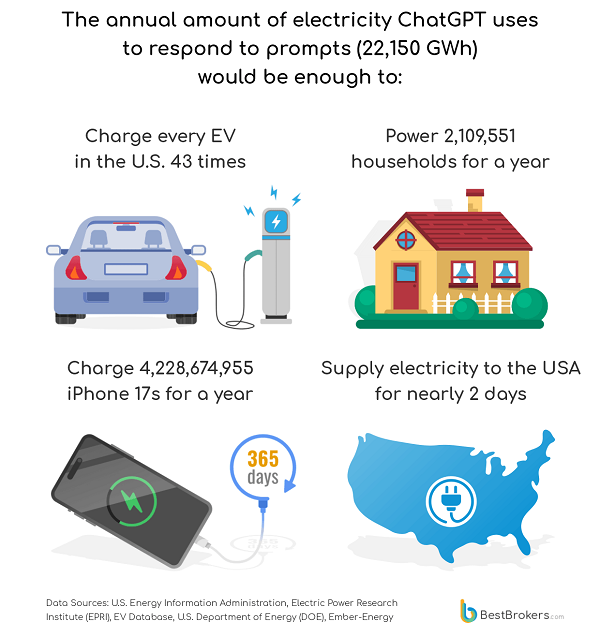
By the end of the third quarter of 2025, the number of electric vehicles on U.S. roads had grown to over 7 million, according to the Alliance of Automotive Innovation. According to the EV database, the average electric car consumes 0.19 kilowatt-hours per kilometre and can travel about 388 kilometres on a full charge, which means it has a battery that can store roughly 72.9 kilowatt-hours of energy. Therefore, we can calculate that charging all the electric vehicles in the U.S. once would require 512.6 million kilowatt-hours. If we take the total energy ChatGPT uses in a year to generate responses and divide it by that number, it turns out we could fully charge every electric vehicle in the U.S. about 36 times.
Now, let’s look at this from a household perspective. According to the Energy Information Administration (EIA), the average home in the United States consumes about 10,500 kilowatt-hours of electricity per year. That means the energy ChatGPT uses each year to handle requests could power more than 2.11 million U.S. homes for an entire year. While that’s only about 1.6% of the over 132 million households in the country, as per the latest Census data, it’s still a massive amount of energy, especially when you consider that the U.S. ranks third globally in terms of number of households.
Think about smartphones next. iPhone 17, for example, has a battery capacity of 14.351 watt-hours, which amounts to about 5.24 kilowatt-hours needed to charge it every day for a whole year. If we compare this to ChatGPT’s yearly energy-use figure, we’d find that the electricity needed by the chatbot could fully charge 4.23 billion iPhones every single day, for an entire year. That’s an incredible number of phones kept powered up, simply from the energy ChatGPT uses to generate responses.
Furthermore, according to the Carbon Trust, which is a UK-based non-profit dedicated to helping businesses cut carbon emissions, one hour of video streaming in Europe consumes about 188 watt-hours of energy. In contrast, ChatGPT spitting out information for just one hour uses approximately 2.5 billion watt-hours. That means that to match the energy consumption of ChatGPT’s hourly operation, you’d need to stream video for a whopping 13.5 million hours, which is more than 1,535 years.
And here’s where it gets even more interesting. Using the latest electricity demand data from energy think tank Ember Energy, we identified dozens of nations, including Slovenia, Kenya, Costa Rica, Estonia, and Luxembourg, which separately consume less energy annually than the amount ChatGPT uses solely to process user queries. In fact, based on our calculations, ChatGPT’s yearly energy usage to handle prompts could power Brazil, which consumed 760.83 terra-watt-hours in 2024, for over 10 days. It is also enough to satisfy the electricity demands of South Korea or Canada for almost 13 days, or even those of the United States for 44 hours. For China, the world’s largest electricity consumer, it would mean that the power drained by ChatGPT for prompts alone could keep the lights on for 19 hours staight.
The Training Costs of ChatGPT
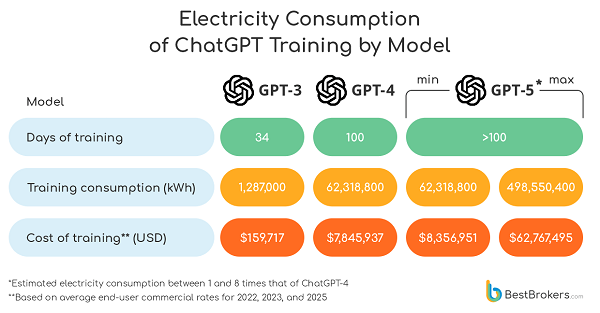
Training large-language models (LLMs) is a highly energy-intensive process as well. During this phase, the AI model ‘learns’ by analysing large amounts of data and examples. This can take anywhere from a few minutes to several months, depending on data volume and model complexity. Throughout the training, the CPUs and GPUs, the electronic chips designed to process large datasets, run nonstop, consuming significant amounts of energy.
For instance, training OpenAI’s GPT-3, with its 175 billion parameters, took about 34 days and used roughly 1,287,000 kilowatt-hours of electricity. But as models evolve and become more complex, their energy demand increases as well. Training the GPT-4 model, with over 1 trillion parameters, consumed around 62,318,800 kilowatt-hours of electricity over 100 days, 48 times more than GPT-3.
The current model, GPT‑5, which was officially released on August 7, 2025, is said to be much more powerful than previous iterations, with training data unavailable. In fact, OpenAI has not shared training times because they can reveal key information about the GPU cluster scale, hardware efficiency, compute budget, model architecture, and cost structure. Typically, to estimate power and water consumption, as well as the carbon footprint of a certain AI model, researchers use information about the number and type of GPUs used for training, training compute (FLOPs), training dataset size (tokens), and scaling patterns. However, for models such as GPT-4 and GPT-5, this information is not public.
It is nearly impossible to calculate the electricity consumption for training the latest model. What most experts believe is that this was not a one-time event, but took many months to complete over multiple retraining phases. Moreover, this complex process used enormous distributed GPU clusters.
In fact, it is the new training method that truly sets OpenAI’s GPT-5 and o1 models apart from their predecessors. The o1 model marked a turning point in the shift from general-purpose language generation to specialised reasoning systems. Released in late 2024, o1 was engineered to ‘think before answering,’ using additional compute during inference to generate structured internal reasoning steps. This approach delivered major gains in complex problem-solving, particularly in mathematics, coding, and logic, while accepting slower output and higher compute costs. Trained with a mix of large-scale pre-training and intensive reinforcement-learning optimisation, o1 became OpenAI’s first model explicitly built for accuracy and stepwise reasoning rather than speed or conversational fluency.
GPT-5 builds directly on this foundation, extending o1’s reasoning architecture into a broader, more capable system. While GPT-5 serves as a fast, general-use model, it can route difficult tasks through a deeper ‘thinking’ engine descended from o1’s methodology, blending responsiveness with high-precision reasoning when needed. GPT-5 integrates these abilities more seamlessly and at a far greater scale. Of course, this ‘chain of thought’ may be similar to how humans tackle problems step-by-step, but it also comes at a much higher cost – up to 8 times what GPT-4 consumed in terms of power (the maximum electricity consumption we used for our calculations, although it may be much higher).
AI Wars: Recent Rise in Competition Not Enough to Cause ChatGPT’s Downfall
The generative AI boom that began in 2022 has quickly turned into one of the most competitive technology races in decades. What began with the meteoric rise of ChatGPT is now a crowded field of AI assistants, search tools, and productivity platforms – all vying to become the default interface between humans and the internet. Yet despite a surge of rivals, the early leader remains firmly in front.
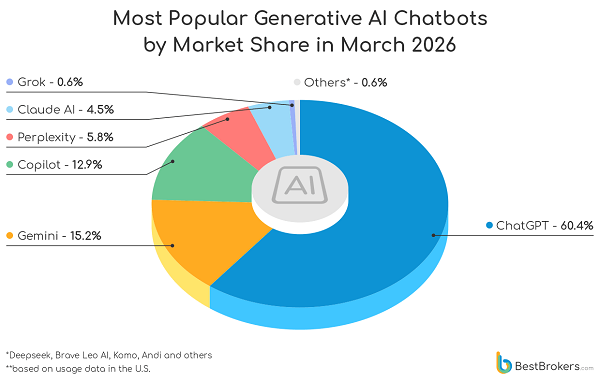
By early 2026, ChatGPT still commands the largest global user base among conversational AI platforms, with a 60.4% market share of all AI searches. But the gap between it and the competition is narrowing as rivals race to embed AI into existing ecosystems. With a market share of 15.2%, its most formidable competitor seem to be Google Gemini, which has rapidly gained traction through its integration with Gmail, Google Docs, and Android devices.
Another fast-rising star is Perplexity AI (5.8% market share), which has positioned itself as an AI-powered alternative to traditional search engines. On the enterprise side, Microsoft Copilot, which is powered by ChatGPT, is gaining adoption through deep integration with Office software and Windows systems, giving it a natural advantage in corporate workflows. Even social media has entered the race. Grok, developed by xAI, has expanded quickly by embedding its assistant directly into X, the platform formerly known as Twitter.
Meanwhile, Claude, developed by Anthropic, has carved out a strong reputation among developers and enterprise users thanks to its emphasis on safety and long-context reasoning. Its high-profile stand off with the Pentagon over the company’s refusal to allow Claude to be used for autonomous weapons systems and domestic mass surveillance ironically made Anthropic’s tool much more visible. After OpenAI signed the same deal just hours later, hundreds of users announced they would be cancelling their ChatGPT subscriptions and using Claude instead.
But where is the traditional Google seach in all this? AI assistants increasingly answer questions directly, summarize complex topics, and conduct research tasks that once required multiple Google queries. But this does not mean traditional search has disappeared: Google’s search engine still handles billions of queries every day – anywhere between 8 and 16.5 billion, according to the latest statistics. This means Google still rules the world of searches, although a new pattern has emerged over the past few months: users turn to AI for explanations and analysis, while still very much relying on conventional search for finding specific websites or services. Case in point – “ChatGPT” consistently ranks among the most searched terms globally on Google.
Estimating OpenAI’s Profits from Paid Subscriptions
While the 3.2 billion daily user queries may cost OpenAI over $3 billion per year, this is nothing compared to the company’s revenues from paid subscriptions. In September 2024, OpenAI COO Brad Lightcap said that ChatGPT had exceeded 11 million paying subscribers. In November, The Information revealed that ChatGPT had roughly 35 million paying subscribers over the summer. Citing internal sources, it wrote that the company planned to increase this figure to 220 million by 2030.
Just for reference, Spotify reported having 281 million premium subscribers globally as of the third quarter of 2025; Netflix had around 300 paid members at the end of 2024. This suggests OpenAI’s ambitions stretch way beyond its already dominant position on the market – it clearly aims to transform ChatGPT from a powerful niche tool into a mass-market subscription service on par with the world’s biggest consumer platforms.
According to the latest announcement from the company, it now has around 50 million paying subscribers. OpenAI has not disclosed the number of Pro, Plus or Go subscriptions. Each offers different perks, with different limitations and pricing. So, how much is OpenAI profiting from paid subscriptions?
The reported 50 million paid subscribers include users across these subscription tiers: the consumer-focused ‘Plus’ plan (typically $20/month) and its more affordable and limited variation ‘Go’ ($8/month), as well as the ultimate option ‘Pro’ ($200/month). There are also two types of business-focused subscription plans – ‘Business’ (25/month) and ‘Enterprise’ (up to $60/month),.
Based on past statistics, we can make some rough estimates of how many users pay for what exactly. Here is a breakdown of what OpenAI might be making from paid subscriptions as of March 2026:
- 8 million Go users paying $8/month
- 32 million Plus users paying $20/month
- 2.5 million Pro users paying $200/month
- 4.5 million Business users paying $25/month
- 3 million Enterprise users paying up to $60/month
This means that the company could make around $1.3 billion from paid subscriptions every month or around $15.798 billion per year. To put things in perspective, this is more than 5 times the estimated annual electricity costs from processing user queries. The annual energy costs ($3.019 billion) could easily be covered with less than three months’ worth of revenue. These are, of course, rough estimations based on publicly available information; not much has been confirmed by the company, however.
Bear in mind that the estimations for the number of paying subscribers are quite conservative, including for the Pro users. The electricity costs, on the other hand, are likely much lower if the company uses its own renewable energy sources, such as photovoltaics and uses electricity from the grid at preferential rates (which it almost certainly does).
Methodology
To estimate the number of queries ChatGPT handles each week and the cost of these operations, the team at BestBrokers based the calculations off of recent reports, including by Sam Altman, who said that ChatGPT had already reached 800 million weekly active users (WAU), while the AI model was processing roughly 2.5 billion prompts per day. By December, media reports, including TechCrunch, referred to a slightly higher number – around 810 WAUs. In February, OpenAI announced there were now 900 million WAUs, while paying subscriptions rose to around 50 million.
With these figures in hand, we calculated the daily electricity consumption of ChatGPT by multiplying the total number of queries by the estimated energy usage per prompt, which is 18.9 Wh, according to the University of Rhode Island’s AI lab. From there, we extrapolated the energy consumption on a monthly and yearly basis. To determine the associated costs of this electricity usage, we applied the average U.S. commercial electricity rate of $0.136 per kWh as of December 2025.
For more information, visit www.bestbrokers.com.