

Market Summary:
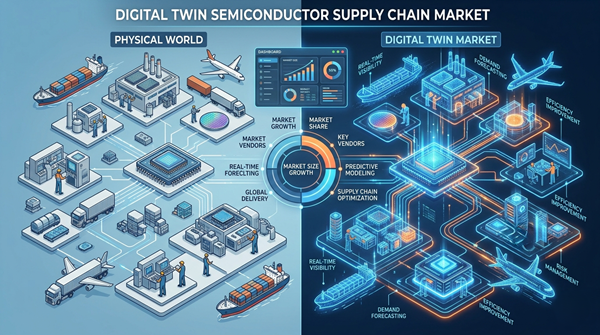
According to Research Intelo, the Global Digital Twin Semiconductor Supply Chain market size was valued at $1.3 billion in 2024 and is projected to reach $7.9 billion by 2033, expanding at a robust CAGR of 22.4% during the forecast period from 2024 to 2033. The major factor propelling this market’s growth is the increasing need for end-to-end supply chain visibility and optimization in the semiconductor industry. As semiconductor manufacturers face mounting pressure for faster time-to-market, enhanced quality control, and resilient supply chain operations, digital twin technology has emerged as a pivotal enabler. By providing real-time simulation, predictive analytics, and process automation, digital twins allow stakeholders to proactively manage risks, reduce costs, and optimize performance across the entire semiconductor value chain.
What is a Digital Twin in the Semiconductor Supply Chain?
A digital twin is a virtual representation of a physical system that mirrors real-world operations using data, simulations, and analytics. In the semiconductor supply chain, this includes modeling factories, logistics networks, inventory systems, and supplier ecosystems.
These digital replicas allow companies to simulate scenarios, identify bottlenecks, and optimize processes without disrupting actual operations. For instance, manufacturers can predict how a delay in raw material supply will impact chip production and adjust strategies accordingly.
Market Drivers Fueling Growth
Increasing Complexity of Semiconductor Supply Chains
The semiconductor supply chain involves multiple stages, including design, fabrication, assembly, testing, and distribution. With global dependencies and multiple stakeholders, managing this ecosystem has become increasingly challenging.
Digital twins provide a unified view of these complex processes, enabling better coordination and transparency across the entire supply chain.
Rising Demand for Real-Time Visibility
In a highly competitive market, real-time data is crucial. Companies need instant insights into production status, inventory levels, and logistics performance.
Digital twin technology integrates data from sensors, IoT devices, and enterprise systems to offer real-time visibility, helping organizations respond quickly to changes and disruptions.
Focus on Risk Mitigation and Resilience
Events such as global pandemics, geopolitical tensions, and natural disasters have exposed vulnerabilities in semiconductor supply chains. Businesses are now prioritizing resilience.
Digital twins allow companies to simulate risk scenarios and develop contingency plans, ensuring business continuity even during unforeseen disruptions.
Key Market Trends
Integration with AI and Machine Learning
The combination of digital twins with AI and machine learning is enhancing predictive capabilities. These technologies enable advanced analytics, helping companies forecast demand, optimize production schedules, and reduce downtime.
Adoption of Cloud-Based Solutions
Cloud computing is playing a vital role in the adoption of digital twins. Cloud-based platforms provide scalability, flexibility, and cost-efficiency, making it easier for companies to deploy and manage digital twin solutions.
Emphasis on Sustainability
Sustainability is becoming a critical focus area in the semiconductor industry. Digital twins help organizations monitor energy consumption, reduce waste, and optimize resource utilization, contributing to greener operations.
Challenges in the Market
High Implementation Costs
Deploying digital twin solutions requires significant investment in technology, infrastructure, and skilled personnel. This can be a barrier for small and medium-sized enterprises.
Data Integration Issues
Integrating data from multiple sources and ensuring its accuracy can be challenging. Inconsistent or incomplete data may affect the performance of digital twin models.
Cybersecurity Concerns
As digital twins rely on interconnected systems and data sharing, they are vulnerable to cyber threats. Ensuring robust security measures is essential for successful implementation.
Future Outlook
According to Research Intelo, The future of the Digital Twin Semiconductor Supply Chain Market looks promising, with continuous advancements in technology and increasing adoption across the industry. As the demand for semiconductors continues to rise, companies will increasingly rely on digital twins to enhance efficiency, reduce costs, and improve resilience.
Emerging technologies such as 5G, IoT, and edge computing will further drive the adoption of digital twins, enabling more sophisticated and real-time applications.
Competitive Landscape
- Siemens AG
- General Electric Company
- IBM Corporation
- Microsoft Corporation
- Dassault Systèmes SE
- PTC Inc.
- SAP SE
- ANSYS Inc.
- AVEVA Group plc
- Schneider Electric SE
- Oracle Corporation
- Rockwell Automation, Inc.
- Honeywell International Inc.
- Bentley Systems, Incorporated
- TIBCO Software Inc.
- Bosch Global Software Technologies
- Autodesk, Inc.
- Tata Consultancy Services Limited (TCS)
- Accenture plc
- Hitachi, Ltd.
Source:https://researchintelo.com/report/digital-twin-semiconductor-supply-chain-market