

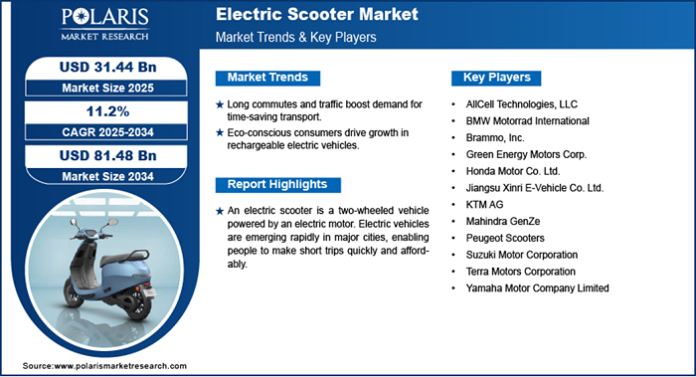
The global mobility landscape is undergoing a seismic shift and electric scooters are at the epicentre of it. Amid soaring fuel prices, worsening urban congestion, and an accelerating climate crisis, two-wheeled electric vehicles have moved from novelty to necessity. According to the latest findings in the Electric Scooter Market report by Polaris Market Research, the sector was valued at USD 28.36 billion in 2024 and is projected to reach an extraordinary USD 81.48 billion by 2034, registering a robust CAGR of 11.2% over the forecast period.
Battery Technology Has Crossed a Tipping Point. The dramatic fall in lithium-ion battery costs once considered the biggest barrier to EV adoption has made electric scooters genuinely cost-competitive with petrol-powered alternatives. Lighter, longer-lasting batteries now enable manufacturers to deliver vehicles with significantly extended ranges and faster charging cycles at price points accessible to mainstream consumers.
Government Incentives Are Accelerating Adoption. From direct purchase subsidies in India and China to tax rebates and emission-zone exemptions across Europe and North America, policymakers worldwide are actively incentivizing the switch to zero-emission personal mobility. These structural supports are creating a virtuous cycle: higher adoption drives manufacturing scale, which in turn drives prices lower.
Rising Fuel Costs Are Making the Choice Obvious. For millions of urban commuters, the calculus has never been clearer. With petroleum prices remaining stubbornly high and the operational cost of an electric scooter a fraction of its petrol counterpart, consumers are voting with their wallets. Add to that the reduced maintenance burden fewer moving parts, no oil changes, regenerative braking systems that feed energy back into the battery and the financial case is compelling.
Eco-Consciousness Is a Genuine Market Driver. The shift away from greenhouse gas-emitting public and private transport is accelerating. Consumers are no longer just considering cost; they are actively weighing environmental impact. Electric scooters generate zero direct emissions and, when paired with renewable energy charging, approach a near-zero lifecycle carbon footprint.
Segmental Breakdown: Where Is the Money?
Understanding where growth is concentrated within the market is critical for investors, manufacturers, and supply chain strategists.
- By Battery Type: The sealed lead-acid battery segment currently commands the largest revenue share, thanks to its rugged durability and ability to sustain up to 300 full charge cycles. However, lithium-ion batteries are gaining ground rapidly, driven by their superior energy density, lower self-discharge rates, and longer operational lifespans despite carrying a higher upfront cost that is progressively declining.
- By Product Type: The retro scooter category leads the market today, blending nostalgic aesthetics with modern EV technology to appeal to consumers seeking both style and practicality. Meanwhile, the folding scooter segment is projected to record the fastest CAGR over the forecast period a direct reflection of the integration of IoT connectivity, big data analytics, and the surging demand for ultra-portable, last-mile mobility solutions in congested urban cores.
- By Voltage: The 48V segment and above is gaining significant traction as performance expectations rise and consumers demand scooters capable of higher speeds, longer range, and more demanding terrain handling.
Regional Dynamics: Asia Pacific Dominates, North America Surges
Asia Pacific held the largest share of the global electric scooter market in 2024 and by a significant margin. The region’s dominance is grounded in manufacturing supremacy, with China, Japan, and Taiwan home to the world’s most prolific rechargeable vehicle producers. Dense urban populations in India and China create naturally high demand for efficient short-distance mobility, while supportive government policies on EV charging infrastructure further entrench the region’s leadership.
North America is the region to watch for future growth momentum. Significant investments in EV charging infrastructure, aggressive emissions regulations, rising consumer environmental awareness, and heavy R&D investment from major automotive and tech players are collectively creating one of the world’s most dynamic and rapidly evolving electric scooter markets.
Europe, meanwhile, continues to expand its scooter-sharing ecosystems across major cities including Paris, Madrid, and Berlin embedding electric micro-mobility into the fabric of urban transit networks.
The AI and Technology Edge Reshaping the Industry
Perhaps the most underreported story in the electric scooter sector is the growing role of artificial intelligence in operational optimization. AI-powered analytics are now enabling fleet operators to minimize downtime through predictive maintenance, maximize vehicle availability by analyzing real-time ridership patterns, and implement dynamic pricing strategies that optimize revenue while keeping rides affordable.
On the safety frontier, AI-based collision detection systems and irresponsible riding pattern identification are reducing accident rates and building consumer trust a critical factor in accelerating mainstream adoption.
The integration of IoT connectivity, particularly in next-generation folding scooters, is transforming these vehicles from simple transportation devices into smart mobility nodes within broader urban mobility-as-a-service (MaaS) ecosystems.
Competitive Landscape: Industry Leaders and Recent Developments
The market features a competitive mix of established automotive giants and agile challengers. Key players shaping the global landscape include Honda Motor Co. Ltd., Yamaha Motor Company Limited, BMW Motorrad International, Suzuki Motor Corporation, KTM AG Peugeot Scooters, Mahindra GenZe, Terra Motors Corporation, and Jiangsu Xinri E-Vehicle Co. Ltd.
Recent industry movements signal the pace of innovation and collaboration:
- August 2025: Swiggy partnered with Bounce to accelerate EV adoption among its delivery workforce, making electric mobility more accessible for gig-economy riders while reducing operational carbon footprints.
- February 2025: Kinetic Green launched a major marketing campaign for its E-Luna model, targeting renewed consumer interest in sustainable urban mobility.
- January 2024: Hero MotoCorp announced plans to launch three new electric scooter models across mid-range, affordable, and B2B segments a clear signal of how incumbents are aggressively expanding their EV portfolios.
Strategic Takeaway: This Market Rewards Early Movers
The global electric scooter industry is no longer an emerging niche it is a high-velocity, multi-billion-dollar sector reshaping how cities move. For investors, it represents a compelling growth narrative backed by structural tailwinds including decarbonization policy, battery cost deflation, urbanization, and digital mobility integration. For manufacturers and technology providers, the window for capturing dominant market positions remains open but not indefinitely.
The question is not whether the electric scooter market will grow. The data is unambiguous on that front. The question is who will build the platforms, the batteries, the AI systems, and the service ecosystems that define the next decade of urban mobility.