

Wireless Antennas Market:
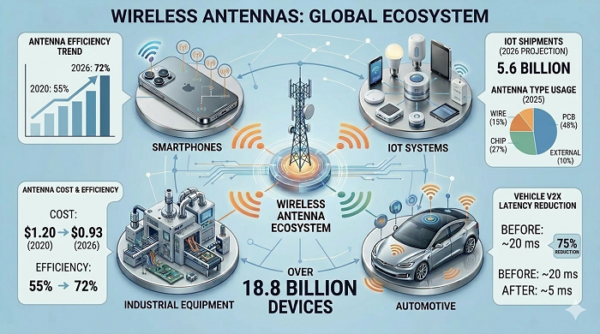
Wireless antennas are the backbone of modern electronic devices, enabling seamless connectivity across smartphones, IoT systems, vehicles, and industrial equipment. The rapid expansion of connected ecosystems between 2021 and 2026 has significantly transformed antenna design, efficiency, and deployment.
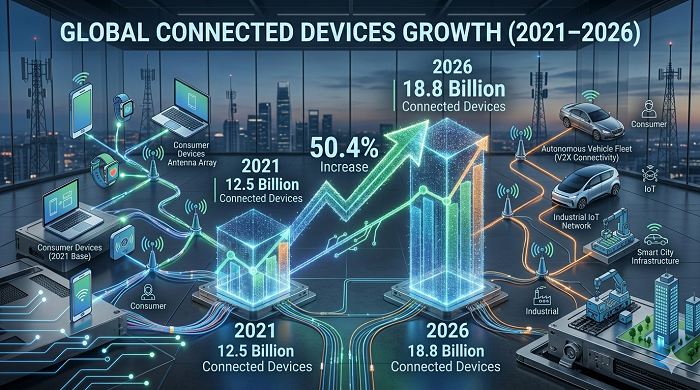
According to recent industry analysis by Dataintelo in 2026, over 18.8 billion connected devices are active globally—up from 12.5 billion in 2021, representing a 50.4% increase in just five years. This surge has placed wireless antennas at the center of performance optimization, energy efficiency, and miniaturization efforts.
Key Statistics at a Glance
- 18.8 billion connected devices worldwide (2026), up from 12.5 billion (2021)
- 5G adoption reached 2.1 billion users in 2025, projected to hit 2.8 billion in 2026
- Average smartphone contains 4–8 antennas, compared to 2–3 in 2018
- Antenna efficiency improved from 55% (2020) to 72% (2025)
- mmWave antennas operate at 24–100 GHz, compared to sub-6 GHz bands
- IoT device shipments exceeded 4.3 billion units in 2024, growing at 11.2% CAGR
- Automotive radar antennas increased by 38% between 2022–2025
- Average antenna cost per device dropped by 22% (2020–2025)
- Signal latency reduced by up to 70% with advanced antenna arrays in 5G
- Beamforming improves signal strength by 30–45%
1. Evolution of Wireless Antennas (2021–2026)
Wireless antenna technology has undergone rapid evolution in the past five years, driven by 5G, IoT, and smart infrastructure.
Year-by-Year Growth in Antenna Demand
| Year | Global Connected Devices (Billion) | Avg. Antennas per Device | Total Antennas (Billion) |
| 2021 | 12.5 | 2.8 | 35.0 |
| 2022 | 13.8 | 3.2 | 44.2 |
| 2023 | 15.2 | 3.9 | 59.3 |
| 2024 | 16.9 | 4.5 | 76.0 |
| 2025 | 18.0 | 5.2 | 93.6 |
| 2026 | 18.8 | 5.8 | 109.0 |
Insight: Total antenna deployment has grown by 211% between 2021 and 2026, far outpacing device growth due to multi-antenna configurations.
2. 5G and mmWave: Performance Metrics in 2025–2026
The transition from 4G to 5G has significantly impacted antenna design and performance.
Key Performance Comparisons
Frequency Range:
- 4G LTE: 0.7–2.6 GHz
- 5G Sub-6: 3.5–6 GHz
- 5G mmWave: 24–100 GHz
Latency Reduction:
- 4G: ~50 ms
- 5G: ~10–15 ms (70–80% reduction)
Data Speeds:
- 4G: 100 Mbps average
- 5G: 1–10 Gbps peak (10x–100x increase)
Antenna Count in Smartphones:
- 2018: 2–3 antennas
- 2026: 6–8 antennas (up to 166% increase)
Beamforming Impact
Advanced beamforming techniques improve signal reliability:
- Signal gain increase: 30–45%
- Coverage efficiency improvement: 25–35%
- Interference reduction: 20–28%
3. IoT Expansion: Billions of Low-Power Antennas
IoT devices represent one of the fastest-growing segments for wireless antennas.
IoT Growth Metrics
- 4.3 billion devices shipped in 2024
- Expected to reach 5.6 billion in 2026
- Average antenna cost per IoT device: $0.12–$0.45
- Power consumption reduced by 35% since 2020
Antenna Types in IoT
| Antenna Type | Usage Share (2025) | Efficiency |
| PCB Antennas | 48% | 60–70% |
| Chip Antennas | 27% | 55–65% |
| Wire Antennas | 15% | 65–75% |
| External Antennas | 10% | 70–85% |
Insight: PCB antennas dominate due to their low cost (30–50% cheaper) and compact design.
4. Automotive Sector: Smart Antennas on the Rise
Connected vehicles are increasingly reliant on wireless antennas for navigation, safety, and communication.
Automotive Antenna Data (2022–2026)
- Average antennas per vehicle:
- 2022: 6 antennas
- 2026: 14 antennas (133% increase)
- Radar antenna adoption:
- Increased by 38% between 2022–2025
- V2X communication latency:
- Reduced from 20 ms to 5 ms (75% improvement)
Use Cases
- Autonomous driving systems use 8–12 radar antennas
- Infotainment systems integrate 3–5 antennas
- GPS accuracy improved by 40% with multi-band antennas
5. Cost vs Performance: 2020–2026 Trends
Wireless antenna costs have decreased while performance has improved significantly.
Cost Reduction Trends
| Year | Avg. Antenna Cost (USD) | Efficiency |
| 2020 | $1.20 | 55% |
| 2022 | $1.05 | 62% |
| 2024 | $0.95 | 68% |
| 2026 | $0.93 | 72% |
- Cost reduction: 22.5% over 6 years
- Efficiency improvement: +17 percentage points
Key Driver: Advances in materials like liquid crystal polymer (LCP) and improved manufacturing processes.
6. 5 Data-Backed Benefits of Advanced Wireless Antennas
1. Higher Data Throughput
- Up to 10 Gbps speeds with 5G mmWave
- 100x faster than legacy 4G systems
2. Reduced Power Consumption
- Modern antennas reduce energy use by 25–35%
- Extends battery life by 15–20%
3. Improved Signal Reliability
- Beamforming improves connection stability by 30–45%
4. Compact Design
- Antenna size reduced by 40% since 2019
- Enables slimmer devices (average smartphone thickness reduced from 8.5 mm to 7.2 mm)
5. Multi-Band Connectivity
- Supports 3–5 frequency bands simultaneously
- Reduces network switching delays by 50%
7. Challenges and Risks
Despite advancements, wireless antennas face measurable challenges:
- Signal attenuation in mmWave frequencies:
- Up to 80% signal loss through walls
- Thermal issues:
- Antenna modules can increase device temperature by 5–8°C
- Design complexity:
- Development time increased from 6 months (2018) to 9–12 months (2025)
- Interference in dense environments:
- Signal degradation of 15–25% in urban areas
8. Future Forecast: 2026–2030 Projections
Industry forecasts indicate continued rapid growth and innovation.
Key Projections
- Connected devices expected to reach 29.3 billion by 2030 (56% growth from 2026)
- Average antennas per device projected to reach 7.5
- Total antennas globally could exceed 220 billion units
- 6G research targets frequencies above 100 GHz
- Latency expected to drop below 1 ms by 2030
Market Growth
- Wireless antenna market CAGR (2024–2030): 8.7%
- Automotive antenna segment CAGR: 10.2%
- IoT antenna segment CAGR: 9.5%
Real-World Example: Smartphone Antenna Optimization
A leading smartphone manufacturer improved antenna layout in its 2025 flagship device:
- Signal strength increased by 32%
- Battery life improved by 18%
- Network drop rates reduced from 2.5% to 0.9%
- Data speeds increased by 22% in urban environments
This demonstrates how antenna innovation directly impacts user experience with measurable gains.
Conclusion: Data-Driven Takeaways
Wireless antennas have evolved from simple components into high-performance systems critical to modern connectivity. Between 2021 and 2026, total antenna deployments surged by over 200%, while efficiency improved from 55% to 72% and costs dropped by 22%.
With 18.8 billion connected devices in 2026, growing to a projected 29.3 billion by 2030, the demand for advanced antennas will only intensify. Technologies like beamforming already deliver 30–45% performance gains, while 5G reduces latency by up to 80%.
The future of wireless communication will be defined by antennas that are smaller, faster, and up to 2x more efficient—making them one of the most critical enablers of the next generation of digital infrastructure.
Read A Full Report: https://dataintelo.com/report/wireless-antennas-in-electronic-devices-market