


Hollow core fibers (HCF) are the next generation of optical fiber technology; they are a specialized type of optical fiber designed to guide light through an air-filled central core, unlike conventional single-mode fiber (SMF) that uses a solid glass core. HCF uses photonic bandgap or anti-resonant structures to confine light within the hollow core. This unique design significantly reduces latency and signal distortion, making it a promising solution for high-performance communication systems. Currently there are two main types of hollow core fiber, double nested anti-resonant nodeless fiber (DNANF) and photonic bandgap guiding fiber (PBG), each with their own internal hollow core fiber structure and manufacturing process.
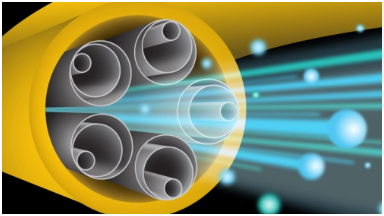
As hyperscale operators and data center owners push the boundaries of network performance, hollow core fiber (HCF) is emerging as the ultimate enabler, delivering ultra-low latency and low loss links for high-speed and data center interconnects.
Hollow core fiber offers several significant advantages, including:
- Lower latency: HCF transmits light at nearly the speed of light in vacuum, resulting in latency of approximately 3.33 µs/km, compared to 4.9 µs/km for SMF.
- Reduced chromatic dispersion (CD): HCF typically exhibits CD values <5 ps/nm/km, while SMF shows ~17 ps/nm/km.
- Equivalent polarization mode dispersion (PMD): HCF can achieve PMD values below 0. 1 ps/√km, compared to 0.1 ps/√km for SMF.
- Reduced nonlinear effects: Due to minimal light-material interaction, HCF exhibits negligible nonlinearities.
- Lower attenuation at specific wavelengths: Recent advancements have achieved attenuation as low as 0.07 dB/km, outperforming typical SMF values of ~0.2 dB/km.
- High damage threshold: The air core allows HCF to handle higher optical powers without thermal damage.
Hollow core fiber is gaining traction in industries where speed, security, and low latency are critical:
- AI & High-performance computing: Facilitates high-bandwidth, low-latency links for synchronization, AI model training and distributed computing.
- Data centers: Enables faster, low latency interconnects and longer reach without amplification.
- Quantum communication: Supports low-noise transmission for quantum key distribution.
- Defense & secure communications: Air-guided structure makes HCF resistant to physical tapping.
- Financial trading: Reduces latency for high-frequency trading environments.
- Smart cities, edge computing and 5G/6G infrastructure: Enables responsive networks required for autonomous systems and real-time data processing.
Testing matters more than ever:
Hollow core fiber offers transformative potential for optical networks by offering unmatched speed and performance, but its successful deployment hinges on rigorous testing and qualification. As deployment scales, robust testing methodologies will be essential to ensuring reliability, interoperability, and long-term viability.
Accurate validation of HCF links requires specialized OTDR configuration and performance, with different bidirectional analysis to ensure precise splice and fiber loss measurements, and overall link integrity. Precise link characterization is essential to guarantee performance, minimize rework, protect ROI, and meet the demanding requirements of 400G, 800G and beyond. Lacking this, operators risk performance gaps that can impact mission-critical applications.
With long-standing optical test leadership, VIAVI delivers the industry’s most comprehensive suite of hollow core fiber testing solutions. The portfolio combines precision measurement, intuitive workflows, and automation to simplify every phase of the HCF lifecycle—from activation and certification to troubleshooting and long-term monitoring. Key capabilities include:
- High performance OTDR optimized for hollow core fiber characterization.
- Advanced dispersion analysis (CD, PMD, AP) (non-OTDR based) for short, medium, and long-distance links.
- Automated fiber inspection to eliminate contamination risks and ensure connector integrity.
- Service activation testing and monitoring to validate performance under live traffic conditions.
- Cloud-enabled reporting and process automation for real-time project tracking and compliance.
The Future of Hollow Core Fiber
Challenging the performance limits of traditional fibers, hollow core fiber technology is advancing swiftly driven by advancements in telecommunications, emerging quantum technologies, specialized industrial applications, defence and aerospace. Telecom operators are demonstrating HCF readiness and hyperscalers are deploying hollow-core fiber for high-performance AI, cloud, and data center interconnects. Emerging as the most promising advancement in optical fiber technology, HCF is becoming mainstream and increasingly deployed in niche, high-value scenarios where latency is critical.