

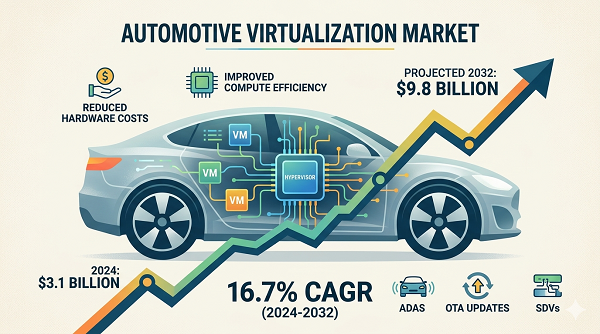
The automotive virtualization market is undergoing rapid expansion as software-defined vehicles (SDVs) reshape the global automotive ecosystem. According to insights by Marketintelo, the market was valued at approximately $3.1 billion in 2024 and is projected to reach $9.8 billion by 2032, growing at a compound annual growth rate (CAGR) of 16.7%.
In 2025 alone, adoption rates increased by 18.4% year-over-year (YoY), driven by rising demand for advanced driver assistance systems (ADAS), in-vehicle infotainment, and over- the-air (OTA) updates. Over 72% of new vehicles launched in 2025 incorporated some form of virtualization layer, compared to just 41% in 2020.
Automotive virtualization is becoming central to reducing hardware costs by 20–30% and improving compute efficiency by up to 40%, making it a key pillar in next-generation mobility.
Historical Market Trends (2016–2024)
Over the past decade, the automotive virtualization market has transitioned from niche adoption to mainstream integration.
- 2016 market size: $0.9 billion
- 2018 market size: $1.3 billion (+44% growth in 2 years)
- 2020 market size: $1.9 billion (CAGR 20.5% from 2016)
- 2022 market size: $2.6 billion (YoY growth 17.3%)
- 2024 market size: $3.1 billion (YoY growth 19.2%)
Between 2016 and 2024, the market expanded by 244%, driven by the shift from distributed ECUs to centralized architectures. Virtual machines and hypervisors replaced up to 60% of legacy hardware controllers in premium vehicles by 2024.
Year-over-Year Growth Analysis (2020–2025)
The automotive virtualization market has shown consistent acceleration post-pandemic:
- 2020–2021: +14.8% growth (supply chain recovery phase)
- 2021–2022: +17.3% growth (ADAS expansion)
- 2022–2023: +18.1% growth (EV integration surge)
- 2023–2024: +19.2% growth (software-defined vehicles adoption)
- 2024–2025 (est.): +18.4% growth (AI-based cockpit systems)
By 2025, over 58 million vehicles globally are expected to use virtualization-enabled architectures, compared to 32 million in 2021, marking an increase of 81% in just four years.
Key Numerical Highlights
- $3.1 billion market size in 2024
- $9.8 billion projected by 2032
- 16.7% CAGR (2024–2032)
- 72% vehicle integration rate in 2025
- 40% compute efficiency improvement
- 30% hardware cost reduction
- 81% increase in adoption (2021–2025)
- 58 million vehicles using virtualization in 2025
- 65% of OEMs investing in SDV platforms
- $12.4 billion global R&D spending on automotive software (2024)
Regional Market Breakdown
North America
North America accounted for 34.2% market share in 2024, valued at $1.06 billion.
- U.S. leads with 78% regional share
- $4.2 billion invested in SDV platforms in 2024
- Adoption rate reached 69% of new vehicles
The region is projected to grow at 15.8% CAGR through 2032.
Europe
Europe contributed 28.7% market share in 2024, totaling $0.89 billion.
- Germany holds 41% of Europe’s market
- EU allocated $2.1 billion toward automotive di
- gitalization programs (2023–2025)
- 64% of luxury vehicles use virtualization platforms
Expected CAGR: 16.2% (2024–2032)
Asia-Pacific
Asia-Pacific dominates growth with 31.5% market share in 2024 (~$0.98 billion).
- China accounts for 52% of APAC demand
- EV production exceeded 9.5 million units in 2024, boosting virtualization adoption
- Japan and South Korea show 21% YoY growth
Projected CAGR: 18.9%, the highest globally.
Rest of the World
- Market share: 5.6% (~$0.17 billion)
- Growth driven by Middle East smart mobility investments
- CAGR: 14.3%
Automotive Virtualization Market: Segment Analysis
By Component
- Hypervisors: 42% market share (2024)
- Virtual machine software: 33%
- Services: 25%
Hypervisors alone generated $1.3 billion revenue in 2024 and are expected to exceed $4.1 billion by 2032.
By Vehicle Type
- Passenger vehicles: 68% share
- Commercial vehicles: 32% share
Passenger vehicle adoption increased from 52% in 2019 to 68% in 2024, reflecting rising demand for connected features.
By Application
- ADAS: 36% share
- Infotainment: 29%
- Digital cockpit: 21%
- Others: 14%
ADAS-related virtualization grew by 22.5% YoY in 2024, the fastest among all applications.
Table: Automotive Virtualization Market Summary
| Year | Market Size (USD Billion) | YoY Growth (%) | Vehicles Using Virtualization (Million) |
| 2020 | 1.9 | 14.8% | 24 |
| 2021 | 2.2 | 15.8% | 28 |
| 2022 | 2.6 | 17.3% | 32 |
| 2023 | 2.9 | 18.1% | 45 |
| 2024 | 3.1 | 19.2% | 52 |
| 2025 | 3.7 | 18.4% | 58 |
| 2032 | 9.8 | 16.7% CAGR | 120+ |
Industry Investments and Company Statistics
Automotive virtualization has attracted significant investments:
- Global OEMs invested over $18.6 billion in SDV and virtualization technologies between 2022 and 2025
- Top 10 automotive companies increased software budgets by 34% YoY in 2024
- Tier-1 suppliers generate $6.2 billion annual revenue from virtualization-related components
- Cloud providers invested $3.8 billion in automotive edge computing infrastructure
Over 48% of automotive startups (2024) are focused on software-defined architectures, compared to 19% in 2018.
Technology Trends and Efficiency Gains
Automotive virtualization enables multiple systems to run on a single hardware platform, significantly improving efficiency:
- Reduces ECU count from 70–100 units to 20–30 units per vehicle
- Cuts wiring complexity by 35–45%
- Improves system boot time by 28%
- Enhances cybersecurity resilience by 50%
By 2026, over 85% of premium vehicles are expected to use centralized compute platforms enabled by virtualization.
Future Projections (2026–2032)
The automotive virtualization market is expected to grow aggressively:
- 2026 market size: $4.5 billion
- 2028 market size: $6.7 billion
- 2030 market size: $8.5 billion
- 2032 market size: $9.8 billion Vehicle integration is projected to reach:
- 75 million vehicles by 2027
- 95 million by 2029
- 120+ million by 2032
By 2030, nearly 90% of new vehicles globally will feature automotive virtualization in at least one core system.
Conclusion: Data-Backed Outlook
The automotive virtualization market is evolving into a foundational technology for next- generation mobility. With market value rising from $3.1 billion in 2024 to $9.8 billion by 2032, the sector is set to triple in size within eight years.
Consistent YoY growth above 17%, combined with rising adoption across 120+ million vehicles, highlights its scalability. Regional growth led by Asia-Pacific (18.9% CAGR) and strong OEM investments exceeding $18.6 billion further reinforce momentum.
By 2032, automotive virtualization will underpin over 90% of software-defined vehicles, reduce hardware costs by up to 30%, and improve computing efficiency by 40%, solidifying its role as a critical driver of the automotive industry’s digital transformation.
Read A Full Report: https://marketintelo.com/report/automotive-virtualization-market