

Pickering guide: Reed Relays in Mining Power and Signal Switching
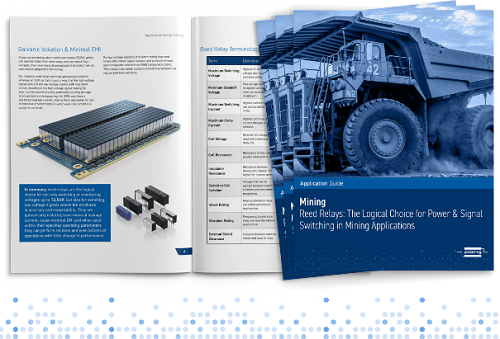
Pickering Electronics, a leading manufacturer of high-performance reed relays, has released a new application guide for engineers designing power and sensing systems for harsh mining environments. The guide, titled: ‘Reed Relays: The Logical Choice for Power & Signal Switching in Mining Applications’, explains why reed relays are well suited to high- and low-voltage switching and sensing applications where reliability, accuracy and low power consumption are critical.
As mining operations become increasingly electrified, switching, monitoring and control circuits are being asked to do more than ever before. Power must be distributed safely and efficiently across systems such as conveyor belts, pumps, ventilation equipment and electrically-powered drills, while sensing and monitoring systems must continue to deliver accurate, repeatable measurements in challenging operating conditions. At the same time, higher voltages are increasingly being used to reduce power losses and improve efficiency.
These changing requirements mean that relays used in mining applications must be capable of handling demanding electrical environments without compromising measurement accuracy or long-term system reliability.
“Mining environments place unique demands on switching technology,” said Robert King, Reed Relays Product Manager at Pickering Electronics. “Higher voltages, harsh operating conditions and the need for accurate monitoring all require relays that combine high isolation, low leakage, fast switching and long-term reliability. This application guide explains why reed relays are such a strong fit for mining equipment, from power distribution and underground load centres to condition monitoring and safety systems.”
The guide explores the wide range of mining applications where reed relays can offer performance advantages. These include high-voltage switching in power distribution units, switchgear, load centres and electrically-powered mining equipment, as well as low-level signal switching in gas and smoke detection, airflow and ventilation sensing, condition monitoring, and geotechnical and ground stability systems. In these applications, relay performance can directly affect both operational efficiency and safety.
“Mining systems often require a combination of robust power switching and precise signal handling, and that is where reed relays can offer a real advantage,” added King. “Whether the goal is reducing losses in higher-voltage systems or maintaining measurement integrity in critical monitoring equipment, choosing the right relay technology can make a significant difference.”
Reed relays offer a compelling solution because they are:
- Hermetically sealed, keeping dust and moisture away from the contacts
- Capable of high switching and stand-off voltages
- Extremely low leakage, supporting accurate sensing and monitoring
- Galvanically isolated, helping protect control electronics
- Fast, compact, and able to deliver millions or even billions of operations
Download this free mining application guide to learn from Pickering’s expert insights and recommendations on selecting the best relay technologies for your specific monitoring and control needs – and discover why reed relays provide the ideal power and signal switching technologies for mining applications.
Pickering is recognised for leading the high-end reed relay market through innovative product design, high-performance components and exceptional quality control. The company’s reputation for innovation is founded on decades of manufacturing excellence. All its relays use instrumentation-grade reed switches for stable, long-life operation—up to billions of cycles—along with formerless coil construction and the company’s patented SoftCenter technology, which improves mechanical robustness. Mu-metal screening enables high packing densities with minimal magnetic interference, and every relay is 100% tested to ensure consistent quality.
For more information, visit Pickering Electronics.