

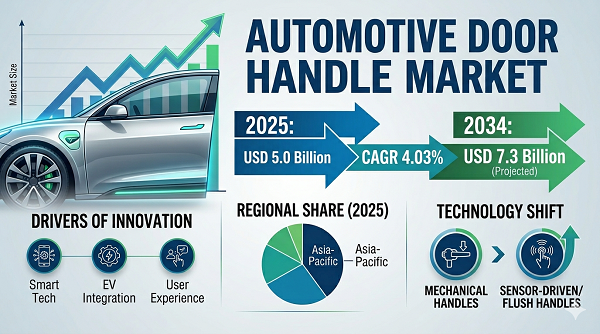
The global automotive door handle market has evolved from a basic mechanical car component into a sophisticated automotive segment driven by safety, convenience, innovation, and vehicle style. According to current research by Marketintelo, this market historically grounded in mechanical designs is now undergoing significant transformation with smart, keyless, and sensor-driven solutions reshaping future demand. The global automotive door handle market was valued at approximately USD 5.0 Billion in 2025, and as the automotive industry ramps up production, market revenues are accelerating across regions, vehicle types, and sales channels, making automotive door handle a critical growth area in the automotive supply ecosystem.
Key Statistics at a Glance
- Global market size (2025): USD 5.0 Billion.
- Projected market size (2034): USD 7.3 Billion.
- Forecast CAGR (2026–2034): 4.03%.
- Largest regional share (2025): Asia-Pacific (~42%).
- Dominant sales channel: OEM (~85%).
The automotive door handle market’s maturity reflects a 5–10 year historical growth trend rooted in global automobile production increases, electrification, and rising consumer preference for advanced access systems.
Historical Market Trends: 2015–2025
From 2015 through 2025, the automotive door handle sector expanded alongside global vehicle sales. Key year-over-year comparisons reveal steady gains in market value and technological complexity:
- 2015–2020: CAGR estimated ~3.5–4.5% as vehicle volumes grew in Asia and Europe (primarily passenger cars).
- 2020–2024: Increased adoption of electronic and sensor-enabled handles led to elevated demand, pushing market valuation near USD 4.95 Billion by 2024.
- 2024–2025: The market rose from approximately USD 4.95 Billion to USD 5.0–5.07 Billion by 2025 a year-over-year growth rate of ~1–2%.
This progress underscores that even traditional mechanical handle demand persisted while newer keyless and smart technologies attracted premium segment investment.
Market Growth Projections: 2026–2034
Analyst forecasts illuminate the future trajectory of automotive door handles:
- 2034 Global Market Projection: USD 7.3 Billion.
- Growth Rate (2026–2034): 4.03% CAGR.
- Projected Value by 2031: ~USD 6.97 Billion (Cognitive Market Research).
Long-term growth drivers include:
- Rising global vehicle production projected to grow by ~20% by 2030.
- Electrification and autonomous vehicle trends boosting demand for flush, sensor, and proximity entry systems.
- Increased consumer preference for personalization and security features.
Regional Market Analysis (2025)
| Region | 2025 Market Value (USD) | % Share | CAGR Forecast |
| Asia-Pacific | ~USD 2.10–2.10 Billion | ~42% | ~5–7% |
| North America | ~USD 1.98 Billion | ~40% | ~3–7% |
| Europe | ~USD 1.2 Billion | ~25% | ~4–5% |
| Latin America | ~USD 247.6 Million | ~5 | ~4–5% |
| Middle East & Africa | ~USD 99.3 Million | ~2%* | ~4–5% |
Highlights:
- Asia-Pacific: Led by demand in China, Japan, India and Southeast Asia. Rapid urbanization and burgeoning passenger vehicle growth are principal drivers.
- North America: Strong premium vehicle adoption fuels sensor and automatic door handle uptake.
- Europe: Focus on lightweight, premium designs and sustainability yields steady demand.
- Latin America & MEA: Smaller share but moderate CAGR due to rising vehicle fleets.
Segment Analysis With Numerical Data
By Handle Type (2025)
- Mechanical Handles: ~73–75% market share.
- Automatic / electronic systems: ~25–27% share.
Mechanical door handles simple, reliable and cost–effective remain dominant despite a rising shift toward smart systems.
By Sales Channel (2025)
- OEM: ~85% share.
- Aftermarket: ~15% share.
This allocation reflects the essential role of original equipment in integrating door handles into new vehicles.
By Vehicle Type (2025)
- Passenger Vehicles: ~75% share.
- Commercial Vehicles: ~25% share.
Passenger cars’ dominance reveals how consumer expectations security, convenience, design—continue to influence market innovations.
Key Industry Statistics & Market Forces
- OEM vs Aftermarket: OEM dominance at ~85% indicates most revenue is tied to vehicle production rather than retrofitting.
- Technology Shift: Sensor-enabled and electronic handles expected to grow faster than mechanical counterparts, especially in EVs and premium segments.
- Material Trends: Lightweight materials like aluminum and high–strength plastics are driving efficiencies and design flexibility.
Revenue Growth: Year-Over-Year Highlights
- 2024 to 2025: ~$4.95 B to ~$5.0 B – ~1% increase.
- 2025 to 2026: ~$5.0 B to ~$4.98–5.01 B – roughly flat to slight uptick in early forecast.
- 2026 to 2031: Estimated growth to ~$6.97 B – ~5% CAGR mid-term.
- 2026 to 2034: Growth toward ~$7.3 B – 4.03% CAGR.
Conclusion: Data-Driven Summary & Projections
The automotive door handle market reflects steady expansion backed by quantitative momentum across vehicle production, regional consumption, and technological adoption. From a base of roughly USD 5 Billion in 2025, the industry is on track for a projected USD 7.3 Billion valuation by 2034, translating to consistent growth across all major regions and segments. Mechanical handles still dominate share, but the transition toward electronic, keyless, and sensor-integrated models aligns with broader automotive digitalization trends.
Final Projections & Insights (2034):
- Global revenue: USD 7.3 Billion.
- Year-on-year average growth: ~4%.
- Emerging tech share: Expected to grow double-digit annually in premium and EV categories.
In summary, the automotive door handle market is poised for both moderate revenue growth and dynamic innovation, blending proven mechanical foundations with next-generation access systems shaping the future of automotive design and user experience.
Read A Full Report: https://marketintelo.com/report/automotive-door-handle-market