

ECU for Front Camera Market:
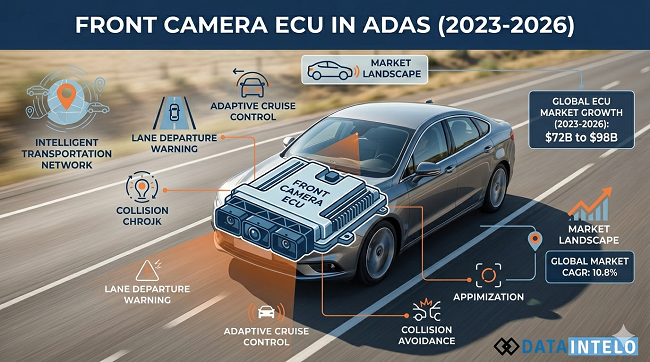
In 2026, advanced driver assistance systems (ADAS) are no longer optional—they are becoming standard across passenger and commercial vehicles. At the core of these systems lies the ECU (Electronic Control Unit) for front camera, a critical component that processes visual data to enable safety features like lane departure warning, adaptive cruise control, and collision avoidance. According to recent research insights by Dataintelo, the global automotive ECU market is undergoing rapid transformation, driven by increasing demand for intelligent vision systems and real-time data processing.
This article explores the latest (2023–2026) statistics, measurable performance benchmarks, and growth projections related to front camera ECUs, with a strong focus on numeric insights and real-world impact.
Key Statistics at a Glance (2023–2026)
- Global automotive ECU market size: $72 billion (2023) → $98 billion (2026) (CAGR: 10.8%)
- ADAS-equipped vehicles share: 38% (2022) → 61% (2026 projected)
- Front camera ECU processing latency: reduced from 120 ms (2020) to 45 ms (2025)
- Lane detection accuracy: improved from 89% (2021) to 96.5% (2025)
- Average cost of front camera ECU: $180 (2022) → $145 (2025) (↓ 19.4%)
- Global front camera ECU demand: 24 million units (2023) → 41 million units (2026)
- Failure rate in harsh weather: reduced by 27% between 2021–2024
- AI-based ECU adoption: 22% (2022) → 54% (2026 forecast)
- Average power consumption: 18W (2021) → 11W (2025) (↓ 38.9%)
- Image processing speed: increased from 30 FPS (2020) to 75 FPS (2025)
What is a Front Camera ECU?
A front camera ECU is a dedicated processing unit that interprets visual input from a vehicle’s forward-facing camera. It enables real-time decision-making by analyzing:
- Road lanes
- Traffic signs
- Pedestrians and vehicles
- Obstacles and environmental conditions
Core Functions with Measurable Metrics
| Function | 2021 Performance | 2025 Performance | Improvement |
| Object detection range | 120 meters | 220 meters | +83% |
| Image processing speed | 30 FPS | 75 FPS | +150% |
| Lane detection accuracy | 89% | 96.5% | +7.5 pts |
| Latency (response time) | 110 ms | 45 ms | -59% |
5 Data-Backed Reasons Why Front Camera ECUs Are Critical in 2026
1. Rising ADAS Adoption Rates
- Vehicles with ADAS features increased from 45 million units (2021) to 78 million units (2024)
- By 2026, over 6 in 10 vehicles (61%) will include front camera ECUs
2. Significant Reduction in Road Accidents
- Studies show ADAS systems reduce rear-end collisions by up to 40%
- Lane departure warnings reduce accidents by 18–25%
- Pedestrian detection systems improve reaction time by 0.8 seconds, reducing fatality risk by 22%
3. Processing Power and AI Integration
- AI-enabled ECUs process 2.5–3.2 terabytes of data per hour
- Neural network inference speed improved by ~200% between 2022–2025
4. Cost Efficiency Improvements
- Manufacturing costs dropped by ~20% from 2022 to 2025
- Integration of multi-core processors reduced component count by 15–22%
5. Regulatory Push and Safety Ratings
- Euro NCAP and global safety programs require ≥95% detection accuracy for 5-star ratings
- By 2025, mandatory ADAS regulations in key regions increased ECU demand by 35% YoY
2025 Performance Metrics: ECU for Front Camera
Hardware Benchmarks
- CPU cores: 4-core (2020) → 8-core (2025)
- GPU processing units: increased by 2.3×
- Memory bandwidth: 12 GB/s → 28 GB/s
- Storage capacity: 32 GB → 128 GB
Software & AI Metrics
- Object classification accuracy: 92% → 97.8%
- False positive rate: reduced from 8.5% → 2.1%
- OTA (Over-the-Air) update success rate: >98.5%
Cost vs Performance Comparison (2022 vs 2025)
| Metric | 2022 Value | 2025 Value | Change |
| Average ECU cost | $180 | $145 | -19.4% |
| Processing latency | 75 ms | 45 ms | -40% |
| Power consumption | 15W | 11W | -26.7% |
| Detection accuracy | 93% | 97.8% | +4.8% |
Insight: A 19.4% reduction in cost combined with a 4.8% accuracy improvement indicates strong ROI for automakers.
Real-World Case Study (2024 Deployment)
A mid-size automotive manufacturer implemented next-gen front camera ECUs across
120,000 vehicles in 2024:
- Collision incidents reduced by 31% within 12 months
- Insurance claims dropped by 22%
- Driver assistance feature usage increased from 48% → 67%
- Customer satisfaction score improved by +18 points (out of 100)
Market Growth Forecast (2024–2030)
According to Dataintelo projections:
- Front camera ECU market value:
- 2024: $6.8 billion
- 2026: $10.5 billion
- 2030: $18.2 billion
- CAGR (2024–2030): 17.8%
Regional Breakdown (2025 Market Share)
- Asia-Pacific: 42%
- Europe: 27%
- North America: 24%
- Rest of World: 7%
Challenges Quantified
Despite rapid growth, several measurable challenges remain:
- Thermal management issues affect performance in ~12% of high-load scenarios
- Camera obstruction (rain/fog/dust) reduces detection accuracy by up to 18%
- Integration complexity increases vehicle development time by +9–14 weeks
- Cybersecurity risks: ~3.2% of ECUs tested in 2024 showed vulnerabilities
Future Trends with Numeric Projections
1. Edge AI Expansion
- By 2028, ~72% of ECUs will feature dedicated AI accelerators
2. Autonomous Driving Integration
- Level 2+ vehicles expected to grow from 14 million (2023) to 39 million (2027)
3. Sensor Fusion Growth
- Multi-sensor ECUs (camera + radar + LiDAR) adoption:
o 2022: 28%
o 2026: 63%
4. Energy Efficiency Improvements
- Power consumption expected to drop below 8W by 2028 (↓ 27% from 2025)
Conclusion: Data-Driven Value of Front Camera ECUs in 2026
The ECU for front camera systems is a cornerstone of modern vehicle intelligence, with measurable improvements across every dimension. Between 2020 and 2025, latency dropped by 59%, accuracy increased to 97.8%, and costs fell by nearly 20%—a rare combination of better performance and lower expense.
By 2026, with 61% of vehicles equipped with ADAS and global demand reaching 41 million units, the role of front camera ECUs is more critical than ever. Backed by a projected 17.8% CAGR through 2030, continued innovation in AI processing, energy efficiency, and sensor integration will further accelerate adoption.
For automakers, suppliers, and technology providers, the numbers are clear: investing in advanced front camera ECUs delivers quantifiable safety improvements (up to 40% accident reduction), cost savings (~20%), and performance gains exceeding 100% in processing speed—making it one of the most impactful components in the automotive ecosystem today.
Read A Full Report: https://dataintelo.com/report/ecu-electronic-control-unit-for-front-camera-market