

Market Summary
According to our Growth Market Report, the global magnetic proximity sensor market size reached USD 3.12 billion in 2024, demonstrating robust growth driven by the expanding adoption of automation across industries. The market is expected to grow at a CAGR of 7.6% from 2025 to 2033, projecting the market size to reach USD 6.04 billion by 2033. This growth is primarily attributed to the increasing demand for contactless sensing solutions in automotive, industrial, and consumer electronics sectors, as well as advancements in sensor technologies that enable higher precision and reliability
Introduction
In a world increasingly driven by automation, precision, and safety, magnetic proximity sensors quietly power countless systems behind the scenes. From industrial robotics to automotive safety and consumer electronics, these sensors enable machines to “sense” without physical contact. As industries evolve toward smarter, more efficient operations, the magnetic proximity sensor market is emerging as a critical enabler of next-generation technologies.
What is a Magnetic Proximity Sensor?
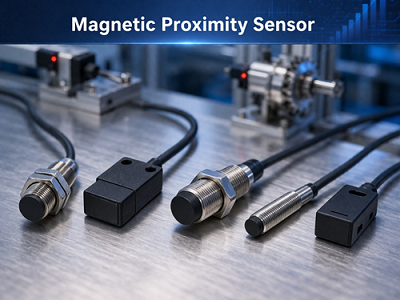
A magnetic proximity sensor is a non-contact device that detects the presence or absence of an object using a magnetic field. Unlike optical or capacitive sensors, it is immune to dust, moisture, and harsh environments, making it ideal for industrial and outdoor applications.
These sensors typically rely on technologies such as Hall Effect or reed switches to detect magnetic changes, offering high reliability and long operational life.
Why Magnetic Proximity Sensors Are Gaining Momentum
1. Demand for Industrial Automation
Industries worldwide are undergoing a transformation toward automation. Magnetic proximity sensors play a vital role in assembly lines, conveyor systems, and robotic arms by ensuring accurate positioning and movement detection.
2. Rise of Smart Vehicles
Modern vehicles are equipped with multiple sensing technologies. Magnetic proximity sensors are widely used in anti-lock braking systems (ABS), gear position sensing, and door detection mechanisms. As electric and autonomous vehicles grow, sensor integration is expanding rapidly.
3. Harsh Environment Compatibility
Unlike optical sensors, magnetic sensors perform reliably in extreme conditions—high temperatures, dust, oil, and vibrations. This makes them indispensable in heavy industries such as mining, oil & gas, and manufacturing.
4. Energy Efficiency and Durability
These sensors consume minimal power and have no mechanical wear, resulting in longer lifespans and reduced maintenance costs—key factors for cost-conscious industries.
Key Market Segments
By Technology
- Hall Effect Sensors
- Reed Switch Sensors
- Magneto-resistive Sensors
Hall Effect sensors dominate due to their compact design and ability to provide digital and analog outputs.
By Application
- Automotive
- Industrial Automation
- Consumer Electronics
- Aerospace & Defense
- Healthcare Equipment
Industrial automation holds the largest share, but automotive is the fastest-growing segment.
By End-User Industry
- Manufacturing
- Energy & Power
- Transportation
- Electronics
Emerging Trends Shaping the Market
Integration with IoT and Smart Systems
Magnetic proximity sensors are increasingly integrated with IoT platforms, enabling real-time monitoring, predictive maintenance, and data-driven decision-making.
Miniaturization
With the push toward compact devices, manufacturers are focusing on smaller, more efficient sensor designs without compromising performance.
Wireless Sensor Technology
The rise of wireless connectivity is transforming sensor deployment, especially in remote and hard-to-access locations.
AI-Driven Sensor Applications
Artificial intelligence is enhancing sensor capabilities by enabling smarter detection, pattern recognition, and anomaly identification.
Challenges in the Market
Limited Detection Range
Compared to other sensor types, magnetic sensors typically have shorter detection distances, which can limit their application scope.
Magnetic Interference
External magnetic fields can sometimes interfere with sensor accuracy, requiring careful system design.
Price Sensitivity in Emerging Markets
While cost-effective in the long run, initial investment can be a barrier for small and medium enterprises in developing regions.
Competitive Landscape
- Honeywell International Inc.
- Infineon Technologies AG
- NXP Semiconductors N.V.
- STMicroelectronics N.V.
- Texas Instruments Incorporated
- TE Connectivity Ltd.
- Panasonic Corporation
- Allegro MicroSystems, Inc.
- TDK Corporation
- Murata Manufacturing Co., Ltd.
- AMS AG
- Analog Devices, Inc.
- SICK AG
- Omron Corporation
- Melexis NV
- Diodes Incorporated
- Sensitec GmbH
- Vishay Intertechnology, Inc.
- DENSO Corporation
- ROHM Semiconductor
Future Outlook
According to our Growth Market Report, The future of the magnetic proximity sensor market looks promising. As industries continue to embrace automation, digitalization, and smart technologies, the demand for reliable sensing solutions will surge. The convergence of sensors with AI, IoT, and edge computing will unlock new possibilities, transforming how machines interact with their environment.
By 2030, magnetic proximity sensors are expected to move beyond traditional roles and become integral components in intelligent ecosystems—powering everything from autonomous factories to smart cities.
Source:- https://growthmarketreports.com/report/magnetic-proximity-sensor-market-global-industry-analysis