

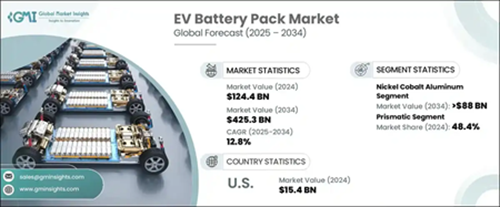
EV Battery Pack Market – The global transition toward clean transportation is accelerating at an unprecedented pace, and at the heart of this transformation lies the electric vehicle (EV) battery pack market. As governments, automakers, and consumers increasingly embrace sustainable mobility, the demand for high-performance battery systems continues to surge. Recent industry estimates suggest that the EV battery pack market is projected to exceed USD 425.3 billion by 2034, reflecting strong long-term growth driven by electrification trends worldwide.
Rising Demand for Electric Vehicles Driving Market Expansion
One of the primary factors fueling the EV battery pack market is the rapid increase in electric vehicle adoption across the globe. Governments in major economies are implementing strict emission norms and offering incentives such as subsidies, tax benefits, and reduced registration costs to promote EV purchases. These supportive policies are significantly influencing consumer behavior and accelerating the shift toward electric mobility.
In addition, rising fuel costs and growing environmental awareness are encouraging consumers to move away from conventional internal combustion engine vehicles. Electric vehicles offer lower operating costs, minimal maintenance requirements, and zero tailpipe emissions, making them an appealing alternative for both individual and commercial users.
As automakers continue to expand their electric vehicle portfolios—from compact city cars to heavy-duty trucks—the demand for efficient and scalable battery packs is growing rapidly. This diversification across vehicle segments further strengthens the market outlook.
Technological Advancements Transforming Battery Performance
Technological innovation remains a cornerstone of growth in the EV battery pack market. Lithium-ion batteries currently dominate the industry due to their high energy density, reliability, and long lifecycle. However, continuous advancements are pushing the boundaries of battery performance.
Emerging battery technologies such as solid-state batteries and advanced chemistries like lithium iron phosphate (LFP) and nickel-cobalt-aluminum (NCA) are significantly improving key performance parameters. These include:
- Faster charging capabilities
- Extended driving range
- Enhanced safety and thermal stability
- Longer operational lifespan
Such improvements are helping to address common concerns such as range anxiety and charging time, thereby increasing consumer confidence in electric vehicles.
Declining Battery Costs Supporting Market Growth
A notable trend shaping the EV battery pack market is the steady decline in battery costs. Over the years, advancements in manufacturing techniques, economies of scale, and improved supply chain efficiency have contributed to reducing the cost per kilowatt-hour.
Lower battery costs directly influence the overall price of electric vehicles, making them more accessible to a wider audience. As affordability improves, adoption rates are expected to rise significantly, further driving demand for battery packs.
This cost reduction trend is also encouraging fleet operators and commercial vehicle owners to transition to electric alternatives, adding another layer of growth to the market.
Strong Policy Support and Investments
Government initiatives and policy frameworks are playing a crucial role in shaping the EV battery ecosystem. Many countries are investing heavily in battery manufacturing infrastructure, including the establishment of large-scale production facilities and localized supply chains.
These efforts aim to reduce dependency on imports while strengthening domestic production capabilities. At the same time, public and private sector investments in research and development are accelerating innovation in battery design and chemistry.
Strategic collaborations between automotive manufacturers and battery producers are becoming increasingly common, ensuring a steady supply of advanced battery technologies and enhancing overall market competitiveness.
Regional Insights: Asia-Pacific Leading the Charge
The Asia-Pacific region currently leads the global EV battery pack market, supported by strong adoption of electric vehicles and well-established manufacturing capabilities. Countries such as China, Japan, and South Korea have developed robust battery production ecosystems, making the region a dominant force in the industry.
China, in particular, stands out due to its large-scale production capacity, favorable government policies, and integrated supply chain. Meanwhile, North America and Europe are emerging as key growth regions, driven by rising investments in EV infrastructure and ambitious emission reduction targets.
These regions are increasingly focusing on building domestic battery manufacturing capabilities to enhance supply chain resilience and support the growing demand for electric vehicles.
Challenges Hindering Market Growth
Despite its strong growth potential, the EV battery pack market faces several challenges. One of the primary concerns is the high cost associated with raw materials such as lithium, cobalt, and nickel. Fluctuations in the availability and pricing of these materials can impact production and profitability.
Supply chain disruptions and geopolitical factors may also pose risks to the market. Additionally, the environmental impact of battery production and disposal remains a critical issue.
Battery recycling and end-of-life management are becoming increasingly important as the number of electric vehicles on the road continues to grow. Developing efficient recycling technologies and sustainable disposal methods will be essential to address these concerns.
Future Outlook: A Dynamic and Competitive Landscape
The future of the EV battery pack market looks highly promising, with continuous innovation expected to reshape the industry. Next-generation technologies such as solid-state batteries are anticipated to deliver higher energy density, improved safety, and faster charging capabilities.
The integration of advanced battery management systems, artificial intelligence, and smart charging solutions will further enhance battery performance and efficiency. Additionally, the expansion of ultra-fast charging infrastructure will play a critical role in accelerating EV adoption.
As competition intensifies, companies will focus on improving product quality, reducing costs, and securing supply chains to gain a competitive edge in the market.
Conclusion
The EV battery pack market is on a strong growth trajectory, driven by increasing electric vehicle adoption, technological advancements, declining costs, and supportive government policies. While challenges related to raw materials and sustainability persist, ongoing innovation and strategic investments are expected to mitigate these issues.
With the market projected to surpass USD 425.3 billion by 2034, EV battery packs will remain a key pillar in the global transition toward sustainable transportation, shaping the future of mobility for years to come.