



Physical AI – Fujitsu Limited and Carnegie Mellon University (CMU) today announced the launch of the Fujitsu-Carnegie Mellon Physical AI Research Center. At the Center, Fujitsu and CMU will jointly advance research and development of core technologies to enhance the capabilities and scalability of physical AI, with the aim of serving as a global research hub that drives the social implementation of these technologies.
Research focus and objectives
Physical AI is expected to contribute to addressing key societal challenges—such as improving productivity, mitigating labor shortages, and ensuring safety—by enabling AI systems to operate in the real world and interact with people and their environments, thereby driving the automation and optimization of operations across sectors including manufacturing, logistics, construction, infrastructure, and healthcare.
However, realizing this vision requires the integration of expertise and technologies across multiple domains, including robotics, AI, simulation, human–robot interaction, and ethics and social acceptance. This makes not only advancements in individual fields essential, but also interdisciplinary collaboration and efforts that bridge academic research with real-world deployment.
Fujitsu and CMU established the Fujitsu-Carnegie Mellon Physical AI Research Center to address these challenges through an integrated research approach that brings together interdisciplinary expertise and connects academia and industry .
A multidisciplinary collaboration
At the Center, reflecting the interdisciplinary nature of physical AI, faculty members from CMU across a wide range of disciplines—including robotics, machine learning, language technologies, human–computer interaction, electrical and computer engineering, civil and environmental engineering, and philosophy—participate in the joint research. Researchers will work alongside Fujitsu scientists, engineers, and technicians to develop physical AI systems designed to tackle real-world challenges. This close collaboration with industry informs and inspires new research directions to meet critical demand.
Participating researchers include:
• Yonatan Bisk, Assistant Professor, Language Technologies
• Fernando De La Torre, Research Professor, Robotics
• Tim Dettmers, Assistant Professor, Machine Learning
• Laszlo Jeni, Assistant Research Professor, Robotics
• Kris Kitani, Associate Research Professor, Robotics
• David Lindlbauer, Assistant Professor, Human-Computer Interaction
• Yorie Nakahira, Assistant Professor, Electrical and Computer Engineering
• Graham Neubig, Associate Professor, Language Technologies
• Jean Oh, Associate Research Professor, Robotics
• Sean Qian, Professor, Civil and Environmental Engineering
• Sebastian Scherer, Associate Research Professor, Robotics
• Peter Spirtes, Department Head and Professor, Philosophy
• Kun Zhang, Professor, Philosophy
Fujitsu and CMU will advance research and development through an interdisciplinary approach that integrates their respective expertise, focusing on areas such as action generation and learning, spatial perception and environmental understanding, multi-robot coordination and optimization, human-robot collaboration and the integration of simulation and real-world environments.
The Fujitsu-Carnegie Mellon Physical AI Research Center will leverage CMU’s new Robotics Innovation Center, which opened in February of this year. The 14,000-square-meter facility at Hazelwood Green in Pittsburgh bridges Carnegie Mellon’s fundamental research and commercial deployment. The Robotics Innovation Center will provide specialized facilities and collaborative space to test physical AI in real-world environments.
Fujitsu Kozuchi Physical OS
Fujitsu aims to realize a physical AI platform that can be applied to mission-critical domains supporting social infrastructure, leveraging its strengths in providing integrated AI, computing, and networking capabilities.
By delivering a unified infrastructure from cloud to edge, Fujitsu seeks to ensure real-time performance, reliability, and safety, while addressing data sovereignty and governance requirements. Through these efforts, Fujitsu contributes to the development of a sustainable social foundation in which humans and robots can collaborate safely and seamlessly.
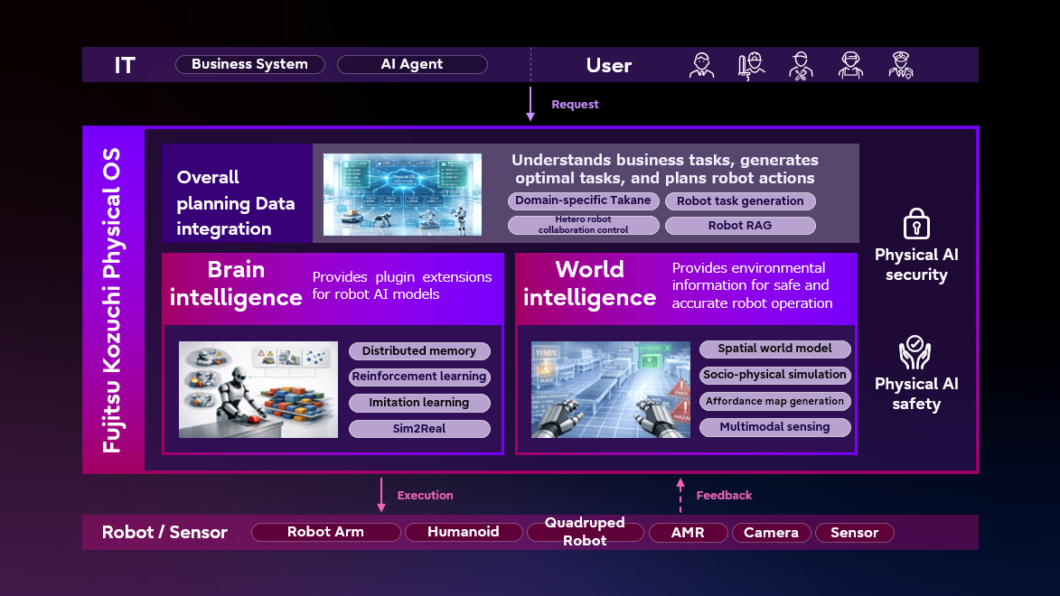
As a concrete initiative, Fujitsu is developing Fujitsu Kozuchi Physical OS, which integrates robots, sensors, systems, and physical spaces (Figure 1). The platform enables the coordinated operation of multiple robots and systems in accordance with operational instructions by combining two capabilities: brain intelligence, which enhances robots’ adaptability to tasks based on prior experience and human imitation, and spatial intelligence, which provides information about real-world environments in which robots operate.
Technologies developed at this research center are scheduled to be gradually incorporated into the platform starting in fiscal year 2026. This will enable the integrated utilization of physical AI technologies that combine expertise from diverse fields, enhancing adaptability to complex and dynamic real-world tasks, while also bridging interdisciplinary research outcomes to real-world deployment.
Future Plans
Fujitsu and Carnegie Mellon University will jointly advance the research and development of core technologies for physical AI, while promoting a society in which humans and robots collaborate, and contributing to the development of a sustainable and resilient society.
For more information visit: https://global.fujitsu/en-global