

IITMAA Sangam – IITMAA Sangam 2026 brought together leaders from government, defence, industry, healthcare, deep technology and academia to deliberate on the technologies, partnerships and capabilities that will shape India’s next phase of growth. Across sectors, discussions at the gathering highlighted a common need for stronger academia-industry-government collaboration, indigenous technology development and the faster translation of knowledge and innovation into real-world applications. From renewable energy and defence to space, deep-tech entrepreneurship and healthcare, the conversations reflected the breadth of the IIT Madras ecosystem and its contribution to India’s technology ambitions.
Highlighting the vital role of technology, innovation and industry collaboration in India’s growth, U-Solar Clean Energy, a clean energy solutions company, participated at IITMAA Sangam 2026, alongside industry and academic leaders. The event brought together perspectives on India’s evolving technology and infrastructure landscape, with Shri Pralhad Joshi, Hon’ble Minister of Education, Government of India, highlighting the role of technology and innovation in strengthening India’s power infrastructure, domestic manufacturing and self-reliance.
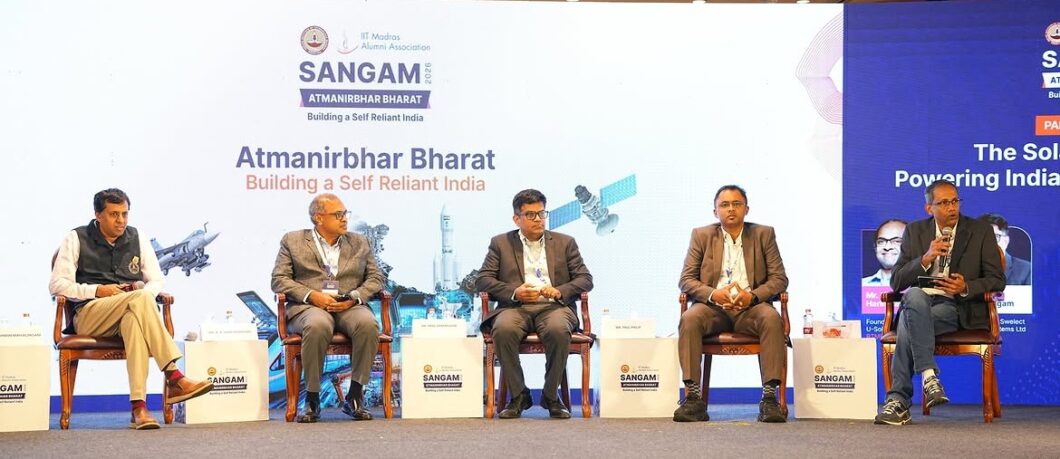
Building on these themes, U-Solar’s Founder & CEO, Mr. K. R. Harinarayan, participated in the panel discussion “The Solar RE-volution: Powering India’s Sustainable Growth,” where industry leaders discussed the evolving role of solar, energy storage, technology and new models of renewable energy deployment in India’s sustainable growth journey. Reflecting this broader shift, U-Solar, with nearly 15 years of operations, has moved beyond the conventional EPC model to combine renewable energy, technology and financial planning, designing solutions around customers’ energy requirements and load profiles through an optimal mix of rooftop, off-site power and storage. The company has evolved from rooftop solar into ground-mounted and floating solar, executing over 300 MW of projects with another 200 MW under execution. Its turnover has grown from around ₹425 crore last year to over ₹1,000 crore this year, representing growth of more than 100%.”
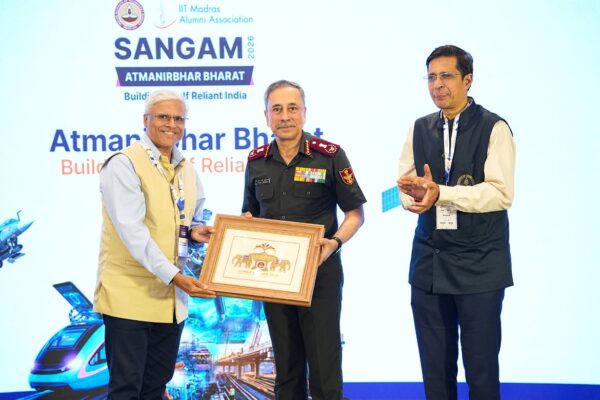
The discussions then turned to the strategic importance of technological self-reliance and the need for closer collaboration between the armed forces, academia and industry. General N. S. Raja Subramani, Chief of Defence Staff, highlighted that “Modern warfare has fundamentally shifted towards a whole-of-nation endeavor where strategic autonomy is directly governed by technological self-reliance. Owning a weapon system is meaningless without controlling its underlying architecture, source code, and supply chains. Ultimate success on today’s depthless battlefield will not depend on isolated platforms or basic research alone, but on an integrated system of systems powered by tight, rapid convergence between the armed forces, industry, and academia to convert raw national potential into decisive operational capability.”
The role of indigenous innovation was further reflected in the space technology sector, with Mr. Pranit Mehta, Co-founder & COO of GalaxEye, highlighting the growing strategic importance of space-based capabilities. He mentioned, “Space is increasingly emerging as the fourth domain of defence, with satellite-based intelligence, communication and navigation becoming critical to national security and modern warfare. At GalaxEye, we are focused on building sovereign space capabilities through indigenous technologies such as OptoSAR, which combines Synthetic Aperture Radar and optical imaging to deliver high-resolution Earth observation across weather and lighting conditions. The Government of India’s ₹63.84 crore RDI support for the development of our next-generation OptoSAR satellite is a significant step in advancing this technology and strengthening India’s capabilities in strategic space technologies. As the nature of threats and countermeasures continues to evolve, dependable, sovereign and responsive space-based intelligence will become increasingly important for national security and defence. I am also grateful for IITMAA, which continue to connect alumni, innovators and the wider IIT Madras ecosystem, creating opportunities to share ideas and contribute to India’s technology ambitions.”
As the Indian deep-tech ecosystem expands, the conversation also highlighted the importance of taking advanced technologies from laboratories and startups to global markets. Mr. Amrutash Misra, Cofounder, CoreVoice – deep-tech focused marketing service, said “India’s deep-tech startup ecosystem is entering an exciting phase of growth, with more than 4,200 deep-tech startups now operating in the country, including over 550 founded in 2025 alone. As Indian founders increasingly build for global markets, the ability to clearly communicate complex technology, differentiate their solutions and build credibility becomes just as important as the technology itself. We are seeing more founders recognise the value of strong narratives and specialised marketing in taking advanced technologies to global audiences. For us, this is a natural evolution of the ecosystem, and one where deep-tech-focused specialists like CoreVoice can play an important role in helping Indian companies articulate their value and build global brands.”
The discussions at IITMAA Sangam also extended to the application of emerging technologies in healthcare, where the focus shifted from innovation alone to measurable outcomes and effective implementation. Dr Abhishek Puri, Consultant Radiation Oncologist, Fortis Hospital Mohali, and Founder, Agravaani Research, said “AI in healthcare scales when we define the problem clearly, beginning with the clinical outcomes we expect and the risks we are prepared to adjudicate. That clarity also settles who pays for deployment, whether hospitals, insurers or the state. Since health is a state subject, coordination between the Centre and the states allows each to address its own demographics and disease burden. Small language models built for niche clinical utility can create feedback loops that connect every intervention to its outcome, from survival in cancer to cure in communicable diseases. Through federated learning, these loops can generate indigenous guidelines for medical education and patient care. This is where sovereign AI advances India’s Viksit Bharat 2047 goals. Engineers build the solutions, doctors define the problems, and progress happens where the two meet. This calls for clinicians who understand the technology layers, and for bringing every stakeholder into the same space. As the first clinician invited to IITMAA Sangam, I value how the platform unites academia, healthcare, technology and industry to translate innovation into meaningful outcomes for India’s healthcare system.
Highlighting the role of IITMAA Sangam as a platform for meaningful engagement between the alumni community and industry, Mr. Shivam Sinha, Founder and CEO, Indiassetz; Co-Founder, ARCA Alternatives, said, “Sangam 2026 gave Indiassetz and ARCA Alternatives a valuable platform to engage with the IIT Madras alumni community and with leaders from government and industry. Our association with IITMAA brings together three complementary strengths — a high-calibre global alumni network, deep expertise in real estate wealth management, and institutional capabilities in alternative investments. Most Indian families accumulate real estate but seldom manage it as a portfolio. Our vision is to make real estate wealth management more transparent and technology-enabled, and the opportunity is not merely to provide products, but to help people make better-informed decisions across their wealth journey. We are delighted to partner with IITMAA and look forward to engaging with the alumni community.”
Together, the discussions at IITMAA Sangam 2026 highlighted the importance of building stronger bridges between knowledge, innovation and implementation. By bringing together alumni, policymakers, defence leaders, entrepreneurs, industry experts, healthcare professionals and academics, the platform highlighted how the IIT Madras community can contribute to solving complex national challenges and advancing India’s capabilities across critical sectors.