


AI Sensing Solutions at CES 2026:
Asahi Kasei Microdevices (AKM) and Aizip have partnered to showcase two innovations in AI-enhanced sensing: real-time swallowing detection using millimeter-wave radar and gesture recognition utilizing electromyography (EMG). This collaboration pairs AKM’s sensing hardware with Aizip’s lightweight artificial intelligence (AI) models to provide manufacturers with solutions that don’t require in-house AI expertise. AKM will demonstrate these technologies at CES 2026 in the Digital Health section of the Venetian Expo at booth 54829.
AKM and Aizip’s collaboration has yielded a millimeter-wave radar solution for real-time swallowing monitoring, addressing the critical need to detect aspiration (accidentally inhaling solid or liquid into the airway) in aging populations. According to the American Thoracic Society, aspiration pneumonia claimed nearly 186,000 American lives from 1999 to 2022, with three quarters of these incidents involving people aged 75 or older. AKM’s millimeter-wave radar module is used to monitor throat movement, eliminating the need for a wearable device. The radar signal is converted into audio data, which Aizip’s AI models analyze locally in real-time to distinguish swallowing from a series of other throat motions and body movements, providing insights into aspiration risk.

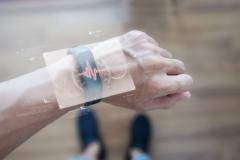
The gesture recognition technology platform is built around AKM’s AK05611 analog front-end IC, which features amplifiers, analog-to-digital converters, and integrated motion artifact (MA) cancellation in a compact 1.56 × 2.71 mm package. In this demonstration, the AK05611 is housed in a wristband and used to detect electromyography signals generated by muscle movements in the forearm. Aizip’s models interpret these signals as specific gestures, such as a closed hand, an open hand, and a single tap. This technology could enable users to interact with their electronic devices, including sending alerts to family or caregivers, without needing to touch a screen.
“These solutions can work in the background—whether it’s a smartwatch recognizing gestures or a sensor monitoring swallowing during meals,” said Gregg Rouse, President of AKM’s U.S. business. “Processing data on the device in real time means we can alert caregivers the moment something goes wrong. That speed matters when you’re trying to prevent someone from choking or aspirating.”
“When you process data locally instead of sending it to the cloud, you eliminate latency, protect privacy, and reduce power consumption,” said Weier Wan, CTO at Aizip. “Our models can extract clinical-grade insights from sensor data using minimal computing resources, allowing manufacturers to add sophisticated sensors to battery-powered devices without sacrificing performance or requiring expensive hardware.”
The synergy between AKM’s sensors and Aizip’s on-device AI solutions redefines the notion of intelligent sensing. Bringing local AI processing to advanced sensors can create valuable and potentially life-saving solutions that may first emerge in digital health and wearable products, but are widely applicable across various other markets, including industrial, smart home, and beyond.
Visit the AKM media kit and Aizip for more information about their presence at CES 2026.