

The Wearable AI Market is emerging as one of the most transformative segments within the Information & Communication Technology (ICT) industry, driven by growing consumer demand, breakthrough AI technologies, and applications across healthcare, consumer electronics, and enterprise operations. AI-powered wearables are reshaping the way users interact with technology, offering real-time insights, predictive analytics, and seamless connectivity across devices.
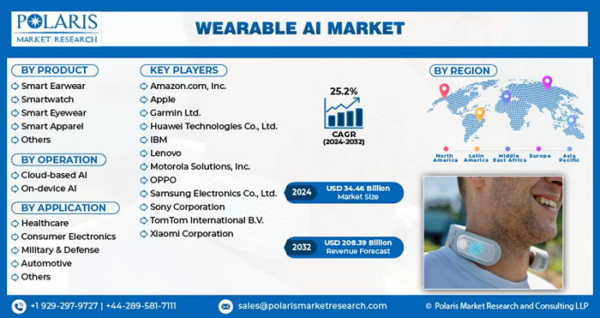
The global wearable AI market is projected to expand at a remarkable CAGR of 25.2% from 2024 to 2032, growing from approximately USD 34.46 billion in 2024 to USD 208.39 billion by 2032. This rapid growth reflects the surging adoption of intelligent wearable devices that go beyond basic tracking, delivering actionable insights, personalized recommendations, and hands-free automation to consumers and enterprises alike.
Technological Advancements Fueling Growth
The growth of wearable AI is powered by the convergence of advanced AI algorithms, miniaturized high-precision sensors, and improved on-device processing capabilities. These innovations have enabled real-time health monitoring, context-aware computing, automated assistance, and predictive analytics — transforming wearable devices into indispensable everyday tools.
Smartwatches remain the largest segment due to their multifunctionality and widespread consumer adoption. However, smart eyewear, earwear, and AI-enabled apparel are rapidly expanding, offering more choices and enhancing user experiences. Modern wearable AI devices can track vital health metrics, such as heart rate, blood oxygen levels, sleep quality, and physical activity. By leveraging machine learning, these devices provide personalized insights, empowering users to make informed lifestyle and wellness decisions.
The growing focus on preventive healthcare and chronic disease management is also driving market expansion. Consumers are increasingly turning to wearable AI devices for proactive health monitoring, early disease detection, and fitness optimization — positioning wearables as essential health companions.
Consumer and Enterprise Adoption
While healthcare remains a key driver, wearable AI adoption is accelerating across consumer and enterprise segments. In the consumer space, devices with virtual assistants and AI-powered features enable hands-free interaction, voice commands, and personalized recommendations. From smart earphones capable of real-time transcription to augmented reality glasses, wearable AI is redefining digital engagement and enhancing daily productivity.
Enterprises are leveraging wearable AI for workplace safety, operational efficiency, and productivity analytics. Devices monitor environmental factors, worker fatigue, and performance metrics in real time, providing actionable insights to optimize workflows, reduce operational risk, and improve safety across industries like manufacturing, logistics, and field services.
Regional Insights
North America currently dominates the wearable AI market due to strong consumer adoption, high disposable income, and an advanced healthcare infrastructure. However, Asia-Pacific is emerging as a key growth region, supported by rising digital penetration, cost-efficient manufacturing, and increasing awareness of AI-driven technologies in countries such as China, Japan, and India.
Competitive Landscape
The wearable AI market is highly competitive, with both global tech giants and innovative startups driving continuous development. Leading companies are heavily investing in research and development to introduce next-generation wearable AI devices that provide enhanced user experiences, advanced AI analytics, and seamless integration with connected ecosystems.
Product differentiation, AI integration, and ecosystem compatibility are critical for market players to maintain a competitive edge. Innovations such as improved battery life, on-device AI processing, and adaptive learning algorithms are key factors influencing consumer choice and adoption rates.
Opportunities and Challenges
Despite its rapid growth, the wearable AI market faces challenges, particularly around data privacy and security. Devices collect sensitive personal data, necessitating secure transmission, robust consent protocols, and compliance with evolving global privacy regulations. Companies that address these concerns with transparent practices are likely to earn greater consumer trust and loyalty.
Additionally, there is significant opportunity in expanding use cases. Beyond health and fitness, wearable AI can support education, sports training, augmented reality experiences, and enterprise efficiency solutions, creating diverse avenues for market expansion.
Future Outlook
The wearable AI market is poised to extend far beyond wrist-worn devices. Smart apparel, AI-powered jewelry, and intelligent eyewear are gaining traction, indicating a future where AI-driven intelligence is embedded in multiple aspects of daily life. Advances in on-device AI processing, adaptive machine learning, and contextual computing will enhance device capabilities and user experiences, driving adoption across all demographics.
With a market set to surpass USD 208 billion by 2032, wearable AI is at the forefront of ICT innovation, promising to redefine how individuals and organizations interact with technology. The next generation of AI-powered wearables is expected to deliver continuous intelligence, predictive insights, and enhanced productivity, making AI a seamless part of everyday life.
In conclusion, the wearable AI market is not just growing; it is revolutionizing digital interaction. From empowering personal wellness to enabling smarter workplaces, wearable AI devices are reshaping the future of technology. With continued innovation and widespread adoption, the wearable AI revolution is set to become a cornerstone of the ICT industry, delivering smarter, more connected, and intelligent experiences for users worldwide.