


Artificial intelligence is entering a new phase where models interpret contextual data whilst interacting with the physical world in real time. At Analog Devices, Inc. (ADI), we call this Physical Intelligence: intelligent systems that can perceive, reason and act locally in the realities of motion, sound, space, or any other physical modality (e.g. time-series sampling).
This evolution aligns with ADI’s strengths. Our heritage in precision sensing, mixed-signal design and physical-edge computing is becoming the foundation for all intelligent systems that operate at the physical interface, be that in space, torque or RF sensing of 6G networks.
In 2026, AI will migrate from chatbots into the physical world, enabling machines to adapt fluidly to their surroundings. From context-aware signal sensing in automotive zonal architectures, to robots that learn new tasks in minutes, digital thought (“reasoning”) and physical action will rapidly converge.
2026 is shaping up to be the year Physical Intelligence moves from concept to reality. Here are my five predictions for how Physical Intelligence will materialize in 2026:
Prediction #1: In 2026, artificial intelligence will step out of our screens and into the world.
The next frontier of AI will be Physical Intelligence. The scaling laws that powered the success of large reasoning models will continue through 2026, but will extend into contexts that learn from real-world signals, such as vibration, sound, magnetics and motion. I predict these physical reasoning models will migrate from the datacenter to the edge, powering a new type of fluid autonomy that thinks and acts locally, sensitive to local physics and without recourse to centralized servers. A factory robot, for example, will be able to reason through unexpected tasks with only a few examples. Expect to see an increase in hybrid “world models” that blend mathematical and physical reasoning with data-driven sensor-fused dynamics, and systems that not only describe the world but participate in it and learn.
Prediction #2: Audio will become the dominant AI interface in consumer electronics.
Audio is about to become a reasoning channel, and we will see this come to life in a big way in 2026. With spatial sound, sensor fusion and on-device reasoning converging, consumer electronics will evolve into contextual companions. Augmented Reality glasses and hearables like earbuds will quietly interpret our environment, inferring intent, emotion and presence. These technological leaps will lead to significantly better noise cancellation in our hearable devices, improved battery life and new form factors that have not yet been imagined. The always-in-ear hearable experience, already on the rise among Gen Z, will become increasingly prevalent due to the “super-human” hearing of context-aware AI.
Prediction #3: Robots will learn like humans, and with minimal data.
In 2026, few-shot and transfer learning will finally reach precision industrial robotics, beyond the confines of flashy demos of somersaulting humanoids. Robots will be trained with minimal data, guided by large reasoning models that understand goals and constraints. This will unlock flexible automation across low-volume, high-mix manufacturing, logistics and healthcare. The 2026 shift will not be humanoids replacing humans. It will be robots that co-reason alongside humans, and without the rigidity and expense of traditional programming.
Prediction #4: AI will have its agentic “inception” moment with the emergence of micro-intelligence.
In 2026, a new class of tiny recursive models will rise: compact systems with remarkable depth of reasoning across a narrow domain, but able to run at the edge. Think of them as micro-intelligences rather than just small models: fluid, adaptive, and task-specific, yet still capable of abstraction and reflection. They will occupy the middle ground between rigid programmed AI seen at the edge today and sprawling foundation models like GPT-5, acting as orchestrators of the specialized agents emerging. These new kinds of models will arise from the race to build fluidly intelligent systems. Expect new benchmarks that measure engineering-focused, multiagent collaboration operating with security and functional safety.
Prediction #5: AI will begin to make AI.
In 2026, the architecture of intelligence itself will become automated. Using synthetic data, code-generation loops, simulation and self-improving pipelines (including evolutionary computing), AI will increasingly design, test and tune its own successors. This will compress innovation cycles from months to hours, transforming how software, models and even hardware co-evolve. It will usher in the era of recursive engineering, where creation itself becomes an intelligent process.
ADI is already investing in these advancements. We see our heritage in precision sensing, mixed-signal design and edge compute as rapidly becoming the foundation of a world where AI is no longer abstract, but embodied in every signal, every sensor, every decision.
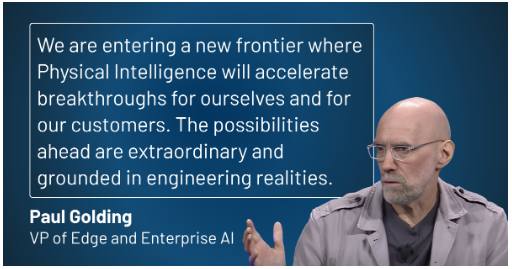
As intelligence gets physical, our mission is to make the world’s data think, reason and act with a fidelity grounded in the stubborn realities of the electro-physical world. We are entering a new frontier where Physical Intelligence will accelerate breakthroughs for ourselves and for our customers. The possibilities ahead are extraordinary and grounded in engineering realities.
For more information, visit www.analog.com.