


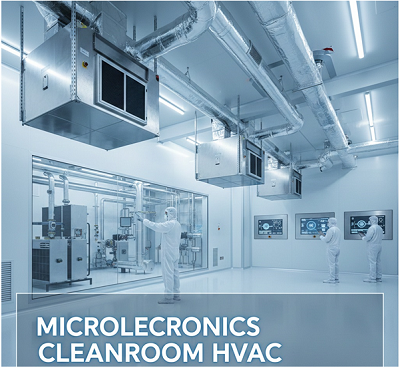
Market Summary
According to our Growth Market Report, the global Microelectronics Cleanroom HVAC market size reached USD 6.85 billion in 2024, driven by the growing demand for contamination-free manufacturing environments in the microelectronics sector. The market is expanding at a robust CAGR of 7.4% and is forecasted to reach USD 12.97 billion by 2033. Primary growth factors include the rapid expansion of semiconductor fabrication plants, rising investments in electronics manufacturing, and stringent regulatory requirements for cleanroom standards worldwide.
Introduction: Where Air Quality Becomes a Competitive Advantage
In the microelectronics world, progress is measured in nanometers, and mistakes are measured in microns of dust. While chips, wafers, and fabrication tools often take center stage, an equally critical system works quietly in the background—the cleanroom HVAC system. In microelectronics manufacturing, HVAC is not merely about comfort or temperature control; it is about governing airflow, particle concentration, humidity, and pressure with near-scientific perfection.
The Microelectronics Cleanroom HVAC Market is emerging as a strategic pillar of the global semiconductor and electronics ecosystem, transforming how fabs are designed, operated, and scaled.
Understanding Cleanroom HVAC in Microelectronics
More Than Heating and Cooling
Cleanroom HVAC systems for microelectronics are engineered ecosystems. Their core mission is to maintain ultra-clean environments by regulating:
- Airborne particle counts at extremely low thresholds
- Temperature stability within fractions of a degree
- Humidity control to prevent electrostatic discharge
- Pressure differentials to stop contamination ingress
Unlike conventional HVAC systems, these solutions must work continuously, predictively, and flawlessly.
Why Microelectronics Demands Specialized HVAC
Microelectronics manufacturing involves processes such as photolithography, etching, deposition, and doping. Each process reacts sensitively to environmental variations. Even a minor airflow disturbance can compromise yield, turning million-dollar wafers into scrap.
Market Drivers: Forces Shaping Demand
The Shrinking Chip, the Growing Challenge
As semiconductor nodes move toward single-digit nanometers, contamination tolerance drops dramatically. This fuels demand for advanced HVAC systems capable of ISO Class 1–5 environments, pushing innovation in airflow modeling and filtration efficiency.
Global Fab Expansion
Governments and private players worldwide are investing heavily in semiconductor fabrication facilities. Every new fab represents a large-scale, long-term investment in cleanroom HVAC infrastructure, often consuming a significant portion of the facility’s capital budget.
Yield Optimization as a Business Imperative
In microelectronics, higher yield equals profitability. Cleanroom HVAC systems are increasingly viewed as yield-enhancing assets rather than operational costs, driving premium system adoption.
Technology Evolution in Cleanroom HVAC
High-Efficiency Filtration Systems
HEPA and ULPA filters are no longer static components. Modern systems integrate smart monitoring to track pressure drops, filter life, and contamination risks in real time.
Laminar Airflow Engineering
Unidirectional airflow designs are becoming more sophisticated, using computational fluid dynamics (CFD) to eliminate turbulence zones that can trap particles.
Energy-Aware HVAC Architectures
Energy consumption is one of the largest operational expenses in fabs. The market is witnessing a shift toward:
- Variable air volume systems
- Heat recovery mechanisms
- Demand-controlled ventilation
These designs balance cleanliness with sustainability.
Design Complexity: Where Engineering Meets Art
Customization Over Standardization
No two microelectronics cleanrooms are identical. HVAC systems must be tailored to process flow, equipment layout, and contamination sensitivity, making customization a key market characteristic.
Integration with Building Management Systems
Modern cleanroom HVAC systems are increasingly integrated with centralized digital platforms, enabling predictive maintenance, real-time alerts, and data-driven optimization.
Challenges Facing the Market
High Initial Capital Investment
Designing and installing microelectronics-grade HVAC systems requires specialized expertise and materials, leading to high upfront costs.
Skilled Workforce Shortage
The complexity of these systems demands highly trained engineers, and the global shortage of cleanroom HVAC specialists can slow project timelines.
Balancing Cleanliness with Energy Efficiency
Maintaining ultra-clean environments while reducing energy usage remains a critical engineering challenge.
Emerging Opportunities
Smart and AI-Driven HVAC Systems
Artificial intelligence is beginning to play a role in predictive airflow management, anomaly detection, and automated optimization, opening a new chapter in cleanroom control.
Modular Cleanroom Concepts
Prefabricated and modular cleanroom HVAC solutions are gaining traction for their faster deployment and scalability, particularly in pilot fabs and R&D facilities.
Sustainability as a Differentiator
Manufacturers are increasingly selecting HVAC partners based on environmental performance, turning sustainability into a competitive edge.
Competitive Landscape
- Carrier
- Daikin Industries
- Johnson Controls
- Trane Technologies
- Lennox International
- Munters Group
- Stulz GmbH
- TROX GmbH
- Camfil Group
- M+W Group (Exyte)
- Clean Rooms International
- Air Innovations
- FläktGroup
- Nortek Air Solutions
- Blue Star Limited
- Vertiv Group
- Thermo Fisher Scientific
- Parker Hannifin
- AAF International (Daikin Group)
- United Technologies Corporation (UTC Climate, Controls & Security)
Future Outlook: HVAC as a Strategic Asset
According to our Growth Market Report, The Microelectronics Cleanroom HVAC Market is evolving from a support function into a core enabler of technological progress. As chips become smaller, smarter, and more powerful, the environments in which they are made must become cleaner, more stable, and more intelligent.
In the coming years, cleanroom HVAC systems will not only protect microelectronic processes but actively shape innovation, yield, and sustainability. For industry stakeholders, understanding this invisible infrastructure is no longer optional—it is essential knowledge in the age of precision manufacturing.
Source:- https://growthmarketreports.com/report/microelectronics-cleanroom-hvac-market