

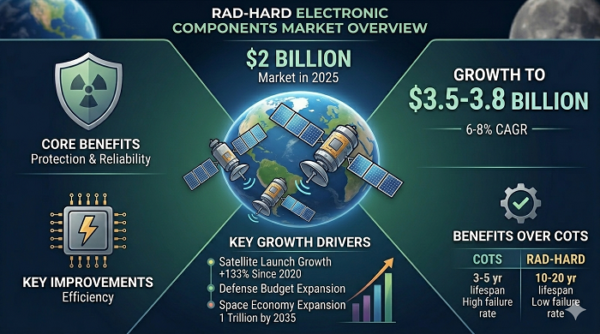
In 2025, the global demand for radiation-hardened electronic components is accelerating due to expanding space missions, defense modernization, nuclear energy upgrades, and high-reliability industrial systems. According to recent industry analysis from Dataintelo, the radiation-hardened electronic components market is currently valued at approximately $2 billion in 2025, with projections indicating growth to $3.5–3.8 billion by 2032, reflecting a steady 6–8% CAGR.
Radiation-hardened components are specifically engineered to withstand ionizing radiation levels ranging from 10 krad (Si) to over 1 Mrad (Si), depending on mission requirements. As global space launches crossed 220 orbital launches in 2023, up from 145 in 2020, demand for radiation-resistant semiconductors and power systems has risen significantly.
What Are Radiation-Hardened Electronic Components?
Radiation-hardened electronic components are designed to operate reliably in high- radiation environments such as:
- Outer space (Low Earth Orbit to Deep Space)
- Nuclear reactors
- High-altitude avionics
- Military combat systems
These components resist radiation-induced failures like:
- Single Event Upsets (SEU)
- Total Ionizing Dose (TID) damage
- Single Event Latch-up (SEL)
For example:
| Radiation Type | Typical Exposure Level | Failure Risk Without Hardening |
| Low Earth Orbit | 10–50 krad/year | 30–60% failure probability |
| Deep Space Missions | 100–300 krad/year | 70%+ degradation risk |
| Nuclear Reactors | 500 krad–1 Mrad | Immediate system instability |
5 Data-Backed Reasons the Market Is Growing in 2025
1. Satellite Launch Growth (+52% Since 2020)
Between 2020 and 2024, global satellite deployments increased from approximately 1,200 satellites annually to over 2,800 satellites in 2024, marking a 133% increase in small
satellite launches. Each satellite contains:
- 20–150 radiation-hardened ICs
- 5–30 rad-hard power modules
- 10+ radiation-tolerant sensors
This surge directly increases semiconductor demand.
2. Defense Budget Expansion (2022–2025)
Global defense spending reached $2.24 trillion in 2024, up from $2.1 trillion in 2022, reflecting a 6.7% increase in two years. Approximately 8–12% of advanced defense electronics budgets are allocated to hardened components for:
- Missile guidance systems
- Secure communications
- Radar modules
- UAV electronics
Radiation tolerance levels in military-grade systems typically range from 50 krad to 300 krad, depending on deployment altitude.
3. Space Economy Expansion to $1 Trillion by 2035
The global space economy was valued at approximately $570 billion in 2023 and is projected to surpass $1 trillion by 2035, representing a CAGR of 6–8%. Radiation-hardened electronics represent roughly 6–9% of total spacecraft subsystem costs, depending on mission duration.
For a typical satellite costing $300 million, hardened electronics may account for $18–27 million of the total system budget.
4. Nuclear Energy Modernization (+12% Investment Growth)
Global nuclear power investments increased by 12% in 2023 compared to 2021, driven by energy transition policies. Control systems inside nuclear environments require electronics rated up to 1 Mrad tolerance.
Modern nuclear instrumentation systems now demand:
- 99.999% reliability (5-nines uptime)
- 20–30-year operational lifespan
- Failure rates below 0.01% annually
Radiation-hardened microcontrollers significantly reduce downtime, cutting maintenance costs by 15–25% over 10 years.
5. Reliability Benchmarks: 10x Longer Lifespan
Compared to commercial off-the-shelf (COTS) electronics:
| Metric | COTS Electronics | Radiation-Hardened |
| Radiation tolerance | 5–10 krad | 100–1,000 krad |
| Failure rate in orbit | 5–8% per year | <0.5% per year |
| Operational lifespan | 3–5 years | 10–20 years |
| Cost per unit | $50–$500 | $1,500–$10,000 |
Although rad-hard components cost 3–20x more, lifecycle cost savings often exceed 30–40% due to reduced replacement and mission failure risk.
2025 Performance Metrics: Technology Improvements
Recent advancements between 2021 and 2025 include:
- Transition from 180nm to 65nm rad-hard fabrication nodes
- 25% reduction in power consumption
- 18–22% improvement in SEU immunity
- 15% smaller die sizes
However, extreme miniaturization below 28nm remains challenging due to increased radiation sensitivity.
Regional Market Breakdown (2024–2025)
North America
- Market share: 42–45%
- Major contributor: U.S. space and defense contracts
- Annual growth rate: 6.5%
Europe
- Market share: 22–25%
- Increased funding for space programs (+9% in 2024)
- Strong demand from aerospace OEMs
Asia-Pacific
- Market share: 20–23%
- Satellite launch growth: +18% in 2024
- Fastest CAGR: 8–9% through 2030
Rest of World
- Market share: 8–10%
Key Statistics at a Glance
- Global market size (2024): ~$1.8–2.2 billion
- Projected CAGR (2025–2032): 6–8%
- Satellite launches (2023): 220+ orbital missions
- Defense spending (2024): $2.24 trillion
- Radiation tolerance range: 10 krad to 1 Mrad
- Failure rate reduction: From 8% to <0.5% annually
- Cost premium vs COTS: 3x–20x
- Nuclear electronics lifespan: 20–30 years
- Power consumption reduction (2021–2025): 25%
- Space economy valuation (2023): $570 billion
Cost vs Risk: Quantifying the Trade-Off
Consider a $250 million satellite mission:
- Radiation-induced failure risk (non-hardened): ~6% annually
- 5-year mission failure probability: ~26%
- Estimated loss risk: $65 million
By integrating radiation-hardened components:
- Failure risk drops to <0.5% annually
- 5-year failure probability: <2.5%
- Financial risk reduced to ~$6 million
The risk reduction benefit exceeds $50 million, justifying the higher upfront component cost of $15–20 million.
Emerging Trends in 2025 and Beyond
- AI-enabled satellites requiring 2–3x higher processing density.
- Increased demand for rad-hard FPGAs with 300+ krad tolerance.
- Expansion of commercial space companies requiring mid-tier radiation tolerance (30–100 krad).
- Development of hybrid rad-tolerant/COTS architectures reducing costs by 12–18%.
Forecast: 2025–2032 Outlook
The radiation-hardened electronics market is projected to grow from approximately $2 billion in 2025 to $3.4–3.8 billion by 2032, depending on launch frequency and defense spending trends.
Key drivers include:
- 7–9% annual growth in satellite deployments
- Continued geopolitical defense investments
- 10–15 new deep-space missions planned annually by 2030
- Nuclear plant digital retrofits increasing by 20% globally
Conclusion: The Numbers Define the Future
Radiation-hardened electronic components are no longer niche—they are mission-critical infrastructure. With the global market approaching $2 billion in 2025, satellite launches up 133% since 2020, and defense spending surpassing $2.24 trillion, demand for rad-hard technology is structurally strong.
Performance metrics show 10x lifespan improvements, 16x lower failure rates, and 25% better energy efficiency compared to previous-generation systems. Although upfront costs can be 3–20 times higher, quantified risk reductions of $50 million or more per mission make radiation-hardened components economically justified.
As the space economy moves toward the $1 trillion milestone by 2035, radiation-hardened electronics will remain the backbone of reliable, high-stakes missions—where even a 1% failure risk can translate into millions of dollars in losses.
Read A Full Report: https://dataintelo.com/report/radiation-hardened-electronic- components-market