

In the intricate world of printed circuit boards (PCBs), not every component is designed for permanence. Some elements serve a crucial, albeit temporary, role in the manufacturing process, only to be removed once their job is done. Among these unsung heroes are Breakaway Tabs PCB, also known as snap-off PCBs or break-off PCBs.
1. What Are Breakaway Tabs PCB?
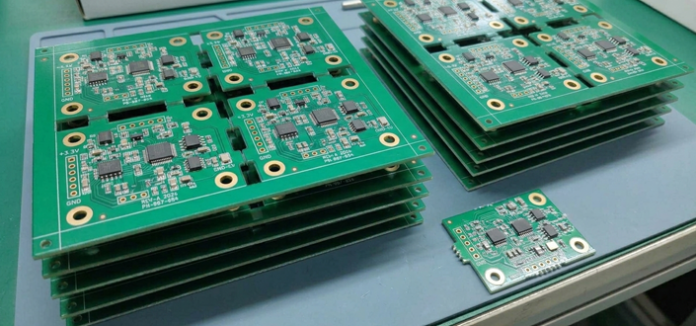
A Breakaway Tabs PCB is essentially a type of printed circuit board featuring small, strategically placed tabs or sections designed to be easily separated from the main board. These tabs do not carry current or hold components; instead, their primary purpose is to connect multiple individual PCBs into a larger, more manageable panel during the manufacturing process. This practice, known as panelization, allows manufacturers to produce several boards simultaneously, enhancing efficiency and reducing per-unit costs.
Implementing panelization through this design brings significant advantages to production:
- Maximizing Production Efficiency
- Significantly Reducing Costs
- Optimizing Automated Assembly
- Enhancing R&D Flexibility
- Ensuring Depaneling Quality
2. Types of Breakaway Tabs PCBs
There are primarily two main types of breakaway tabs used in PCB manufacturing.
Perforated Breakaway Tabs (Mouse Bites)
Perforated breakaway tabs, commonly referred to as “mouse bites,” involve a series of small, closely spaced drilled holes along the connection lines between the individual PCBs and the main panel. These holes create a weakened line that allows the boards to be snapped apart relatively easily.
Mechanism: The small holes act as stress concentration points. When manual pressure is applied, the material between the holes breaks, separating the boards.
Advantages:
- Typically allows for manual separation, making them suitable for low-volume production or prototyping without specialized equipment.
- More flexible in terms of shape and placement compared to V-gro oves.
- Less stress on components near the edge during separation compared to V-grooves.
Disadvantages:
- Can leave small, rough edges or “nibs” where the tabs were, which might require sanding or filing for a smoother finish.
- Consistency of separation can vary depending on the quality of perforation and manual force applied.
- Requires careful design to ensure enough material strength for handling but weak enough for breaking.
V-Groove Breakaway Tabs (V-Cuts)
V- groove breakaway tabs, or “V-cuts,” feature V-shaped channels scored into the PCB material on both the top and bottom sides along the separation line. These grooves weaken the board, allowing for a clean break.
Mechanism: The V-shaped cuts reduce the board’s thickness along the desired break line. Specialized depaneling tools (like a roller or shear) apply pressure to this weakened line, causing a clean, straight separation.
Advantages:
- Produces very clean and precise separation with smooth edges, minimizing post-depaneling finishing.
- Ideal for straight-line separations and high-volume production, as it’s well-suited for automated depaneling machines.
- Offers higher structural integrity during handling compared to perforated tabs, provided the grooves aren’t excessively deep.
Disadvantages:
- Requires specialized depaneling equipment (V-cutters or shear machines), which might be an additional cost for smaller operations.
- Limited to straight -line cuts; cannot be used for complex or curved board outlines.
- Can induce significant stress on components close to the V-cut line during depaneling, potentially causing damage if not designed correctly.
Here’s a comparison of the two types:
| Feature | Perforated Tabs (Mouse Bites) | V-Groove Tabs (V- Cuts) |
| Separation Method | Manual breaking, sometimes with tools | Mechanical depaneling tool (roller, shear) |
| Edge Finish | Can leave rough edges/nibs | Clean, smooth edges |
| Geometry | Allows for complex, non-linear shapes | Limited to straight lines |
| Equipment Needed | Minimal (manual) | Specialized depaneling machines |
| Component Stress | Lower stress near break line | Higher stress near break line (design carefully) |
| Cost (Depaneling) | Potentially lower for low volume | Higher initial tool cost, efficient for high volume |
3. Depaneling Methods: Separating Your Boards
Once PCBs have been fabricated and assembled on a larger panel, the next crucial step is depaneling – the process of separating the individual boards from the panel. The method chosen largely depends on the type of breakaway tab used, the volume of production, and the required finish quality.
- Manual Breaking:
- Applicability: Primarily used for boards with perforated tabs (mouse bites).
- Process: Operators manually apply pressure along the perforated lines to snap off the individual boards. This can be done by hand or with simple hand tools.
- Pros: Low initial equipment cost, flexible for small batches or complex shapes, no need for specialized machinery.
- Cons: Can lead to inconsistent edge quality, potential for operator fatigue or injury, slower for high volumes, and potential for stressing components if not done carefully. The residual “nibs” from the mouse bites may also need post-processing.
- Roller Depaneling:
- Applicability: Exclusively for V-groove PCBs.
- Process: The V-grooved panel is fed through a machine with two rollers. The rollers apply pressure precisely along the V-cut lines, causing the boards to snap apart cleanly.
- Pros: Fast, produces very clean and smooth edges, suitable for medium to high-volume production.
- Cons: Requires dedicated roller depaneling equipment, limited to straight cuts, and can induce mechanical stress on components near the V-cut line.
- Shear Depaneling (Guillotine Cutter):
- Applicability: Also used for V-groove PCBs, particularly for straight cuts.
- Process: A guillotine-style blade presses down or shears across the V-cut line, separating the boards.
- Pros: Very fast and efficient for straight lines, provides clean cuts.
- Cons: Requires specialized machinery, can induce high mechanical stress on the board and components during the cut, not suitable for boards with delicate components near the edges.
- Router Depaneling:
- Applicability: Can be used for any board outline, including those with breakaway tabs (often used to clean up mouse bite remnants or cut complex shapes).
- Process: A high-speed router bit precisely cuts along the desired board outline. This is often used as a secondary process after initial depaneling with other methods, or for boards that cannot use V-grooves or mouse bites.
- Pros: Excellent edge quality, handles complex shapes, minimal stress on components during the final cut.
- Cons: Slower than other methods, higher equipment cost, generates dust/debris, requires specialized programming.
Choosing the right depaneling method is as crucial as designing the breakaway tabs themselves, directly impacting the final quality, cost, and efficiency of your PCB manufacturing process.
4. Best Practices for Implementing Breakaway Tabs
To maximize the benefits of Breakaway Tabs PCB and avoid common pitfalls, adherence to best practices is essential throughout the design and manufacturing phases:
- Early Manufacturer Consultation: Always involve your PCB manufacturers early in the design process.
- Consider the End Use: If smooth edges are critical for aesthetics or fitting into an enclosure, V- grooves or post-depaneling routing might be necessary. If a rougher edge is acceptable, mouse bites are more flexible.
- Adequate Component Keep-Out Zones: Establish strict keep -out zones around all breakaway tab lines.
- Optimize Tab Quantity and Placement: Use enough tabs to provide structural integrity to the panel during handling.
- Document Design Specifications: Clearly communicate all breakaway tab specifications in your Gerber files and fabrication notes.
- Stress Management for V-Grooves: When using V-grooves, be acutely aware of the potential for mechanical stress.
- Test and Validate: Especially for new designs or complex boards, consider ordering a small prototype run to test the breakaway tab design and depaneling process.
- Consider Depaneling Equipment: Choose your tab type based on the available depaneling equipment at your assembly house .
5. Summary
The two primary types—perforated tabs (mouse bites) and V-groove tabs (V-cuts)—each offer distinct advantages, from allowing manual separation for flexible designs to providing precise, smooth breaks ideal for automated, high-volume production. If you are looking for a reliable and efficient PCB manufacturer, PCBAndAssembly is a partner you can trust. We offer high-quality PCB fabrication, assembly, component sourcing, and more—using advanced machinery and top-grade materials to ensure reliability and consistency.