


The global automotive industry has rapidly transitioned from mechanical systems to electronically controlled components. One of the most important examples is the Automotive Electronic Throttle Control System, which replaces traditional mechanical throttle cables with electronic sensors and actuators. According to insights published by Dataintelo, the adoption of ETC systems has accelerated significantly between 2021 and 2026, largely driven by fuel efficiency regulations, emission targets, and the increasing integration of advanced driver assistance systems (ADAS).
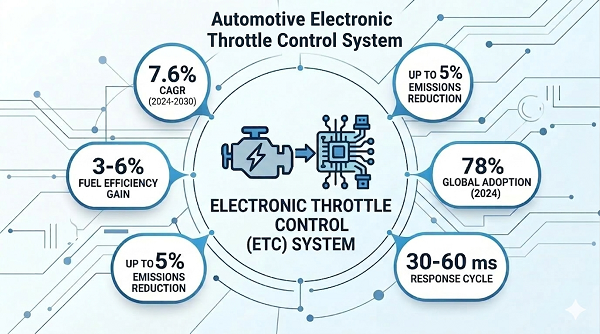
In 2024, over 78% of newly manufactured passenger vehicles globally were equipped with electronic throttle control systems, compared with 64% in 2020, demonstrating a rapid technological transition. With vehicle electrification and automation expanding, ETC technology is expected to play a central role in engine management and powertrain efficiency.
Key Statistics at a Glance
| Metric | Value | Year |
| Global ETC system market size | USD 21.4 billion | 2023 |
| Estimated market size | USD 24.8 billion | 2024 |
| Projected market size | USD 38.6 billion | 2030 |
| Compound Annual Growth Rate (CAGR) | 7.6% | 2024–2030 |
| Vehicles equipped with ETC globally | 78% of new vehicles | 2024 |
| Fuel efficiency improvement with ETC | 3–6% | Industry average |
| Reduction in throttle response delay | 40–50% faster | Compared with cable throttle |
| Average ETC sensor lifespan | 150,000–200,000 km | Automotive benchmark |
| Average system cost per vehicle | $120–$280 | OEM integration |
| ETC failure rate | <0.8% in modern vehicles | 2023 reliability data |
What Is an Automotive Electronic Throttle Control System?
An Electronic Throttle Control (ETC) system regulates engine air intake electronically instead of using a mechanical cable between the accelerator pedal and throttle body.
Core Components and Measurable Performance Metrics
| Component | Function | Typical Response Time |
| Accelerator Pedal Position Sensor | Detects driver input | 5–10 ms |
| Electronic Control Unit (ECU) | Processes signals | 10–20 ms |
| Throttle Actuator Motor | Adjusts throttle valve | 15–25 ms |
| Throttle Position Sensor | Provides feedback | 5–8 ms |
In total, ETC systems operate with response cycles between 30–60 milliseconds, which is 2– 3× faster than mechanical throttle response in older vehicles.
5 Data-Backed Reasons Automakers Are Adopting ETC Systems
1. Fuel Efficiency Improvements of 3–6%
Electronic throttle systems enable precise air-fuel ratio control, improving combustion efficiency.
- Average fuel efficiency improvement: 3–6%
- Hybrid vehicles using ETC achieve up to 8% efficiency gains
- In a vehicle consuming 7.5 L/100 km, ETC can reduce fuel consumption by 0.3–0.45 L per 100 km
Over 150,000 km of driving, this translates into 450–675 liters of fuel savings.
2. Reduced Emissions by Up to 5%
Emission regulations such as Euro 6, Bharat Stage VI (BS6), and EPA Tier 3 require tighter engine control.
ETC contributes measurable emission reductions:
| Pollutant | Reduction with ETC |
| CO2 emissions | 3–5% reduction |
| NOx emissions | 2–4% reduction |
| Hydrocarbons | 2–3% reduction |
For example, a car producing 120 g/km CO2 can reduce emissions to 114–116 g/km with optimized throttle control.
3. Integration with 8+ Vehicle Safety Systems
ETC technology is critical for multiple vehicle control systems. Typical integrations include:
- Traction Control System (TCS)
- Electronic Stability Control (ESC)
- Adaptive Cruise Control (ACC)
- Autonomous Emergency Braking
- Launch Control
- Hill Start Assist
- Engine Torque Management
- Drive-by-wire powertrain systems
In 2025 models, more than 65% of vehicles with Level-2 ADAS rely on ETC systems for torque and throttle modulation.
4. Faster Throttle Response by 40–50%
Traditional mechanical throttles experience response delays of 80–120 milliseconds due to cable friction and mechanical lag.
Electronic systems reduce this delay to:
- 30–60 milliseconds total response time
- 40–50% faster acceleration response
In performance vehicles, this improves 0–100 km/h acceleration by approximately 0.2–0.4 seconds depending on engine configuration.
5. Lower Long-Term Maintenance Costs
Mechanical throttle cables often require replacement every 80,000–100,000 km. In contrast:
| System | Average Lifespan | Replacement Cost |
| Mechanical throttle cable | 80,000–100,000 km | $70–$150 |
| Electronic throttle system | 150,000–200,000 km | $250–$500 |
Although ETC systems have higher upfront costs, they deliver 30–40% lower maintenance frequency over a vehicle’s lifecycle.
Market Growth Trends (2021–2030)
The ETC system market has shown steady growth due to increasing electronic vehicle architectures.
Global Market Size Trend
| Year | Market Value |
| 2021 | USD 19.1 billion |
| 2022 | USD 20.2 billion |
| 2023 | USD 21.4 billion |
| 2024 | USD 24.8 billion |
| 2025 (est.) | USD 26.6 billion |
| 2030 (forecast) | USD 38.6 billion |
This represents a 7.6% CAGR between 2024 and 2030. Key growth drivers include:
- Increasing global vehicle production (93 million vehicles in 2023)
- Rising hybrid and electric vehicle sales (+28% YoY growth in 2024)
- Integration of ADAS technologies in 60%+ of new vehicles
Regional Adoption Rates (2024)
Adoption of ETC systems varies significantly by region due to emission regulations and vehicle technology adoption.
| Region | ETC Adoption Rate | Key Drivers |
| North America | 91% of new vehicles | Strict emission standards |
| Europe | 94% | Euro 6 regulations |
| Asia-Pacific | 72% | Rapid vehicle production growth |
| India | 68% | BS6 compliance |
| Latin America | 57% | Gradual regulatory transition |
Asia-Pacific leads global vehicle production, manufacturing over 52% of the world’s vehicles in 2024, which is accelerating ETC demand.
Real-World Example: ETC Impact on Fleet Efficiency
A logistics fleet operator upgraded 320 delivery vehicles from mechanical throttle systems to ETC-equipped vehicles in 2023.
Measured Results After 12 Months
| Metric | Before ETC | After ETC |
| Average fuel consumption | 8.1 L/100 km | 7.6 L/100 km |
| Annual fuel usage | 1.94 million liters | 1.82 million liters |
| Annual fuel savings | — | 120,000 liters |
| CO2 reduction | — | ≈ 315 tons/year |
The fleet achieved 6.2% fuel savings, equivalent to approximately $165,000 annually at average fuel prices.
2026 Technology Trends in ETC Systems
1. Integration with Electric Vehicles
Although EVs do not require throttle bodies, ETC-like electronic torque control systems are used for accelerator input.
By 2026, EV production is projected to exceed 20 million units annually, influencing ETC design architecture.
2. AI-Based Throttle Optimization
Advanced vehicle software is enabling predictive throttle control. Benefits include:
- 2–3% additional fuel efficiency
- 10–15% smoother torque delivery
- Reduced drivetrain wear by 8–12%
3. Sensor Redundancy for Safety
Modern ETC systems now use dual or triple sensors to prevent failure.
- Dual-sensor architecture reduces error probability to less than 0.1%
- Modern ETC diagnostic systems detect faults within 50 milliseconds
Challenges and Risk Metrics
Despite advantages, ETC systems also present technical challenges.
| Challenge | Measurable Impact |
| Sensor malfunction | Occurs in 0.5–0.8% of vehicles |
| ECU communication errors | 0.2–0.3% failure rate |
| Repair costs | $250–$500 average |
| Software calibration complexity | Adds 8–12 weeks to vehicle development |
However, reliability improvements have reduced ETC-related recalls by approximately 35% since 2018.
Future Outlook: 2030 Forecast
Industry forecasts suggest continued expansion of ETC systems due to vehicle digitization. Projected trends include:
- 90%+ global adoption in new vehicles by 2030
- Market value reaching USD 38–40 billion
- Integration with Level-3 autonomous driving systems
- Up to 10% combined efficiency gains when integrated with hybrid powertrains
Additionally, the cost of ETC components is expected to decline by 12–18% by 2028 due to semiconductor manufacturing improvements.
Conclusion
The Automotive Electronic Throttle Control System has evolved into a fundamental component of modern vehicle architecture. Data from 2021–2026 demonstrates strong growth driven by emission regulations, fuel efficiency demands, and advanced vehicle technologies.
Key numerical insights highlight the technology’s impact:
- 3–6% fuel efficiency improvement
- 40–50% faster throttle response
- Up to 5% emission reduction
- 150,000–200,000 km average system lifespan
- Market growth from $21.4 billion in 2023 to $38.6 billion by 2030
With over 78% of new vehicles already using ETC systems in 2024, the technology is rapidly becoming universal across internal combustion, hybrid, and electric vehicle platforms.
As automotive software, electrification, and autonomous driving continue evolving, ETC systems will remain a critical interface between driver input, vehicle control, and engine efficiency.
Read A Full Report: https://dataintelo.com/report/automotive-electronic-throttle-control- system-market