

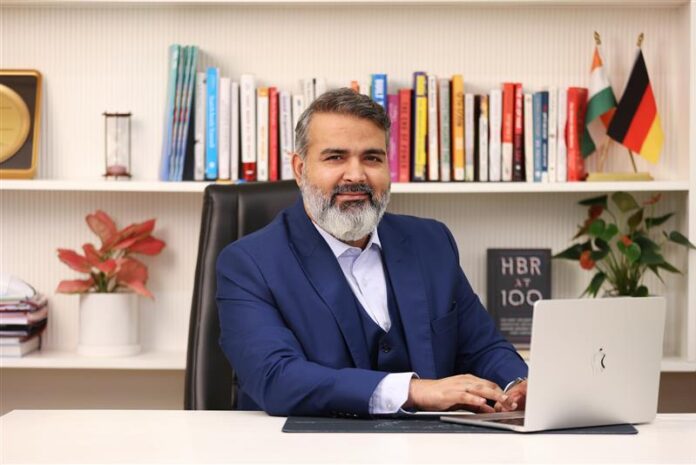
In conversation with Bhupinder Singh, President – IMEA (India, Middle East, Africa), Messe München | CEO, Messe München India
Q: India’s electronics narrative has clearly shifted. What, in your view, is the defining change in the market today?
Bhupinder Singh: The defining shift is from intent to execution—at scale. Capacity is scaling, compliance is tightening, and decision cycles are shrinking. the market needs to accelerate the ability to evaluate technologies, validate partners and move from specification to deployment without losing time to scattered vendor evaluations. In this environment, business platforms have to do more than convene—they have to enable outcomes.
Q: What is the differentiating role played by electronica India and productronica India as marketplaces in 2026?
Bhupinder Singh: Our role is to reduce friction in a complex supply chain. With electronics manufacturing being inherently interconnected, electronica India and productronica India bring the complete value chain into one focused environment so companies can assess solutions end-to-end, align stakeholders across functions, and make higher-confidence choices. At the end of the day, this is not just a showcase but is built as a decision-grade marketplace.
Q: What can the industry expect from the April 2026 editions in terms of scale and participation?
Bhupinder Singh: Scale is important—but decision density is what drives outcomes and the April 2026 edition is designed for high-intent density. Featuring 400+ exhibitors representing more than 1,000 companies from over 20 countries. who will connect with 30,000+ expected trade attendees, engaging through live demos, working equipment, supplier discussions and structured meetings. When multiple options are in one lens, teams benchmark faster, compare more precisely and shorten decision timelines. This one event can replace months of scattered vendor evaluations with a few days of qualified, high-value evaluation. Quite simply, teams don’t come here to browse—they come to decide.
Q: You’re introducing two editions every year. Why make that change now?
Bhupinder Singh: Because the pace has fundamentally changed. Product cycles are shorter, supplier qualification is tighter and project timelines are less forgiving. A single annual touchpoint—or a once-in-two-years cadence—doesn’t match how companies are deciding, building and scaling today. This also aligns with the momentum created by India’s PLI and ECMS schemes, which are accelerating investments in electronics components, products and systems manufacturing and for pushing faster capacity build-outs across regions. Taking these factors into consideration, from 2026, we go biannual: Greater Noida in April and Bengaluru in September—two markets, two buying cycles, two strategic windows every year to assess solutions, progress partnerships and accelerate implementation.
Q: What does the biannual format unlock for exhibitors?
Bhupinder Singh: It creates three distinct advantages: speed, precision and responsiveness.
First, pipeline velocity improves—exhibitors can engage buyers more frequently, which directly supports conversion.
Second, regional precision—North and South are both high-opportunity, but they operate differently in procurement cycles and ecosystem density.
Third, market responsiveness—brands can launch updates, gather feedback and recalibrate strategy with far less lag. In electronics, speed is not a nice-to-have. It’s a competitive advantage. And for visitors it means access. If you’re sourcing, building, or scaling in India, you don’t have to wait for a single annual sourcing window. You can qualify suppliers, shortlist faster and keep projects moving with a six-month rhythm.
Q: The April edition is being hosted by Uttar Pradesh. What does that add to this event?
Bhupinder Singh: Hosting changes the quality of engagement. With Uttar Pradesh as host, the presence of relevant government departments and institutional stakeholders becomes structural—not optional. For international and domestic participants, a host state context brings sharper visibility on facilitation and readiness—so expansion conversations move from exploratory to executable
Q: The event will be inaugurated by Hon’ble Chief Minister of Uttar Pradesh Shri Yogi Adityanath. What does that signal to the sector at large?
Bhupinder Singh: It signals strategic commitment. Electronics is central to national competitiveness and industrial growth, and state ecosystems increasingly shape how fast outcomes are achieved. A Chief Minister-led inauguration reinforces that electronics is being treated as a strategic growth engine. For the market, that matters—it strengthens confidence and elevates the business environment around the marketplace.
Q: Uttar Pradesh has also announced specific initiatives at electronica India an productronica India 2026. Why specifically around these events?
Bhupinder Singh: The aim is to elevate engagement beyond generic networking and create structured access. These initiatives are designed to raise the signal-to-noise ratio and make engagement more purposeful:
- UP Electronics Leadership Summit: A closed-door gathering of 100+ CEOs to accelerate top-level partnership and investment conversations
- CM-Meet: An invite-only leadership roundtable to align on priorities and collaboration themes
- 1: 1 meetings with international companies: To foster and accelerate alliances, JVs and market-entry conversations.
- Startup Showcase: 20+ startups to connect innovation with adoption and manufacturing capability
Q: How international is the 2026 edition—practically speaking?
Bhupinder Singh: You’ll see a genuinely global footprint—strong participation across Asia, Europe and the US—bringing better benchmarking and more partnership options. As we progress toward the event, we are building toward the planned scale of 400+ exhibitors from 20+ countries. For visitors and exhibitors alike, this matters because international presence improves benchmarking, expands partnership options, and raises the standard of technical and commercial discussions.
Q: What does “end-to-end ecosystem” actually translate to on the show floor?
Bhupinder Singh: It translates to a complete, decision-ready view of electronics manufacturing—where stakeholders can assess both upstream and downstream implications and qualify partners with confidence. That includes components and modules, SMT and assembly, automation, test and inspection, embedded hardware and connectivity, EMS capabilities, and the factory disciplines that protect yield and reliability—cleanroom readiness, ESD control, safety systems and process consistency. The point isn’t variety. The point is readiness because electronics outcomes are not driven by one technology choice—they are driven by how choices perform together across the production flow.
Q: You also announced an important milestone for India’s PCB ecosystem—BPCA 2026 with ELCINA. What is changing?
Bhupinder Singh: We’ve formally signed the next chapter for BPCA 2026—Bharat’s platform for Printed Circuit Boards and Assemblies—with ELCINA (Electronic Industries Association of India). As part of this evolution, the India PCB Tech Conference will now be known as the Bharat PCB Tech Conference, a stronger national platform for PCBs and assemblies—aligned with global standards and manufacturing readiness. With BPCA alongside electronica India and productronica India 2026, we’re building a more focused, future-ready PCB ecosystem under one roof.
Q: Where does the Bharat Electronics Yatra fit into the larger strategy?
Bhupinder Singh: The Yatra is about building market readiness before the event and expanding engagement beyond the venue. It takes the conversation directly to the clusters and decision-makers, captures on-ground perspectives, and drives awareness across the broader production chain. The outcome is better participation quality: a more informed audience, sharper buyer intent and a show floor aligned to real needs. It’s a pipeline builder, pulling the ecosystem in—focused on relevance and ensuring this trade forum remains connected to the market between editions.
Q: Final message—why should the April 2026 electronica India and productronica India editions be on every serious calendar?
Bhupinder Singh: Because India is no longer “next.” India is now—building capacity, tightening standards, and scaling faster than most markets can track. In that kind of cycle, the advantage goes to those who compare rigorously and lock the right partners ahead of the curve. electronica India and productronica India are built as a decision-grade marketplace—where technologies are benchmarked live and partnerships move from conversation to commitment. And Greater Noida in April 2026 is where market leaders go to get ahead—and stay ahead.”
electronica India 2026 | productronica India 2026
8–10 April 2026 | India Expo Mart, Greater Noida (Uttar Pradesh)