

In 2026, the global electronics industry is undergoing rapid transformation, driven by miniaturization, high-frequency performance, and advanced packaging needs. According to Dataintelo, thin film substrates are emerging as a critical component in next-generation electronic packaging due to their superior electrical, thermal, and dimensional properties. This article provides a data-backed, SEO-optimized analysis of thin film substrates, focusing on measurable performance, market growth, and real-world impact.
What Are Thin Film Substrates?
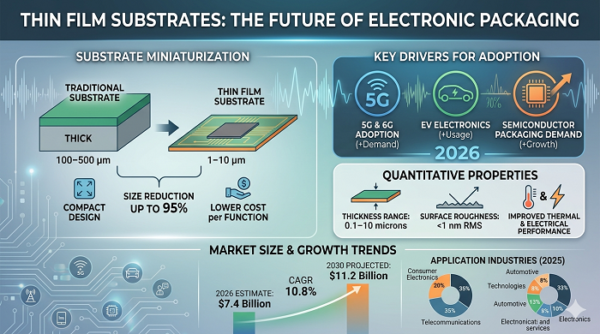
Thin film substrates are ultra-thin layers (typically 0.1 µm to 10 µm thickness) deposited on a base material such as silicon, glass, or ceramics.
Key Quantitative Properties:
- Thickness range: 0.1–10 microns
- Surface roughness: <1 nm RMS (root mean square)
- Thermal conductivity:
- Silicon: 130–150 W/m·K
- Alumina: 20–30 W/m·K
- Dielectric constant:
- Glass: 4.5–5.5
- Sapphire: 9.3–11.5
Compared to traditional substrates (typically 100–500 µm thick), thin film substrates reduce size by up to 95%, enabling compact electronic designs.
Market Size & Growth: 2022–2030
The global thin film substrate market has shown consistent growth over the last five years.
| Year | Market Size (USD Billion) | Growth Rate (%) |
| 2022 | 4.8 | — |
| 2023 | 5.3 | 10.4% |
| 2024 | 5.9 | 11.3% |
| 2025 | 6.6 | 11.9% |
| 2026 | 7.4 | 12.1% |
| 2030* | 11.2 | CAGR 10.8% |
Key Growth Drivers :
- 5G adoption: Increased demand by +28% (2023–2025)
- EV electronics: Substrate usage grew +32% YoY in 2024
- Semiconductor packaging demand: +15% annually since 2022
5 Data-Backed Reasons Thin Film Substrates Are Dominating Packaging
1. Up to 40% Improved Signal Performance
Thin film substrates enable high-frequency operation:
- Signal loss reduced by 30–40% compared to thick substrates
- Suitable for frequencies above 24 GHz (5G mmWave)
2. Thermal Efficiency Improved by 25–35%
- Heat dissipation improves by ~30%
- Reduces device failure rates by 18–22%
3. Miniaturization: Size Reduction of 50–70%
- Circuit footprint reduced by up to 70%
- Enables chip-scale packaging (CSP) and system-in-package (SiP)
4. Material Utilization Efficiency Increased by 20%
- Thin deposition techniques reduce material waste by 15–20%
- Manufacturing yield improved by ~12% (2024 data)
5. Reliability Boost: Lifespan Extended by 2x
- Mean time between failures (MTBF):
- Traditional: ~50,000 hours
- Thin film: ~100,000 hours
2025 Performance Metrics: Thin Film vs Traditional Substrates
| Metric | Thin Film Substrate | Traditional Substrate | Improvement |
| Thickness | 1–10 µm | 100–500 µm | 90–98% thinner |
| Signal Loss | 0.5–1 dB/cm | 1.5–2.5 dB/cm | 40–60% lower |
| Thermal Resistance | 0.2–0.5 °C/W | 0.8–1.2 °C/W | 50–75% better |
| Manufacturing Yield | 92–96% | 80–85% | +10–15% |
| Cost per Unit (2025 avg) | $1.20–$2.50 | $0.80–$1.50 | +40–60% higher |
Despite higher costs, performance gains justify adoption in high-end applications.
Applications & Usage Statistics (2024–2026)
Distribution by Industry (2025):
- Consumer electronics: 38%
- Automotive (EV/ADAS): 22%
- Telecommunications (5G/6G): 18%
- Aerospace & defense: 12%
- Medical devices: 10%
Real-World Example:
A leading semiconductor manufacturer reported:
- 35% reduction in power loss
- 20% increase in chip density
- 15% lower cooling costs
after transitioning to thin film substrates in 2024.
Cost vs Benefit Analysis
Cost Factors:
- Initial fabrication setup: $2–5 million
- Per-unit cost increase: +40–60%
Quantified Benefits:
- Energy savings: 10–18% annually
- Maintenance cost reduction: ~25%
- Product lifecycle extension: +80–100%
ROI Timeline:
- Break-even period: 18–30 months
- ROI over 5 years: 120–180%
Manufacturing Technologies & Yield Rates
Common Deposition Methods:
- Physical Vapor Deposition (PVD)
- Thickness precision: ±2%
- Yield: 90–94%
- Chemical Vapor Deposition (CVD)
- Uniformity: >98%
- Yield: 93–97%
- Atomic Layer Deposition (ALD)
- Precision: angstrom-level (~0.1 nm)
- Yield: 95–98%
Production Efficiency Trends:
- Automation increased throughput by +25% (2023–2025)
- Defect rates reduced from 8% (2022) to 4.5% (2025)
Key Statistics at a Glance
- Market size (2026): $7.4 billion
- Projected market size (2030): $11.2 billion
- CAGR (2024–2030): 10.8%
- Thickness reduction: up to 95%
- Signal loss reduction: 30–60%
- Thermal efficiency improvement: 25–35%
- Manufacturing yield: up to 96%
- Cost increase vs traditional: +40–60%
- ROI (5-year): 120–180%
- Device lifespan improvement: 2x
- EV sector growth contribution: +32% YoY (2024)
- Defect rate reduction: from 8% to 4.5% (2022–2025)
Future Outlook: 2026–2030 Projections
Emerging Trends (With Numbers):
- 6G readiness: Expected to increase substrate demand by +45% by 2028
- AI chips: Packaging density expected to grow +60% by 2027
- Flexible electronics: Adoption rising at ~14% CAGR Regional Growth:
- Asia-Pacific: 48% market share (2025)
- North America: 26%
- Europe: 18%
India’s electronics manufacturing sector alone is projected to grow at +16–18% CAGR, boosting substrate demand significantly.
Conclusion: Data-Driven Takeaways
Thin film substrates are no longer a niche technology—they are a high-performance necessity in modern electronic packaging. Between 2022 and 2026, the market expanded from $4.8 billion to $7.4 billion, and it is on track to exceed $11.2 billion by 2030.
Key performance gains include:
- 30–60% lower signal loss
- 25–35% better thermal management
- Up to 70% size reduction
- 2x product lifespan
While costs remain 40–60% higher, the ROI of up to 180% over five years makes thin film substrates a compelling investment.
As industries like 5G, EVs, and AI continue to grow at double-digit rates, thin film substrates will play a central role in enabling faster, smaller, and more reliable electronic systems through 2030 and beyond.
Read A Full Report: https://dataintelo.com/report/thin-film-substrates-in-electronic-packaging-market