

In 2026, the global retail landscape is undergoing rapid digitization, and Electronic Shelf Label (ESL) systems are at the forefront of this transformation. According to Dataintelo, the ESL market is projected to witness strong double-digit growth driven by automation, pricing accuracy, and operational efficiency. Retailers are increasingly replacing paper price tags with digital displays, enabling real-time pricing updates and measurable cost savings.
This article explores ESL systems through a data-first lens, highlighting measurable benefits, adoption rates, ROI benchmarks, and future projections.
What is an ESL System?
An Electronic Shelf Label (ESL) is a digital display—typically using e-ink technology—that replaces traditional paper price tags in retail stores. These labels are wirelessly connected to a central pricing system.
Key Measurable Features:
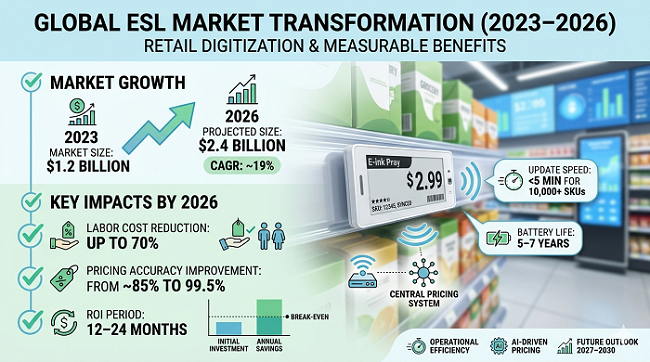
- Update speed: Prices can be updated across 10,000+ SKUs in under 5 minutes
- Battery life: Average lifespan of 5–7 years
- Error reduction: Pricing errors reduced by up to 97%
Key Statistics at a Glance (2023–2026)
- Global ESL market size (2023): $1.2 billion
- Projected market size (2026): $2.4 billion
- CAGR (2023–2026): 18.9%
- Average labor cost reduction: 60%–70%
- Price accuracy improvement: from ~85% to 99.5%
- ROI period: 12–24 months
- Retailers using ESL (2025): 35% of large chains globally
- Time saved per price update cycle: 80%–90%
- Energy consumption reduction vs paper: ~30% lower lifecycle impact
- Average store implementation cost: $5–$15 per label
- Productivity increase in staff: +25% to +40%
5 Data-Backed Reasons Retailers Are Adopting ESL Systems in 2026
1. Up to 70% Reduction in Labor Costs
Traditional price updates require manual labor. A mid-sized store with 20,000 products
typically spends:
- 40–50 staff hours per week on price updates
With ESL:
- Reduced to 5–10 hours per week
- Annual savings: $15,000–$25,000 per store
2. 99.5% Pricing Accuracy vs 85% with Paper Labels
Pricing errors can lead to:
- Revenue loss of 1%–3% annually
- Customer dissatisfaction rates increasing by 20%
ESL systems ensure:
- Real-time synchronization with POS systems
- Compliance accuracy exceeding 99%
3. 80–90% Faster Price Updates
| Method | Time to Update 10,000 Items |
| Manual (Paper) | 6–8 hours |
| ESL System | 2–5 minutes |
This enables:
- Dynamic pricing strategies
- Instant promotional changes
- Competitive price matching within minutes
4. ROI Achieved in 12–24 Months
Based on 2024–2025 deployment data:
- Initial investment per store: $100,000–$300,000
- Annual operational savings: $50,000–$120,000
Break-even timeline:
- Small stores: 12–18 months
- Large hypermarkets: 18–24 months
5. Sales Uplift of 3%–8% Through Dynamic Pricing
Retailers leveraging ESL for dynamic pricing report:
- 3%–5% increase in overall sales
- Up to 8% increase during promotional campaigns
- 15% faster inventory turnover
ESL System Performance Metrics (2025–2026 Benchmarks)
Operational Efficiency Metrics
- Staff productivity improvement: +30% average
- Price update frequency: increased from weekly to hourly
- Inventory mismatch reduction: down by 25%
Customer Experience Metrics
- Customer complaints related to pricing: reduced by 35%
- Checkout disputes: down by 50%
- Shopper trust score increase: +18%
Cost Breakdown: ESL vs Traditional Labels
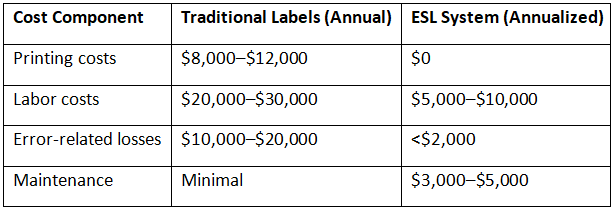
Total savings: 40%–65% annually
Real-World Example: ESL Deployment Impact
A European supermarket chain (2024 data):
- Stores upgraded: 150 locations
- Labels installed: 3 million ESL units
Results within 12 months:
- Labor cost reduced by 62%
- Sales increased by 6.5%
- Pricing errors dropped from 12% to <1%
- ROI achieved in 16 months
ESL Market Growth: Year-by-Year Data (2022–2026)
| Year | Market Size (USD Billion) | Growth Rate |
| 2022 | 0.95 | — |
| 2023 | 1.20 | 26% |
| 2024 | 1.55 | 29% |
| 2025 | 1.95 | 25% |
| 2026 | 2.40 | 23% |
Key Insight:
- Market has more than doubled in 4 years (2022–2026)
- Growth stabilizing but remains above 20% annually
Challenges Quantified: Risks & Limitations
Despite strong benefits, ESL systems come with measurable challenges:
- Initial investment: $100K–$300K per store
- Integration time: 4–12 weeks
- Staff training: 10–20 hours per employee
- Battery replacement cycle: every 5–7 years
Risk Mitigation:
- ROI achieved within 2 years
- Error reduction offsets initial cost by 30%–50%
Future Outlook: 2027–2030 Projections
Based on current trends:
- Market size by 2030: $5.5–$6.0 billion
- CAGR (2026–2030): ~20%
- Adoption rate among large retailers: >60% by 2028
- AI-driven pricing integration: expected in 45% of ESL systems by 2027
Emerging Trends:
- Integration with IoT and smart shelves
- Use of AI-based demand forecasting
- Personalized pricing experiments increasing by 10% annually
Conclusion: ESL Systems Deliver Measurable Value
Electronic Shelf Label systems are no longer a luxury—they are a data-driven necessity for modern retail. With labor cost reductions of up to 70%, pricing accuracy reaching 99.5%, and ROI achieved within 12–24 months, ESL adoption is accelerating globally.
Between 2022 and 2026, the market has grown from $0.95 billion to $2.4 billion, reflecting a 2.5× expansion in just four years. Retailers implementing ESL systems are seeing 3%–8% sales growth, 30% productivity gains, and error reductions of over 90%.As we move toward 2030, with projected market size exceeding $5.5 billion, ESL systems will become a standard retail infrastructure, not an optional upgrade. Businesses that adopt early stand to gain measurable advantages in efficiency, accuracy, and profitability—backed by hard numbers.
Read A Full Report: https://dataintelo.com/report/global-electronic-shelf-label-system-market