

STMicroelectronics recently hosted a virtual briefing to unveil its latest automotive MCU, Stellar P3E. Designed for next-generation vehicles, this MCU stands out with its Neural ART Accelerator—an embedded neural processing unit (NPU) that brings real-time AI capabilities directly to the edge. This integration makes the P3E not just a performance upgrade, but a future-ready platform aligned with the growing demands of software-defined and intelligent vehicles.
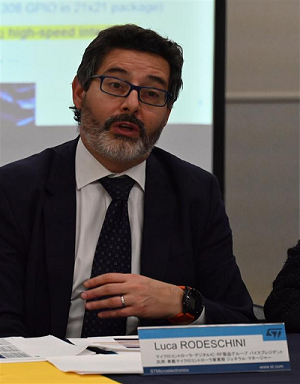
In the following Q&A, Electronics Media talks with Luca Rodeschini, Group Vice President and General Manager of the General Purpose and Automotive Microcontrollers Division at STMicroelectronics, to take a deep dive into the next generation of automotive microcontrollers. The discussion explores the newly launched Stellar P3E MCU, covering its Neural ART Accelerator architecture, the growing complexity of automotive E/E systems, and the evolving requirements of software-defined vehicles. It also highlights key design considerations, primary applications, and what engineers need to know when developing next-generation automotive platforms.
Q1. What is the Stellar P3E MCU, and how is it positioned in ST’s automotive portfolio?
Luca Rodeschini: Stellar P3E is a high-performance automotive microcontroller within STMicroelectronics’ Stellar P family, targeted at drivetrain and powertrain control for both internal combustion and electrified vehicles. It is specifically architected to support X-in-1 domain consolidation and software-defined vehicle (SDV) architectures, combining real-time control with embedded AI acceleration.
Q2. What differentiates Stellar P3E from conventional automotive MCUs?
Luca Rodeschini: The key differentiator is the integration of the Neural ART Accelerator, an embedded neural processing unit (NPU). Unlike traditional MCUs that rely solely on CPUs for control algorithms, P3E enables on-chip execution of neural networks with significantly reduced latency, power consumption, and memory footprint, making it suitable for real-time edge AI applications.
It is strategically important to enhance the capability of microcontrollers to run efficient AI networks and address emerging challenges. Neural-network-based approaches enable advanced classification and regression tasks that simpler mathematical functions—such as those handled by a traditional PPU—are not efficient enough to execute in real time.
Q3. Can you elaborate on the Neural ART Accelerator architecture and its benefits?
Luca Rodeschini: The Neural ART Accelerator is optimized for neural network operations such as convolution, pooling, and activation functions. Its dataflow architecture enables highly efficient inference execution, delivering up to ~69× acceleration compared to CPU-based implementations. This allows deployment of AI models for predictive and adaptive control without requiring external compute resources.
Neural ART is designed as a full data flow architecture that consumes only tens of milliwatts. By minimizing memory access and operating efficiently in both 8-bit and 16-bit modes, it ensures optimized performance for isolated AI workloads, delivering improved efficiency and real-time responsiveness
Q4. How does Stellar P3E address the increasing complexity of automotive E/E architectures?
Luca Rodeschini: The device supports function consolidation through high compute density, extensive I/O, and integrated AI capabilities. It enables multiple traditionally discrete ECUs—such as inverter control, battery management, and onboard charging—to be unified within a single controller, reducing system-level complexity, wiring, and BOM cost.
Q5. What are the compute and processing capabilities of the MCU?
Luca Rodeschini: Stellar P3E features a multi-core CPU cluster delivering approximately 8,000 CoreMark of computing power, distributed across four independent CPUs. Two of these cores operate with a lockstep mechanism to enhance functional safety, while the overall architecture supports flexible configurations—such as split-lock and lockstep modes—allowing designers to balance safety and performance based on application requirements.
On the computing platform side, the four cores provide the flexibility to run multiple concurrent functions. Combined with available memory resources, the system can typically integrate around 6–7 functions within a single microcontroller—demonstrating a high level of system consolidation and efficiency for modern automotive architectures.
Q6. How does the MCU ensure compliance with automotive safety and cybersecurity standards?
Luca Rodeschini: The platform incorporates hardware safety mechanisms to ensure freedom from interference (FFI) between critical functions. It supports functional safety architectures aligned with ISO standards and complies with ISO 21434 for cybersecurity. Features such as lockstep cores, memory protection, and task isolation ensure high safety integrity, while compliance with ISO 21434 strengthens cybersecurity.
Q7. What memory architecture does Stellar P3E employ?
Luca Rodeschini: The MCU integrates up to 19.5 MB of embedded non-volatile memory based on ST’s proprietary Phase Change Memory (PCM) technology. PCM provides fast, reliable non-volatile memory to host multiple functions, including AI models. The embedded non-volatile memory is critical for automotive MCUs, which must load with no-latency and run numerous functions directly on the device. ST’s PCM technologies offer industry-leading density, delivering more than twice the capacity within the same silicon area. This extra capacity supports more advanced functions, including AI workloads, where model weights can be stored in PCM with minimal impact on inference time. It also enables continuous OTA software updates throughout the product lifetime.
Q8. What are the key analog and connectivity features of the device?
Luca Rodeschini: Stellar P3E is designed to simplify X-in-1 integration by offering an exceptionally I/O-rich architecture. With up to 308 general-purpose I/Os in a compact 21 × 21 package—around 20% more than many current market solutions.
Complementing this is a robust and highly capable analog front end tailored for demanding automotive environments. The platform features over 100 ADC channels, including both Sigma-Delta and SAR variants, enabling high-precision sensing required for advanced power electronics control. This high level of analog integration ensures accurate monitoring and control across critical vehicle systems.
Communication is another key strength of the P3E. It supports high-bandwidth connectivity with up to Gigabit Ethernet, alongside the latest generation of CAN communication with CAN-XL. This combination enables a smooth and scalable transition from legacy automotive networks to more deterministic, high-speed communication architectures—without requiring a complete platform redesign.
Q9. How does the MCU contribute to power efficiency and energy management?
Luca Rodeschini: Power efficiency in AI execution is a critical design consideration, and Stellar P3E addresses this at both system and architectural levels.
First, there is a strategic shift in where AI workloads are executed—moving them away from centralized vehicle compute units, which typically have the highest power consumption, toward edge, zonal, and X-in-1 aggregated architectures. This transition allows the central compute to be powered down when not required, while still keeping essential AI functions active. Such an approach is especially valuable for long-duration tasks, such as vehicle charging scenarios, where AI-driven monitoring or optimization needs to remain operational over extended periods with minimal energy usage.
At the platform level, power efficiency is further enhanced by executing AI workloads on a dedicated neural-AI accelerator instead of the CPU. CPUs inherently consume more power for such tasks, whereas the accelerator is purpose-built to handle neural network execution efficiently. By keeping all processing within the accelerator, the system minimizes data movement and optimizes signal precision—ensuring that computations are performed at the required level of accuracy without unnecessary overhead. This significantly reduces the overall power consumption of AI execution.
Additionally, the platform incorporates advanced low-power modes that enable selective activation of critical vehicle functions without fully waking the entire system. This is particularly important in electric vehicles, where reducing energy consumption during standby or idle states directly contributes to improved battery life and overall vehicle efficiency.
Together, these strategies enable a highly optimized balance between AI capability and energy efficiency, making the platform well-suited for next-generation automotive architectures.
Q10. What are the primary application areas and benefits for OEMs and Tier 1 suppliers?
Luca Rodeschini: Stellar P3E is designed for applications including electric powertrain control, battery management systems (BMS), onboard chargers (OBC), DC-DC converters, and body electronics. Stellar P3E is engineered to support high levels of system integration, both in terms of hardware scalability and software consolidation. It offers up to 308 general-purpose I/Os in a compact 21 × 21 package—around 20% more than many existing solutions—providing OEMs and Tier 1 suppliers with the headroom needed to continuously add new functions as X-in-1 architectures evolve.
This hardware capability is complemented by xMemory, which delivers high-density, high-speed, and reliable storage for firmware and complete software packages, including AUTOSAR stacks. Together, these enable continuous over-the-air (OTA) updates and seamless software consolidation across multiple domains such as powertrain, body, and chassis. As a result, OEMs can deploy, refine, and upgrade vehicle functionalities over time without requiring hardware changes—directly supporting the transition toward software-defined vehicles and zonal/centralized architectures.