


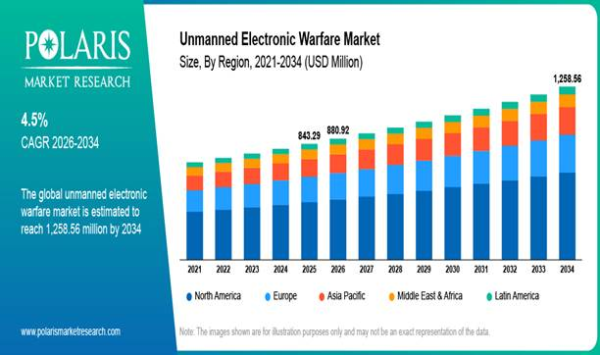
The global Electronics & Semiconductors industry is witnessing a transformative shift as unmanned systems integrate advanced electromagnetic capabilities. According to the latest insights from Unmanned Electronic Warfare Market Report, the Unmanned Electronic Warfare Market is poised for sustained growth, projected to reach USD 1,258.56 million by 2034, expanding at a CAGR of 4.5% between 2026 and 2034. This surge is driven by the increasing reliance on autonomous platforms for intelligence gathering, signal disruption, and secure communications in complex combat environments.
Market Overview: Redefining Warfare Through Electromagnetic Dominance
Unmanned electronic warfare (EW) refers to the deployment of autonomous or remotely operated platforms—such as UAVs, UGVs, USVs, and satellites—equipped with systems designed to detect, intercept, disrupt, or protect electromagnetic signals. These systems play a crucial role in modern warfare by enabling forces to operate in contested environments without exposing personnel to high-risk zones.
The market was valued at USD 843.29 million in 2025, reflecting strong adoption across defense agencies worldwide. As geopolitical tensions intensify and cyber-electromagnetic threats grow more sophisticated, defense organizations are prioritizing investments in spectrum dominance technologies. This has elevated unmanned EW from a niche capability to a core pillar of next-generation military strategy.
Key Growth Drivers Accelerating Market Expansion
One of the most significant drivers of the unmanned electronic warfare market is the rising demand for advanced surveillance and intelligence systems. Modern military operations increasingly rely on real-time data acquisition and analysis, which unmanned EW platforms provide efficiently. These systems enable continuous monitoring of enemy communications and radar activities, enhancing situational awareness and decision-making capabilities.
Another critical growth factor is the increase in electronic and cyber warfare incidents globally. Nations are investing heavily in technologies capable of neutralizing adversary communication systems, GPS signals, and radar networks. Unmanned EW platforms, with their ability to perform jamming, deception, and signal interception, are emerging as essential tools in countering such threats.
Additionally, government defense contracts and rising military budgets are significantly contributing to market growth. Major defense contractors are securing large-scale projects aimed at enhancing unmanned EW capabilities, fostering innovation and accelerating deployment cycles.
Technology Trends: AI, Swarms, and Cognitive EW Systems
The unmanned electronic warfare landscape is evolving rapidly with the integration of cutting-edge technologies. One of the most prominent trends is the adoption of AI-driven cognitive EW systems, which enable platforms to analyze and respond to electromagnetic threats in real time. These systems leverage machine learning algorithms to classify signals, adapt jamming techniques, and optimize spectrum usage dynamically.
Another emerging trend is the use of swarm-based EW operations, where multiple unmanned platforms coordinate to overwhelm enemy defenses. This distributed approach enhances operational efficiency and reduces the risk of mission failure.
The convergence of quantum technologies and cyber-electronic warfare is also gaining traction, offering enhanced encryption, secure communications, and improved threat detection. Furthermore, advancements in resilient navigation systems are enabling unmanned platforms to operate effectively in GPS-denied environments, ensuring mission continuity in contested regions.
Segment Insights: Airborne Platforms Lead the Charge
Among various platforms, the airborne segment dominated the market with a 35.64% revenue share in 2025. Airborne unmanned systems offer significant advantages, including high-altitude operations, extensive coverage, and enhanced flexibility. These capabilities make them ideal for surveillance, signal interception, and electronic attack missions.
In terms of capabilities, electronic protection systems accounted for a notable share, as defense forces prioritize safeguarding their communication and radar systems from enemy interference. The growing emphasis on secure and resilient communication networks is expected to further drive this segment.
Regional Analysis: North America Leads, Asia-Pacific Accelerates
Geographically, North America holds the largest market share at 49.80%, driven by substantial defense spending, advanced technological infrastructure, and strong presence of leading defense contractors. The United States, in particular, continues to invest heavily in autonomous warfare systems and electronic spectrum dominance.
Meanwhile, the Asia-Pacific region is projected to register the fastest growth, with a CAGR of 4.9%. Rising geopolitical tensions, especially in maritime regions, and increasing defense modernization programs in countries such as China, India, and Japan are fueling demand for unmanned EW solutions.
Competitive Landscape: Strategic Collaborations and Innovation
The unmanned electronic warfare market is highly competitive, characterized by the presence of global defense giants focusing on innovation and strategic partnerships. Companies are investing in AI-enabled platforms, lightweight EW payloads, and integrated multi-domain solutions to gain a competitive edge.
Recent developments highlight the industry’s momentum. For instance, advancements in autonomous EW integration have demonstrated the ability of unmanned systems to detect, analyze, and respond to threats in real time. Similarly, the introduction of compact EW payloads for small drones is making electromagnetic intelligence more accessible to frontline units.
Challenges: High Costs and Complex Integration
Despite strong growth prospects, the market faces challenges such as high development and deployment costs. Advanced EW systems require sophisticated hardware, software, and integration capabilities, which can limit adoption, particularly in developing regions.
Additionally, the complexity of integrating EW systems with existing defense infrastructure poses technical challenges. Ensuring interoperability, cybersecurity, and reliability remains a critical concern for defense organizations.
Future Outlook: Autonomous Warfare to Drive Long-Term Growth
Looking ahead, the unmanned electronic warfare market is set to play a pivotal role in shaping the future of defense technologies. The increasing adoption of fully autonomous systems, combined with advancements in AI, quantum computing, and semiconductor technologies, will redefine how military operations are conducted.
As nations continue to prioritize electronic spectrum dominance and invest in next-generation warfare capabilities, unmanned EW systems will become indispensable assets. The convergence of electronics, semiconductors, and defense technologies is expected to unlock new opportunities, positioning the market for steady growth over the next decade.
Conclusion: High-Impact Opportunity for Defense and Semiconductor Ecosystems
The Unmanned Electronic Warfare Market represents a high-growth opportunity within the Electronics & Semiconductors sector, driven by rising defense investments, technological innovation, and evolving threat landscapes. With strong market fundamentals and increasing adoption of AI-enabled systems, the industry is poised for long-term expansion, making it a critical area for stakeholders seeking strategic advantage in the global defense ecosystem.
For more information, visit https://www.polarismarketresearch.com/industry-analysis/unmanned-electronic-warfare-market