

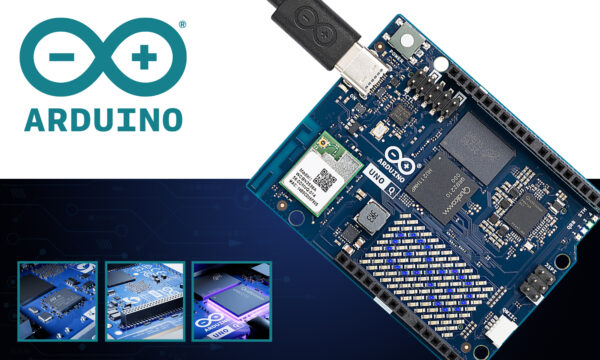
AI Vision Inspection – TME (Transfer Multisort Elektronik Sp. z o.o.), the global, multimillion dollar revenue stockholding distributor of electronic components, will be demonstrating during this year’s electronica (Hall B5:361) how Edge AI is transforming automated vision quality control using Arduino UNI Q. The board serves as a compact control and data processing platform designed for local image analysis directly on the device. By processing image data at the edge rather than sending frames to external servers, the system reduces delays, decreases network load, and allows for faster response to detected irregularities.
“Just a few years ago, automated vision control systems relied heavily on costly smart cameras and elaborate vision systems requiring significant financial outlays and specialised expertise,” says Paweł Sióda, Senior Product Manager, TME. “With compact platforms like the Arduino UNO Q, engineers can now rapidly build a demonstrator, test effectiveness through a pilot project and gradually expand their AI vision inspection capabilities in-house.”
AI vision inspection uses machine learning models trained on sample photos showing correct and defective elements. Once trained, the models can classify products, detect assembly errors, recognise colours and identify surface damages or illegible prints in real time. Rather than replacing human operators, these AI systems handle the monotonous inspection tasks with consistent accuracy, allowing operators to focus on verifying flagged items.
A typical architecture powered by the Arduino UNO Q integrates a compatible camera, LED lighting, a part presence sensor and a communication module to transmit classification results to operators or PLC, SCADA and MES systems. A power supply, cables and connectors complete the AI vision inspection station. The Arduino UNO Q natively supports Bluetooth and Wi-Fi, simplifying integration into factory networks. Engineers can initiate deployments with a low-risk proof-of-concept (PoC) on a single process before scaling across addition stations.
TME offers over 1.5 million products from about 1,500 leading manufacturers, providing all the required elements to builds a complete Arduino UNO Q demonstrator. Both 2GB and 4GB variants of the platform are available from TME.
Quality control using AI is just one example of the capabilities of the Arduino UNO Q platform. During electronica visitors are invited to meet the TME team (B5:361) to learn how the platform can also be also used for condition monitoring and vibration monitoring.
For more information visit: https://www.tme.com/in/en/.