

The global transportation sector is undergoing one of the most profound transformations in modern history. Electric vehicles are no longer niche innovations—they are becoming mainstream solutions for cleaner, more efficient mobility. Yet, the true catalyst behind this transition is not the vehicle itself, but the infrastructure that supports it. EV chargers are rapidly redefining how energy is delivered to vehicles, positioning the EV chargers market as a strategic pillar of the global energy and mobility landscape.
As the world moves toward electrification, EV charging infrastructure is emerging as a long-term investment priority for governments, utilities, technology providers, and private enterprises alike.
Market Outlook 2035: From Early Deployment to Global Scale
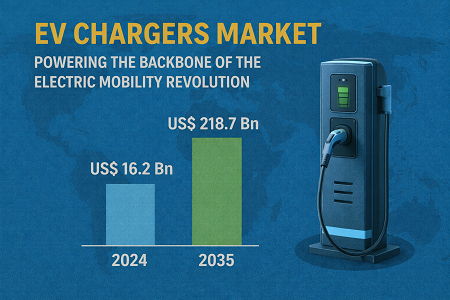
The EV chargers market generated US$ 16.2 billion in revenue in 2024, reflecting accelerating infrastructure rollouts across key regions. However, this figure represents only the foundation of a much larger expansion. By 2035, the market is projected to reach approximately US$ 218.7 billion, growing at a striking CAGR of 26.7% from 2025 to 2035.
This exponential growth highlights the shift from pilot projects to full-scale charging ecosystems. Charging infrastructure is increasingly being treated as essential public utility infrastructure—on par with roads, fuel stations, and power grids—ensuring sustained capital inflow and policy support over the next decade.
Why EV Chargers Are Becoming Strategic Assets
Infrastructure Drives Adoption
EV adoption depends heavily on charging accessibility. Consumers may be willing to purchase electric vehicles, but their confidence is directly tied to how easily they can charge them. A robust charging network removes uncertainty and transforms EV ownership into a practical, everyday experience.
As a result, EV chargers are no longer optional add-ons; they are essential assets that directly influence EV sales, urban planning decisions, and transportation policy frameworks.
Charging as an Energy Interface
Modern EV chargers act as a bridge between transportation and energy systems. Unlike traditional fuel stations, EV chargers interact with power grids, renewable energy sources, and digital platforms. This interaction enables better energy management, load balancing, and emissions reduction—making chargers active participants in the clean energy transition.
Market Highlights and Performance Snapshot
Several indicators demonstrate the strength and momentum of the EV chargers market:
- Market size reached US$ 16.2 billion in 2024, driven by global electrification initiatives
- Revenue is expected to rise to US$ 218.7 billion by 2035, indicating long-term scalability
- The market is forecast to grow at a 26.7% CAGR between 2025 and 2035
- North America led the global market in 2024 with a 37.2% revenue share
- Level 2 chargers dominated by charging speed, accounting for 66.2% of market share
Charging Speed Dynamics: The Rise of Level 2 Infrastructure
Charging speed plays a critical role in shaping deployment strategies. While fast chargers receive significant attention, Level 2 chargers remain the backbone of the EV charging ecosystem, holding 66.2% of the global market share in 2024.
Level 2 chargers offer a practical balance of charging efficiency and installation cost. They are widely adopted in residential buildings, office complexes, retail spaces, and parking facilities. Their ability to deliver reliable daily charging without requiring extensive grid upgrades makes them the most scalable solution for mass EV adoption.
This dominance reflects the market’s focus on everyday usability rather than limited high-speed charging alone.
Regional Landscape: North America’s Early-Mover Advantage
In 2024, North America emerged as the largest EV chargers market, accounting for 37.2% of global revenue. This leadership is driven by early EV adoption, strong government incentives, and large-scale infrastructure investments.
Federal and state programs in the region have accelerated charger installations along highways, urban corridors, and residential zones. Meanwhile, growing adoption of electric fleets and public transportation systems continues to fuel demand for high-capacity charging networks, reinforcing North America’s position as a global infrastructure leader.
Competitive Environment: Technology and Networks Shape Success
The EV chargers market is highly competitive, with innovation and scalability defining market leadership. Major players such as ABB Ltd, Siemens AG, Schneider Electric, ChargePoint Holdings, Inc., EVBox Group, Wallbox N.V., Tesla, Inc., and Blink Charging Co. are driving industry evolution.
These companies are expanding beyond hardware manufacturing to offer integrated charging ecosystems that include software platforms, network management, billing solutions, and predictive maintenance. Strategic collaborations with automakers, utilities, and commercial property owners are enabling rapid network expansion and long-term service models.
Smart Charging: The Next Phase of Market Evolution
A defining trend in the EV chargers market is the transition toward smart and connected charging systems. Smart chargers use data, connectivity, and automation to optimize charging schedules, reduce peak demand, and improve grid efficiency.
As EV adoption scales, unmanaged charging could strain electricity networks. Smart charging mitigates this risk by aligning charging behavior with grid capacity and renewable energy availability. This capability will become increasingly essential as millions of EVs connect to power systems worldwide.
Expanding Opportunities Beyond Passenger Vehicles
While passenger EVs currently dominate charging demand, future growth will increasingly be driven by commercial and industrial applications. Electric buses, delivery vans, logistics fleets, and shared mobility services require centralized, high-capacity charging infrastructure.
Fleet electrification presents a major opportunity for large-scale charger deployment, long-term contracts, and recurring service revenue—further strengthening the market’s growth outlook.
Conclusion: EV Chargers as the Foundation of Electric Mobility
The EV chargers market is evolving from a supporting role into a foundational element of the global transportation and energy ecosystem. With market value projected to grow from US$ 16.2 billion in 2024 to US$ 218.7 billion by 2035, charging infrastructure will shape how quickly and effectively the world transitions to electric mobility.
As chargers become smarter, more widespread, and more integrated with clean energy systems, they will not only power vehicles—but also drive the future of sustainable transportation.
These insights are based on a report on the by EV chargers market Transparency Market Research (TMR).