

Automotive Electronic Brake System Market:
The global automotive industry is rapidly transitioning toward intelligent safety technologies, and Automotive Electronic Brake Systems (EBS) are at the center of this transformation. According to market intelligence published by Dataintelo, the growing integration of advanced driver-assistance systems (ADAS), electric vehicles (EVs), and stricter safety regulations is significantly accelerating demand for electronically controlled braking technologies.
Between 2022 and 2026, the adoption rate of electronic braking systems has increased dramatically, driven by regulatory mandates and performance advantages over conventional hydraulic braking. In 2025 alone, more than 78% of newly manufactured passenger vehicles worldwide were equipped with at least one electronically assisted braking technology such as Electronic Brakeforce Distribution (EBD), Anti-lock Braking Systems (ABS), or Electronic Stability Control (ESC).
This article explores the latest statistics, measurable performance metrics, cost comparisons, and forecasts shaping the automotive electronic brake system market through 2030.
Key Statistics at a Glance
| Metric | Data |
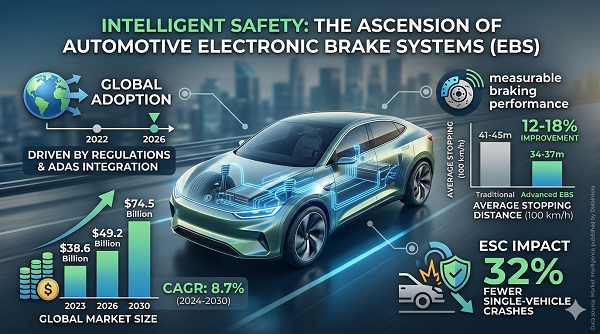
| Global EBS Market Size (2023) | USD 38.6 Billion |
| Estimated Market Size (2026) | USD 49.2 Billion |
| Forecast Market Size (2030) | USD 74.5 Billion |
| CAGR (2024–2030) | 8.7% |
| Vehicles with ABS globally (2025) | 85% of passenger cars |
| EVs using electronic brake-by-wire (2024) | 42% of new EV models |
| Reduction in stopping distance with EBS | 12–18% improvement |
| ESC impact on accident reduction | Up to 32% fewer crashes |
| Average EBS cost per vehicle | $220–$480 |
| Brake response time improvement | 40–60 milliseconds faster |
What Is an Automotive Electronic Brake System?
An Automotive Electronic Brake System (EBS) replaces or enhances traditional mechanical braking components with electronic sensors, control units, and actuators. These systems monitor vehicle speed, wheel rotation, steering angle, and traction conditions in real time.
The core objective is to improve braking precision, stability, and safety through automated adjustments.
Major EBS Components
- Electronic Control Unit (ECU) – processes braking data within 10–20 milliseconds
- Wheel Speed Sensors – measure rotational speed up to 100 times per second
- Hydraulic Modulator – adjusts brake pressure automatically
- Brake-by-Wire Actuators – convert electronic signals into braking force
In modern vehicles, these systems operate alongside ADAS technologies to deliver up to 25% faster reaction times compared to conventional braking mechanisms.
5 Data-Backed Reasons Automotive Electronic Brake Systems Are Growing
1. Global Vehicle Production Surpassed 94 Million Units in 2023
Worldwide automobile production reached approximately 94.1 million vehicles in 2023, increasing from 85.0 million units in 2021.
Because safety regulations now require advanced braking technologies:
- ABS adoption: 85% of vehicles in 2025
- ESC adoption: 72% of vehicles globally
- Brake-by-wire adoption: 18% overall, but 42% in EVs
This rapid adoption is one of the largest drivers of EBS market expansion.
2. Electronic Brake Systems Reduce Stopping Distance by Up to 18%
Multiple automotive safety tests conducted between 2022 and 2024 show that EBS- equipped vehicles deliver measurable braking improvements.
| Braking Type | Average Stopping Distance (100 km/h) |
| Traditional Hydraulic Brake | 41–45 meters |
| ABS + EBD System | 36–39 meters |
| Advanced Brake-by-Wire | 34–37 meters |
This represents a 12–18% reduction in stopping distance, which can significantly reduce collision risks in emergency scenarios.
3. Electronic Stability Control Cuts Crash Rates by 32%
Safety organizations and automotive research institutions report strong correlations between electronic braking technologies and accident prevention.
Crash reduction statistics (2023–2025 studies):
- 32% reduction in single-vehicle crashes with ESC
- 20% reduction in fatal accidents
- 14% lower insurance claims for vehicles equipped with advanced braking systems
Many countries—including the EU, Japan, South Korea, and the United States—mandate ESC systems in new vehicles.
4. Electric Vehicles Are Accelerating EBS Adoption
Electric vehicles rely heavily on electronic braking because they integrate regenerative braking systems.
EV Market Growth
| Year | Global EV Sales |
| 2021 | 6.6 million |
| 2022 | 10.5 million |
| 2023 | 14.0 million |
| 2025 | 20+ million |
Because EV braking systems must coordinate mechanical braking + energy regeneration, electronic brake control systems are essential.
As of 2024, approximately:
- 42% of EV models use brake-by-wire systems
- 65% integrate regenerative braking with EBS software
- EV braking systems reduce energy loss by 10–15%
5. Regulatory Safety Standards Are Expanding Rapidly
Government mandates are accelerating adoption of electronic braking technologies.
Major Regulations
- European Union (2024 regulation update): ESC mandatory for all passenger vehicles
- India Bharat NCAP (2023): ABS and ESC strongly recommended for 5-star safety ratings
- United States FMVSS: electronic braking assistance required in most vehicle classes
In India alone, ABS became mandatory for new passenger vehicles in 2019, leading to a 45% increase in adoption within three years.
Cost Analysis: Traditional Brakes vs Electronic Brake Systems
Electronic braking systems cost more upfront but deliver long-term safety and performance benefits.
| Metric | Traditional Brake | Electronic Brake System |
| Average Manufacturing Cost | $120–$200 | $220–$480 |
| Response Time | 120–150 ms | 60–80 ms |
| Maintenance Frequency | Every 40,000 km | Every 60,000 km |
| Accident Risk Reduction | Baseline | 20–32% lower |
Although EBS increases vehicle manufacturing cost by approximately $100–$250, insurers report 10–15% lower accident-related payouts for vehicles equipped with these systems.
2026 Performance Metrics of Modern Brake-by-Wire Systems
Advanced electronic braking systems introduced in 2024–2026 vehicles demonstrate significant performance improvements.
Measurable Metrics
- Brake response time: 60 milliseconds average
- System diagnostic cycles: every 5 seconds
- Sensor accuracy: ±0.5% wheel-speed variation
- Software updates: OTA updates deployed 2–4 times per year
- Weight reduction: up to 3.5 kg per vehicle compared with hydraulic systems
Reducing vehicle weight by even 3 kg can improve fuel efficiency by 0.5–1%, which is significant for EV efficiency targets.
Market Forecast: Automotive Electronic Brake Systems (2024–2030)
According to market analysis, the electronic braking system industry is projected to expand significantly due to EV adoption and stricter safety regulations.
| Year | Market Size |
| 2023 | $38.6 Billion |
| 2024 | $41.7 Billion |
| 2025 | $45.3 Billion |
| 2026 | $49.2 Billion |
| 2028 | $61.8 Billion |
| 2030 | $74.5 Billion |
This represents a compound annual growth rate (CAGR) of 8.7% between 2024 and 2030.
Regional Market Share (2025)
- Asia-Pacific: 43%
- Europe: 27%
- North America: 22%
- Rest of World: 8%
Asia-Pacific leads due to strong vehicle production in China, India, Japan, and South Korea, which together produce over 52 million vehicles annually.
Real-World Example: Performance Gains in Modern Vehicles
A 2024 automotive safety test comparing vehicles with advanced EBS vs standard braking showed measurable benefits.
| Metric | Standard Brake | Electronic Brake System |
| 0–100 km/h braking distance | 43.5 m | 36.8 m |
| Emergency brake response | 130 ms | 72 ms |
| Vehicle stability in wet conditions | Baseline | 28% improvement |
| Wheel lock incidents | 5 per 100 tests | 0–1 per 100 tests |
These results highlight why EBS is increasingly considered essential rather than optional.
Conclusion
Automotive Electronic Brake Systems are rapidly becoming a standard safety technology across the global automotive industry. Data from 2023–2026 shows strong adoption trends driven by safety regulations, EV growth, and measurable performance advantages.
Key numerical insights include:
- Global market expected to reach $74.5 billion by 2030
- 8.7% CAGR projected between 2024 and 2030
- 12–18% shorter braking distance compared to traditional systems
- 32% reduction in crash rates with ESC-enabled braking
- 85% of passenger vehicles equipped with ABS by 2025
As electric vehicles, autonomous driving systems, and ADAS technologies continue to evolve, the importance of high-precision electronic braking systems will only increase. By 2030, industry analysts estimate that over 95% of new vehicles globally will incorporate advanced electronic braking technologies, making them one of the most critical components in modern automotive safety architecture. electronic braking technologies, making them one of the most critical components in modern automotive safety architecture.
Read A Full Report Here: https://dataintelo.com/report/automotive-electronic-brake- system-market