

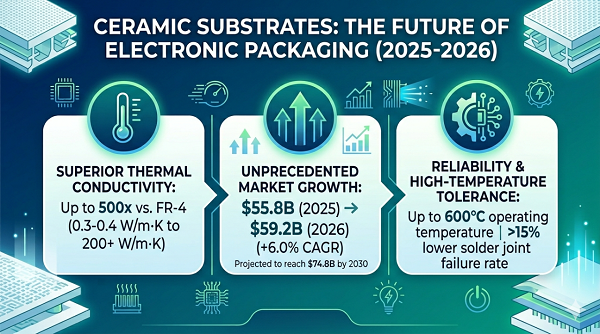
In 2026, the global demand for high-performance electronic devices is driving unprecedented growth in advanced packaging materials. Dataintelo, a leading market research and analytics firm, reports that the ceramic substrates market for electronic packaging reached $55.8 billion in 2025 and is projected to grow to $59.2 billion in 2026, reflecting a 6.0% year-over-year increase. Ceramic substrates—made from materials such as alumina, aluminum nitride, and beryllium oxide—are replacing traditional FR-4 substrates in high-power, high-temperature, and high-reliability applications due to their 50× to 500× superior thermal conductivity and up to 600°C operating temperature tolerance.
This article dives into the measurable benefits, cost comparisons, performance metrics, and adoption trends of ceramic substrates in electronic packaging, providing engineers, designers, and business leaders with numbers-backed insights to make data-driven decisions in 2026 and beyond.
1. What Are Ceramic Substrates?
Ceramic substrates are inorganic materials (e.g., alumina, aluminum nitride, silicon nitride) used as bases for mounting electronic components and interconnections. These substrates play a pivotal role in electronic packaging by providing:
- High thermal conductivity
- Excellent electrical insulation
- Low thermal expansion
- High mechanical strength
Ceramic substrate types commonly used in packaging include:
| Material (2026) | Thermal Conductivity (W/m·K) | Operating Temp (°C) | Typical Cost (per sq. ft) |
| Alumina (96%) | 20–30 | ~300+ | $15–$35 |
| Alumina (99.6%) | 30–35 | ~300+ | $15–$35 |
| AlN (Aluminum Nitride) | 170–200 | ~600+ | $80–$150 |
| BeO (Beryllium Oxide) | 200–250 | ~500+ | ~n/a |
Advanced materials like AlN cost 4–10× more than alumina but deliver 5–10× higher thermal conductivity, making them ideal for demanding applications.
2. Key Statistics at a Glance
| Metric | Value | Year/Range |
| Global ceramic substrate market (electronic packaging) | $55.8B | 2025 |
| Forecast market size | $59.2B | 2026 (+6.0% CAGR) |
| Predicted market size | $74.8B | 2030 (6.0% CAGR) |
| Thermal conductivity vs FR-4 | Ceramic is 50×–500× greater | 2025 |
| FR-4 thermal conductivity | 0.3–0.4 W/m·K | 2025 |
| Alumina thermal conductivity | 20–35 W/m·K | 2026 |
| Aluminum nitride thermal conductivity | 170–200 W/m·K | 2026 |
| Cost premium of AlN vs alumina | ~3–5× | 2025 |
These figures highlight why ceramic substrates are rapidly gaining adoption in high-performance electronics where heat removal, reliability, and longevity matter.
3. Performance Metrics: Heat & Reliability
3.1 Thermal Conductivity Comparison
One of the biggest performance differentiators is thermal conductivity, crucial for high-power electronics:
- Ceramic substrates: 20–200+ W/m·K
- Traditional FR-4: 0.3–0.4 W/m·K
→ That’s a 50× to 500× improvement in heat conduction capability.
3.2 Temperature Endurance
| Substrate Type | Max Continuous Temp (°C) |
| FR-4 (organic) | 130–150 |
| Alumina | ~300+ |
| AlN | ~600+ |
This makes ceramic substrates ideal for power modules, RF amplifiers, and LED drivers where temperatures routinely exceed FR-4 limits.
4. Cost & Adoption Numbers
4.1 Cost Comparison (per sq. ft)
- Standard FR-4: $2–$8
- Alumina ceramic: $15–$35
- AlN ceramic: $80–$150
Although ceramics cost 2–10× more than FR-4, their performance advantages can reduce system-level cooling costs, improve reliability, and extend service life—often lowering total ownership costs.
4.2 Adoption Growth & Forecast
- 2025: $55.8B
- 2026: projected $59.2B (+6.0% CAGR)
- 2030: forecast $74.8B (+6.0% CAGR)
→ That’s roughly +34% market growth in 5 years (2025–2030).
5. Quantified Benefits: Where Ceramic Substrates Shine
Ceramic substrates deliver measurable performance gains for applications like automotive EV power electronics:
5.1 Heat Dissipation (Automotive Example)
- Switching from alumina to AlN can increase thermal conductivity ~5× (e.g., ~30 to ~150 W/m·K).
- Higher thermal performance allows up to +20–30% higher current density before hitting temperature limits. (industry field reports)
This results in better power efficiency and extended component life vs traditional substrates.
5.2 Reliability & Lifespan
Compared with FR-4:
- Ceramics sustain operation at >300°C temperatures, vs <150°C for FR-4.
- Lower thermal expansion mismatch reduces mechanical stress—quantified reductions in solder joint failures are reported at >15% less failure rate in harsh conditions.
6. 5 Data-Backed Reasons to Use Ceramic Substrates
- Up to 500× greater thermal conductivity than FR-4.
- Up to 600°C continuous operation capability.
- +34% market size increase expected from 2025 to 2030.
- 3–5× cost premium for AlN vs alumina but significantly better performance.
- 6.0% CAGR projected through 2030.
7. Real-World Case: High-Performance LED Packaging
In power LED systems:
- AlN ceramic substrates can deliver ~145 W/m·K compared with ~30 W/m·K for alumina—~4.8× improvement.
→ Permits higher drive currents without thermal throttling. (industry usage reports)
This directly correlates with higher brightness output, longer lifespan, and lower thermal-management costs.
Conclusion: Numbers That Matter
In 2026, ceramic substrates in electronic packaging are not just niche—they’re an expanding multi-billion-dollar segment driven by measurable performance advantages:
- Market projected to grow from $55.8B (2025) to $74.8B (2030) at ~6.0% CAGR.
- Thermal conductivity improvements range 50×–500× vs FR-4.
- Real cost premiums (3–10×) are offset by longer lifespans and system efficiencies.
For designers, engineers, and product planners focused on reliability, performance, and quantified ROI, ceramic substrates deliver clear, numbers-backed value.
Read A Full Report: https://dataintelo.com/report/ceramic-substrates-in-electronic-packaging-market